
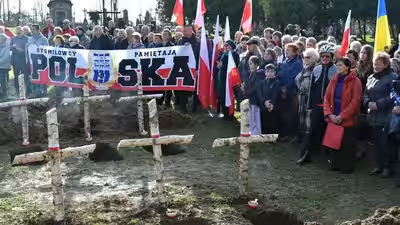
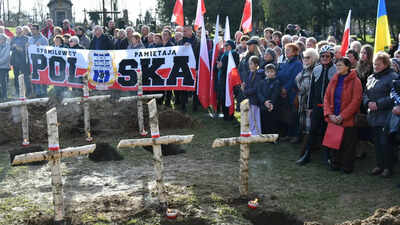
Russia is being accused of using a painful chapter in the history of Poland and Ukraine to deepen tensions between the two countries, as Warsaw and Kyiv remain divided over the killings that took place during World War 2.Polish officials and researchers say Moscow has sharply increased online messaging in Poland around the Volhynia massacres, while also using the issue to fuel anger against Ukrainians living in the country.The campaign has largely played out on social media, with much of the content appearing in Polish. Analysts say the aim is not always to create completely false stories, but to amplify real disputes in ways that can deepen existing divisions.
How Russia is ‘exploiting’ the Volhynia dispute
The historical dispute centres on the Volhynia massacres between 1943 and 1945. Poland says Ukrainian nationalists killed around 100,000 Poles during the violence, while thousands of Ukrainians were also killed in retaliatory attacks.Tensions over the issue increased after Ukrainian President Volodymyr Zelenskyy named an army unit after insurgents linked to the massacres. Polish president Karol Nawrocki, who is from the political right, responded by stripping Zelenskyy of a major Polish honour in June.Polish deputy digital minister Pawel Olszewski said the disagreement was quickly followed by a surge in Russian messaging across social media and Russian media platforms, including Telegram.Research by the state-backed Polish Institute of International Affairs found that Polish-language anti-Ukrainian content on X, Facebook, Instagram, TikTok and YouTube rose by more than 250% after Zelenskyy’s decision.Filip Bryjka of PISM said much of this increase appeared to have been artificially boosted through bots, creating the impression that anti-Ukrainian sentiment was spreading rapidly.
The facts may be real, but the narrative can still be manipulated
Analysts say one reason this type of campaign is difficult to detect is that it does not necessarily depend on completely fabricated information.Instead, genuine events and historical grievances can be repeatedly highlighted and framed in ways that encourage anger towards a particular group.“The event is real, but the interpretation is imposed by an external actor,” said Wojciech Pokora, an analyst at Info Ops Poland Foundation.Moscow has rejected the accusations. The Russian embassy in Warsaw said Russia does not interfere in relations between other countries.“The Russian Federation does not interfere in the relations between other states,” the Russian embassy in Warsaw said in an emailed statement, adding that accusations about Russia spreading disinformation to undermine support for Ukraine are baseless.The issue has gained greater importance because Poland remains one of Ukraine’s strongest supporters in its war against Russia, but public backing for Ukraine has weakened.An IBRiS poll published last month found that 33.6% of respondents said their attitude towards Ukrainians had worsened following the latest dispute linked to the World War Two killings.Another IBRiS survey found that support for continuing military assistance to Ukraine had fallen to 52%, compared with 78% in 2022.
Ukraine fatigue creates fertile ground for the campaign
Researchers caution that declining support for Ukraine cannot be blamed entirely on Russian influence.Poland is home to an estimated 1.8 to 1.9 million Ukrainian migrants, while disagreements over grain imports and the unresolved legacy of the Volhynia killings have also contributed to public frustration.Olszewski said the Russian messaging had “fallen on fertile ground”.Meanwhile, hostility towards Ukrainians in Poland has reportedly increased, prompting prime minister Donald Tusk to call for an end to xenophobic attacks.The issue could become even more politically significant ahead of Poland’s 2027 parliamentary elections. Polling suggests Tusk’s pro-European government could struggle to retain power, while support for the far-right has been growing.That makes the Volhynia dispute more than a historical argument. For Poland, it touches on a painful national memory. For Ukraine, it is part of a complicated shared history with its neighbour. And for Russia, Polish analysts argue, the disagreement offers an opportunity to deepen divisions between two countries that have otherwise stood together against Moscow.