


BENGALURU/HUDERABAD: Even as the US govt suspended processing under the Permanent Labour Certification (PERM) programme for some Indian IT firms, potentially jeopardising eligible employees’ pathways to permanent residency, the sector’s stocks rallied on Friday, suggesting limited market concern amid declining dependence on H-1B visas.However, the suspension could create talent retention and hiring challenges. H-1B employees may move to employers not covered by the suspension to keep their green card applications on track, potentially triggering an exodus of skilled professionals. Top talent may also hesitate to join affected companies if doing so means losing a viable pathway to permanent residency.

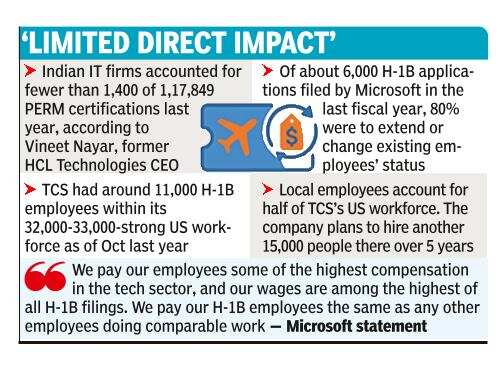
Vikram Shroff, partner for employment, labour and benefits at AZB & Partners, said the suspension should not affect Indian IT companies’ ability to service US clients, although it could delay new applications. “It is hoped that the suspension is temporary and is withdrawn once the investigation is completed,” he said.TCS said the PERM programme suspension was unlikely to affect its workforce strategy or customer engagements, as its applications under the programme had been in single digits over the past two years.“Our original business model has always been that people go from here, work on the project, go onsite, spend two, three years there, and come back. So there is a continuous movement of talent between onsite and offshore,” TCS CEO K Krithivasan said.As of October last year, TCS had around 11,000 H-1B employees in its 32,000-33,000-strong US workforce. While acknowledging that some employees may want to stay in the US permanently, Krithivasan said permanent residency had never been central to the company’s workforce strategy. Local employees account for 50% of TCS’s US workforce, and the company plans to hire another 15,000 people there over five years.Microsoft said 80% of the approximately 6,000 H-1B visa applications it filed in the last fiscal year were to extend or change the status of existing employees. Applications for new hires accounted for just 1% of its US workforce and involved individuals already legally present in the country.“We pay our employees some of the highest compensation in the tech sector, and our wages are among the highest of all H-1B filings. We pay our H-1B employees the same as any other employees doing comparable work,” the company said in a statement.Cyrus D Mehta, managing partner of New York-based law firm Cyrus D Mehta & Partners, called the suspension a “warped approach”. “Immigration is not a zero-sum game,” he said, disputing the suggestion that hiring foreign workers necessarily takes jobs away from Americans. Responding to Vice-President JD Vance’s criticism of Microsoft over its 2025 layoffs, Mehta said the layoffs did not prevent companies from recruiting foreign workers with specialised skills.Stephen Yale-Loehr, a retired professor of immigration law practice at Cornell Law School, called the Department of Labor’s action illegal, arguing that companies had not been given a due process hearing before their applications were suspended.“I am sure the companies will sue. But litigation takes time, and in the meantime these companies can’t use the PERM green card system. This is another attack on legal immigration by the Trump administration,” he said.David J Bier, director of immigration studies at the Cato Institute, said he viewed the current US administration as the most hostile to legal immigration of any administration.Industry leaders said the suspension affecting eight major technology companies could accelerate the shift of high-value technology work to India and boost growth in global capability centres (GCCs), despite a limited immediate impact.Former HCL Technologies CEO Vineet Nayar said Indian IT companies accounted for fewer than 1,400 of the 117,849 PERM certifications issued last year, suggesting the direct impact could be limited. He said the move could accelerate the relocation of US technology work to India.Former Tech Mahindra CEO CP Gurnani and co-founder and vice-chairman of AIONOS, said India should use the opportunity to attract experienced technology talent back home.Nasscom senior vice-president and chief strategy officer Sangeeta Gupta said the business impact was likely to be negligible, as companies had filed few PERM applications in recent years and the move was prospective, not retrospective.