
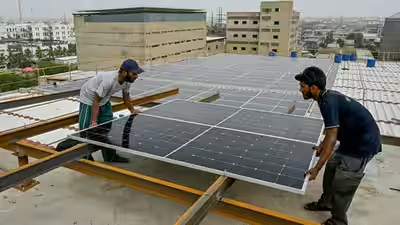
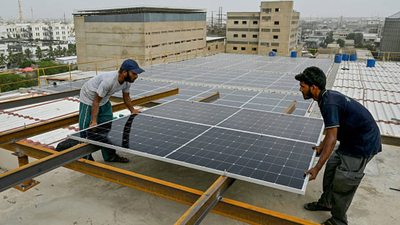
The global solar capacity is growing rapidly, so much so that by 2030, approximately 100 million households will rely on rooftop solar, according to the International Energy Agency. According to research by the World Economic Forum, covering only about 50% of the world’s existing rooftops with solar panels could meet total global electricity demand. One such country that has taken a massive step in this direction is Pakistan.Over the past few years, Pakistan has adopted solar power at rates that have saved it billions during an ongoing global energy crisis. It has even cushioned the country from the effects of the war going on in Iran, which has impacted much stronger economies massively.Pakistan gets almost all of its oil and gas from the Middle East, where US and Israeli bombing of Iran has caused crude prices to jump past $150 a barrel and tankers to be stuck in the Strait of Hormuz for months. While it might still be spending on fuel imports, the country has saved much in electricity due to a recent yet rapid shift to solar power.It was at the beginning of the Ukraine War that the country began its solar boom, when it couldn’t afford to buy liquefied natural gas, leading to power outages. “It also led to soaring electricity bills,” said Rabia Babar, an energy market analyst at the Pakistan-based nonprofit Renewables First, as per a report by Fast Company.Some power bills were as much as 30-40% of people’s income, more than they were spending on accommodation. According to WEF, Pakistan’s electricity bills have spiked by a whopping 155% since 2021. At the same time, the price of solar panels had fallen steeply about 60% in a year, and an oversupply of them was available in the country from Chinese manufacturers. Thus, people naturally shifted to buying and installing, in order to avoid using grid power.“You could go to your local bodega, buy a solar panel and charge controller and a battery, and install it yourself,” said Jigar Shah, an energy entrepreneur and investor who previously led the Loans Program Office at the U.S. Department of Energy, to the outlet. “It was so cheap that people were able to do it with discretionary funds, $50 that they had.”What followed then was a grassroots DIY movement. Self-taught solar entrepreneurs learned about installation and repair of the panels on YouTube and local WhatsApp groups. As one installed solar on their roofs, the neighbours followed. Businesses added solar and batteries to factory buildings. Farmers started using solar pumps, rather than diesel, for irrigation. Cheap solar panels also helped bring power to rural homes that had always been off the grid.In 2025, Pakistan was the second-largest importer of Chinese solar panels in the world. Driven by small installations across the country, about ten per cent of the grid shifted to solar within a few years. “When you think about the sheer volume and the population of Pakistan, it certainly is the largest deployment of solar and battery storage to solve energy poverty in the world,” Shah said.Over the past decade, Pakistan has imported a massive 51 gigawatts of solar power. That’s more than the entire capacity of power plants on the country’s electric grid. This slow and steady yet impactful move has helped the country avoid spending more than $12 billion on fossil fuel imports, according to a report from Renewables First.While it still has to import fossil fuels for transportation, the solar power dependence could save another $6.3 billion in the country’s pockets as crude prices surge even further. According to the World Resources Institute, Pakistan is undergoing “one of the most striking people-led energy shifts in history.”What makes the entire transition interesting is that the shift to solar power in Pakistan was a people’s solution to a problem, rather than a government-driven programme. Often shifts to green energy are slow and led by policy, but in Pakistan it has been rapid and spontaneous due to a combination of market forces and citizen initiative.