
A new study published in the journal Geosystems and Geoenvironment has identified the 2.56-billion-year-old Pichhore orbicular granite in Madhya Pradesh as one of the world’s oldest known orbicular granites. The ancient rock has drawn geologists’ attention because of its unusual spherical structures, known as orbicules, which are rarely found anywhere in the world. Beyond its remarkable age; the formation is helping researchers better understand the geological processes that shaped the Earth’s earliest continental crust more than 2.5 billion years ago.
A rare geological marvel hidden in central India
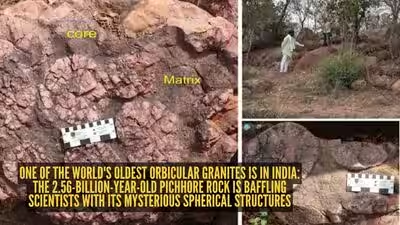
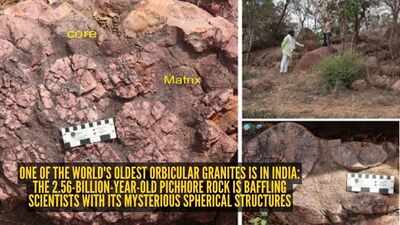
The Pichhore orbicular granite is located near Kutawali village in the Shivpuri district of Madhya Pradesh, within the ancient Bundelkhand Craton – one of India’s oldest geological regions. What sets this granite apart from ordinary rocks are its distinctive orbicules which are nearly spherical structures that can grow up to 30 centimetres in diameter. Each orbicule consists of a central core surrounded by several concentric mineral layers made primarily of quartz, feldspar and mica giving the rock a striking appearance.According to the study, orbicular granites are exceptionally rare, with only a limited number of occurrences reported worldwide. Using uranium-lead (U-Pb) zircon dating – the researchers determined that the Pichhore granite crystallised around 2.56 billion years ago, making it the second-oldest known orbicular granite identified so far, after one discovered in Western Australia.The dating also revealed the presence of inherited zircon crystals as old as 3.5 billion years indicating that fragments of even older continental crust had survived and were later incorporated into the younger granite. These ancient mineral grains provide valuable evidence that Earth’s earliest crust had already begun recycling during the Neoarchean Era.


Image Credit: X/ Research Matters
How mysterious spherical structures formed billions of years ago
One of the biggest questions surrounding orbicular granites has always been how their distinctive spherical structures formed. According to the researchers, the Pichhore granite offers important clues to solving this long-standing geological mystery.The study suggests that the granite formed deep beneath the Earth’s surface during the Neoarchean Era, a time when the planet was still evolving and stable continents were beginning to emerge. The researchers propose that a pulse of hotter, darker magma intruded into an existing body of cooler, potassium-rich granitic magma containing water and dissolved minerals.The sudden thermal disturbance triggered rapid undercooling of the magma. As it cooled, minerals began crystallising around small rock fragments or crystals, gradually forming a series of concentric layers. This process produced the granite’s distinctive orbicules.The researchers also analysed the rock’s chemical composition and found evidence that the magma responsible for the granite was generated through the melting and reworking of older continental crust rather than directly from Earth’s mantle. This indicates that crustal recycling, a process fundamental to modern plate tectonics, was already taking place more than 2.5 billion years ago.
Why this discovery matters
The discoveries allow the Pichhore granite to be much more than an old rock formation. It is, in effect, a record of events that took place during a key stage in the evolution of the Earth. Analysis of its age, mineral content and unique orbicules allows geologists to gain insights into the creation and evolution of the oldest continental crust.The study also highlights the scientific importance of the Bundelkhand Craton, which preserves some of the oldest rocks in the Indian subcontinent. Ancient formations like the Pichhore granite help researchers reconstruct the conditions that existed when the young Earth was still cooling and the first continents were taking shape.Even though it is significant, the uncovered Pichhore granite is exposed over a relatively small area and can be easily affected by humans through farming activities. According to the authors, preservation of the place is necessary because it is an extremely rare geological find that can continue to serve as a source of knowledge about Earth’s evolution.With its age, mysterious spheres and signs of old crustal recycling Pichhore orbicular granite is considered one of India’s most remarkable geological discoveries. As further studies of this amazing rock are conducted by researchers, it is likely to help us learn more about the origin of the world’s oldest continents and the geological processes of their formation.