
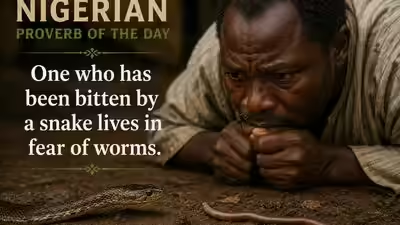
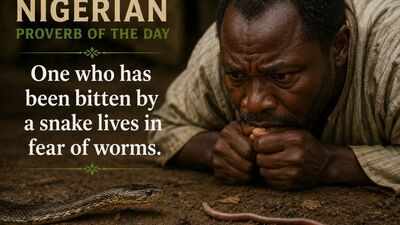
Have you ever flinched at something completely harmless, simply because it reminded you of an old hurt? A Nigerian proverb captures that feeling perfectly. One who has been bitten by a snake lives in fear of worms, it says. Among the Igbo people, where the saying is well known, it speaks a truth everyone recognises the moment they hear it. After a real and painful bite, even a harmless little worm wriggling in the soil can send a shiver down the spine. The snake did the damage, but the fear spreads to anything that even faintly resembles it. The proverb is the African cousin of the English phrase once bitten, twice shy. In a handful of plain words, it captures how deeply pain teaches us caution, and how that caution can quietly outgrow the very danger that caused it.
Nigerian proverb of the day
“One who has been bitten by a snake lives in fear of worms.”
Meaning of the proverb
On the surface the image is simple. A snake bite is dangerous, sometimes deadly. A worm is harmless. Yet the person who has felt fangs sink into their skin can no longer look at anything long, thin and wriggling without a jolt of fear. The body remembers. The mind, trying to keep itself safe, begins treating every worm as a possible snake.That is the heart of the proverb. A painful experience leaves a mark, and that mark shapes how we see the world long after the event is over. Once something has hurt us badly, we grow wary not only of that exact thing, but of everything that resembles it. Someone betrayed by a close friend may struggle to trust the next kind face. A person who lost money in one bad deal may flinch at every offer that comes after. The snake is long gone, but the fear it planted keeps spreading, fastening itself onto perfectly harmless worms.
Origins in Nigerian culture
Nigeria is one of the most linguistically rich countries on earth, home to hundreds of languages and a deep, living tradition of proverbs. Sayings like this one are not mere decoration. In many Nigerian communities, a well-placed proverb is a mark of wisdom and good speech, woven naturally into everyday talk, used to settle arguments, soften hard truths and teach the young.This particular proverb is recorded as Igbo, from the people of southeastern Nigeria, where snakes are a real and present danger in farmland and bush rather than a distant idea. That makes the image vivid instead of abstract. Everyone listening knows what a snake bite means, and everyone has seen a worm turned up in the soil. By drawing a line between the two, the proverb takes a common rural scene and turns it into a lesson about the human heart, one that travels far beyond any farm.
The wisdom of a wary heart
It would be easy to read the proverb as a simple mockery of fear, but it isn’t quite that. There is genuine wisdom hidden in the wary heart. The person who fears worms after a snake bite is, in a sense, still learning. Pain is one of life’s sharpest teachers, and a healthy respect for danger is part of what keeps us alive. The child who touches a hot pan learns to be careful near the stove. The caution that follows a hard lesson is often the very thing that protects us the next time around.So the proverb is not only laughing at the snake-bite victim. It understands them. To have been truly hurt and to come away more careful is natural, even sensible. Caution, in this light, is simply the mind’s honest effort to make sure the same wound is never suffered twice. Nobody who has felt real venom should be blamed for treading carefully afterwards.
When fear grows larger than the danger
And yet the proverb carries a gentle warning folded inside it. A worm is not a snake. When our fear spreads to things that cannot actually harm us, it stops protecting us and starts shrinking our world. The person who treats every worm as a threat will struggle to walk through a garden at all, let alone work the land.This is where the saying quietly points toward healing. At some stage, the deeper wisdom lies not in fearing more, but in learning to tell the worm from the snake once again. To recover from a painful experience is not to forget it, but to stop letting it colour every single thing that follows. The bite was real. The lesson was earned. But a life lived in dread of every harmless worm becomes its own kind of poison, slower than venom, yet draining all the same. The wisest response to an old wound is to stay alert to real danger while refusing to let imagined danger run the rest of your days.