
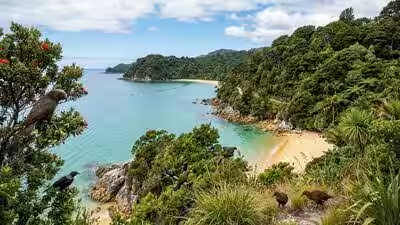
The Abel Tasman National Park can still look much as visitors might expect from a New Zealand wilderness: forest, rivers, beaches and a coastline opening onto the sea. Yet beneath that familiar scenery, the park has undergone a long ecological repair. According to the Project Janszoon official website it began in 2012, parts of the park had lost much of their natural richness to introduced predators and invasive plants. Fourteen years of pest control, weed removal, habitat work, species recovery and education have since changed what can be heard and seen across the landscape. Native birds are returning to places where they have become scarce, forest plants are recovering and a wider community has become involved in looking after the park.
A 14-year restoration effort began in New Zealand’s Abel Tasman
The Abel Tasman had the appearance of an intact landscape when Project Janszoon was established. Its ecological condition told a less reassuring story. Introduced pests were affecting native wildlife, while weeds were competing with indigenous vegetation. Some of the park’s forests had become unusually quiet because birds that once formed part of the everyday soundscape were no longer common in many areas.That became the starting point for Project Janszoon, a conservation partnership launched in 2012 with the Department of Conservation (DOC), mana whenua, the Abel Tasman Birdsong Trust and local communities. Project Janszoon founder Devon said, “It was the first time that philanthropy at scale had really injected funding into one of these projects. What was different was we were able to look at the national park as a whole, whereas DOC had always focused on the pressure points.”According to Project Janszoon, more than $21 million was invested in the restoration work over 14 years.

PC: Project Janszoon
Abel Tasman’s restoration went beyond removing pests and invasive plants
Much of the restoration has involved work that visitors may not immediately notice. Predator control helped create safer conditions for native birds, while teams and volunteers worked against invasive vegetation. Wilding pines were removed, and gorse and other weeds have been tackled along beaches and elsewhere in the park. The purpose was not simply to clear unwanted plants or reduce pest numbers. The wider aim was to give native species enough space and protection to re-establish themselves.Some of the changes are now visible in the forest. Mistletoe and rata are among the native plants making a return, while areas once affected by invasive vegetation have been brought back towards a more indigenous character.
Native birds began appearing again
The clearest signs of change can be found in the wildlife. Kākā have returned to areas of the park, while whio and pāteke have also been recorded. For people who knew the park before the restoration programme, the change is particularly noticeable in the sounds of the bush.Ropata Taylor, chair of the Ngāti Rārua Ātiawa Iwi Trust, described, “You were struck by how quiet and silent the bush was. Now in 2026, it is like a different place. The diversity of plants, the sounds of the manu. It has gone from this kind of quite sterile state to this vibrant living state.”
The project reached beyond the forest
Project Janszoon’s work was not confined to ecological management. More than 10,000 students took part in its youth ambassador and education programmes, giving younger generations direct experience of the park and its restoration work. That educational element became part of a broader change in how the Abel Tasman was cared for. DOC’s Martin Rodd said, “The work on the ground, the biodiversity achievements, have been amazing. But the ownership of it, to me that was the magic. We need to keep building on that.”The park’s restoration therefore involved people as well as habitats. Volunteers continued weed control, communities participated in conservation activity, and iwi and other partners became part of the longer-term stewardship of the area.
The philanthropic partnership behind Abel Tasman’s 14-year restoration
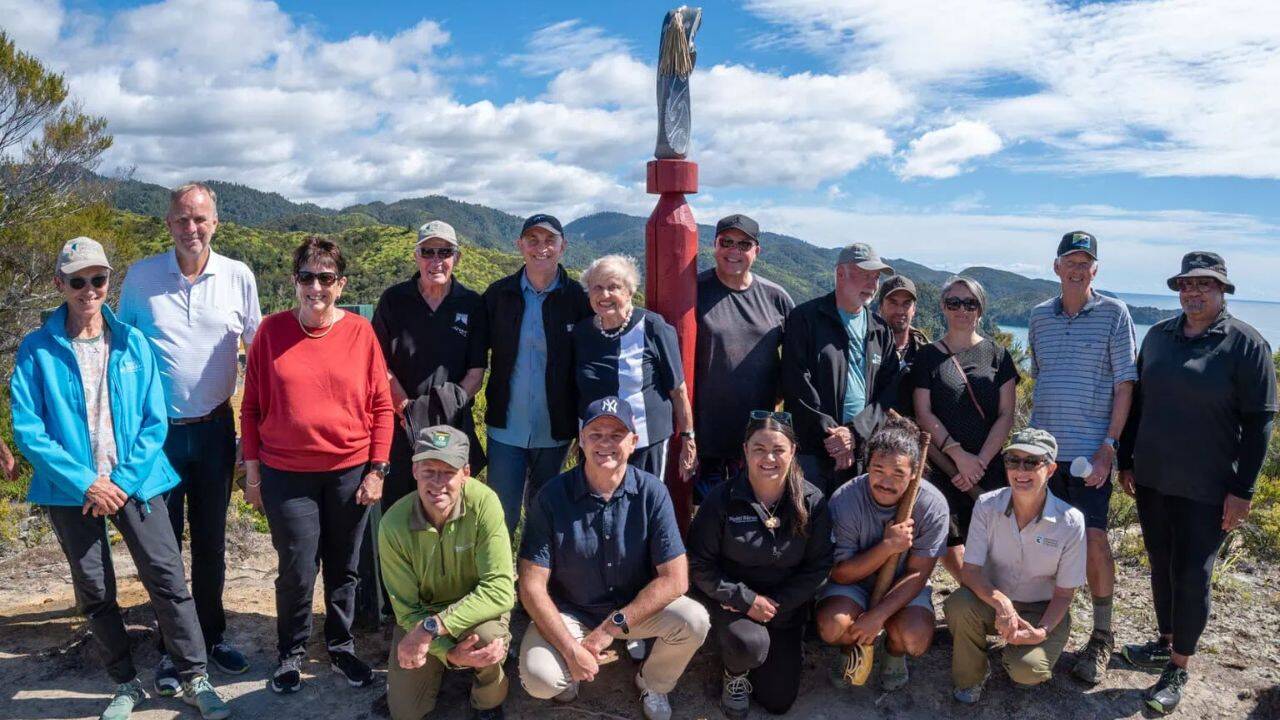
Project Janszoon was unusual in New Zealand because of the scale of private funding directed towards a national park. Neal and Annette Plowman supported the project and later established the NEXT Foundation, a philanthropic organisation that has committed $250 million to education and environmental work.For Project Janszoon, philanthropy provided an opportunity to work across the park over a sustained period rather than concentrating only on individual pressure points. The arrangement brought together private funding, conservation expertise, government agencies, iwi and community groups. The model has since been used in other conservation projects around New Zealand.For the Plowmans, the Abel Tasman project became a long-term commitment rather than a short funding exercise. In February 2026, representatives of Ngāti Rārua, Ngāti Tama and Te Ātiawa presented them with a wheku, a carved post, on the coastal track above Rākauroa/Anchorage in recognition of their contribution.
The next phase of Abel Tasman’s restoration begins after 14 years
Project Janszoon’s formal role came to an end on 30 June 2026. That does not mark the end of the restoration programme. DOC and the NEXT Foundation have signed what is known as the Tomorrow Accord, under which DOC has committed to maintaining agreed biodiversity gains achieved during the project’s 14 years. The responsibility now shifts more firmly towards the Department of Conservation, mana whenua, landowners, communities and other organisations involved in the park. The change is important because ecological recovery can be lost if pest control, weed management and monitoring stop. The progress made in Abel Tasman depends on those gains being maintained over time.
Native wildlife and forest plants are returning to Abel Tasman
Fourteen years ago, the Abel Tasman could appear untouched while carrying many of the ecological pressures common to protected areas affected by introduced species and invasive plants. By 2026, the evidence of restoration is easier to encounter. Kākā move along the coast. Whio and pāteke occupy waterways. Robins are appearing near beaches again. Native forest plants are returning, while invasive vegetation has been pushed back.The most striking change may be less visible than any of these individual species. It is the return of a richer, noisier and more varied forest environment. Project Janszoon has finished its own chapter in the park’s history. The next one belongs to the organisations, iwi, volunteers and communities now responsible for keeping those ecological gains in place.