
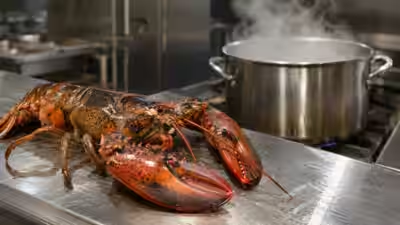
New York City lawmakers have introduced a bill seeking to prohibit restaurants and other food-service establishments from putting live lobsters, crabs and other crustaceans directly into boiling water to cook them, bringing the treatment of marine animals under renewed scrutiny. The proposed legislation, introduced on November 19, 2026, argues that crustaceans may experience pain and distress when subjected to the practice without being stunned first. If passed, restaurants would still be allowed to serve lobster, crab and other crustacean dishes, but would have to use alternative preparation methods. Establishments violating the proposed restriction would receive a warning for their first offence, while repeat violations could attract civil penalties of up to $100.
Why New York City wants to ban boiling lobsters alive
Animal welfare concerns form the central argument behind the proposed legislation. Its sponsors have cited scientific research suggesting that lobsters, crabs and other decapod crustaceans possess the capacity to experience pain and distress.The supporting memorandum argues that putting these animals directly into boiling water without first stunning them can cause significant suffering. It also points to restrictions introduced in other countries and argues that restaurants should adopt preparation practices that minimise unnecessary harm.The debate has gained attention as scientific research increasingly examines the nervous systems, behaviour and responses of invertebrates that have traditionally received less consideration under animal-welfare laws.
What does the proposed legislation say?
The bill, identified as Introduction 1188-2026, was sponsored by New York City Council members Oswald J. Feliz and Harvey D. Epstein. It seeks to amend the city’s Administrative Code by introducing a provision prohibiting food-service establishments from placing live crustaceans into boiling liquid for cooking or preparing them for human consumption.The proposed restriction covers aquatic invertebrates belonging to the crustacean group, including lobsters and crabs. Its wording is not limited to these two species, meaning other crustaceans intended for human consumption could also fall within its scope.The legislation would apply to restaurants and other food-service establishments, as well as owners, operators, employees and individuals acting on their behalf. It does not prohibit the sale or consumption of crustaceans or prevent restaurants from offering seafood dishes prepared using other methods.
Restaurants could face fines for repeat violations
The proposed legislation outlines a two-stage penalty system for establishments found violating the restriction.A restaurant committing a first violation would receive a notice explaining the alleged breach, along with a warning that subsequent violations could result in financial penalties. No monetary fine would be imposed for the first offence.However, a second or subsequent violation could attract a civil penalty of up to $100 for each offence. If the bill is approved and becomes law, the restrictions would come into effect 180 days after its enactment.
What a major scientific review found about crustacean pain
A 2021 review commissioned by the UK government’s Department for Environment, Food and Rural Affairs (DEFRA) and conducted by researchers at the London School of Economics (LSE) examined more than 300 scientific studies on the sentience of cephalopods and decapod crustaceans.Led by researchers including Dr Jonathan Birch, the review assessed eight criteria associated with the capacity to experience feelings, including pain receptors, connections within the nervous system, protective behaviour, associative learning and responses to pain-relieving substances.The researchers found strong scientific evidence that decapod crustaceans, including lobsters, crabs and crayfish, are sentient and capable of experiencing pain, distress or harm.The report also recommended banning live boiling, among other slaughter methods, where more humane alternatives are available, unless the animals are first effectively stunned using electricity.
Other countries have introduced animal-welfare protections
New York City’s proposal follows a wider international discussion about the treatment of crustaceans in the seafood industry.Switzerland has introduced regulations requiring crustaceans to be stunned before they are killed, while Norway has also adopted restrictions concerning the boiling of live lobsters without prior stunning.The UK took a different legislative approach in 2022 when its Animal Welfare (Sentience) Act formally recognised decapod crustaceans, including lobsters and crabs, and cephalopod molluscs, including octopuses, as sentient animals. This recognition requires their welfare to be considered in relevant government decision-making, rather than imposing a blanket ban on boiling them alive in restaurants.
Restaurant industry raises concerns over the proposal
The proposed restriction has also drawn criticism from some restaurant owners and hospitality industry figures in New York.Some restaurateurs have questioned the need for another regulation affecting food preparation, pointing to the financial pressures already facing the city’s hospitality industry, including high rents, food costs, labour expenses and taxes.Some restaurant operators have also expressed concern that additional restrictions could complicate their operations and affect plans to open or expand businesses in the city.Supporters of the proposal, meanwhile, maintain that it would not remove lobster or crab from restaurant menus. Instead, establishments would have to change how they prepare the animals before cooking them.Introduction 1188-2026 was formally introduced in the New York City Council on November 19 and referred to its Committee on Health for consideration.The proposal must undergo the city’s legislative process before it can become law. Until then, restaurants can continue using existing preparation methods, including boiling live crustaceans.If enacted, the measure would introduce a new animal-welfare requirement for food-service establishments while allowing customers to continue ordering lobster, crab and other crustacean dishes prepared using alternative methods.