


If you’ve ever waited years for something important – a degree, a promotion, a long journey – you know how strange it feels when the defining moment itself is over in what seems like an instant. That’s exactly what happened with NASA’s New Horizons mission to Pluto. Engineers and scientists spent nearly a decade sending a small spacecraft three billion miles into the outer solar system… for a flyby that was effectively over before a single workday on Earth had finished, as reported by Science Daily.New Horizons didn’t stop at Pluto. It couldn’t. The way the spacecraft was built – and the way it was launched – meant that this mission was always going to be about one high‑speed pass and a long, patient wait for the results.
A nine‑year trip to a moving target
New Horizons left Earth on January 19, 2006, riding one of the most powerful rockets available at the time. It needed that punch because Pluto isn’t just far away – it’s also small, dim and moving along its own orbit around the Sun. NASA had to aim the spacecraft at a point in space that Pluto would occupy on a single morning in July 2015.To get there fast enough, the mission used two key ingredients:– A very energetic launch that gave New Horizons a huge initial speed.– A gravity assist from Jupiter, using the giant planet’s pull to bend and boost the spacecraft’s trajectory toward the Kuiper Belt.All of that energy came with a trade-off: the spacecraft was never designed to brake and drop into orbit. There simply wasn’t the fuel or propulsion system onboard to slow from over 30,000 miles per hour to “Pluto speed.” Instead, the entire mission was planned around one precise flyby.For most of the journey, New Horizons spent long stretches in hibernation to save power and reduce wear on its systems. Teams on Earth would periodically wake it up to check its health, refine its path, and rehearse the observation sequences that would have to run flawlessly at Pluto.
Why a flyby instead of an orbiter?


At first glance, it might seem odd: Why go all that way and not stay? The answer lies in basic physics and mission design.To orbit Pluto, a spacecraft would have to:– Carry a large amount of fuel to slow down dramatically on arrival.– Use a more complex propulsion system capable of major braking maneuvers.– Accept a heavier, more expensive spacecraft and launch.New Horizons was built to be small, relatively simple, and fast. That allowed it to:– Reach Pluto in under 10 years instead of taking much longer.– Travel onward into the Kuiper Belt to study another distant object after the Pluto encounter.The cost of that reach was unforgiving timing. The instruments had only a few hours, really just a narrow window around closest approach, to capture the best possible data before Pluto literally slid out of view behind the spacecraft’s motion.
The morning Pluto turned from pixels into a world
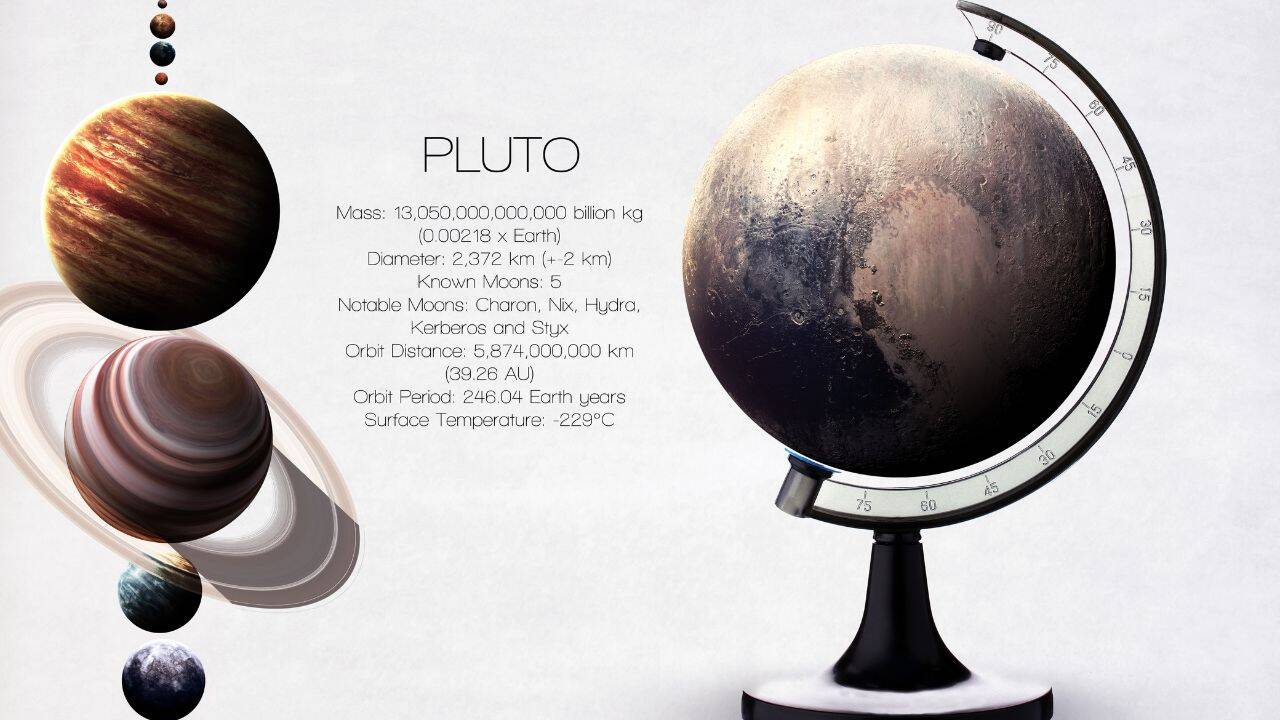
On July 14, 2015, after nearly a decade of travel, New Horizons swept through the Pluto system at more than 30,000 miles per hour. It passed just about 7,750 miles above Pluto’s surface – closer than many commercial flights are to Earth’s ground, if you imagine it in atmospheric terms.Up to that point, Pluto had been mostly a fuzzy dot in telescopes: Something you could measure and track, but not really see in detail. During the flyby, that changed dramatically. In a few tightly choreographed hours, the spacecraft:– Imaged Pluto’s surface at resolutions fine enough to reveal mountains, plains and possible glaciers.– Observed its largest moon, Charon, along with several smaller moons.-Measured the structure of Pluto’s thin atmosphere and the space environment around it.The most striking transformation was visual. A once‑blurred planetary body suddenly showed:– A vast bright heart‑shaped region, including a smooth plain called Sputnik Planitia.– Tall mountains made of solid water ice.– Haze layers in the atmosphere reaching high above the surface.– Evidence of flowing nitrogen ice and a surprisingly diverse landscape.All of this happened while the spacecraft was completely out of touch with Earth.
How do you feel about the approach NASA took with the New Horizons mission, prioritizing a flyby over orbiting Pluto?
3k+ users shared opinion today
5k+ users already voted today
3k+ users shared opinion today
Why New Horizons went “radio silent” at the crucial moment
You might expect NASA to stay in constant contact with a spacecraft during a historic encounter, but New Horizons did the opposite, and for good reason.The spacecraft had a simple design: it couldn’t point its main communications antenna one way and its scientific instruments another at the same time. To talk to Earth, it had to turn its whole body. To do science, it had to point its instruments directly at Pluto and its moons.During closest approach, the mission team made a clear choice:– Prioritise data collection over live communication.– Let the spacecraft spend those precious hours filling its onboard recorders instead of sending information back in real time.So while the world was watching animations and early, low‑resolution images, the probe itself was silently sweeping past Pluto, capturing the best views and measurements it would ever get, and not saying a word until it was done.Only after the flyby did New Horizons turn its antenna back toward Earth and send a simple, crucial message: It was alive, healthy, and had completed its observation plan.
Why the data took more than a year to arrive
You might imagine that once the spacecraft turned toward home, the information would arrive quickly. In reality, the “afterlife” of those few hours at Pluto lasted about 15 months.Several factors shaped that slow return:– Distance: At Pluto’s distance, a radio signal takes about four and a half hours just to cross the gap to Earth.– Low data rate: The spacecraft has limited power and a small transmitter. Compared to everyday internet speeds, its data rate is tiny.– Shared antenna time: It has to use big Earth‑based dishes that also support other missions, so New Horizons only gets part of the schedule.– Pointing and power: Each downlink requires careful alignment and enough energy onboard.Instead of one big download, the Pluto data came down in many small sessions. Early on, scientists requested a selection of “priority” images and measurements to confirm the mission’s success and start analysing the most obvious features. The rest trickled in gradually.By late October 2016, more than 15 months after closest approach, the last bits from the 2015 flyby finally arrived. In total, the spacecraft returned roughly 50 billion bits of data about the Pluto system.
A fast flyby, a slow unfolding of discovery
That long delay changed the rhythm of how the world learned about Pluto. The flyby itself was a single historic moment – a calendar date everyone remembers. The science, however, was spread out over months and years.Each new batch of data:– Sharpened earlier images into higher‑resolution views.– Filled in composition maps, showing where different ices and materials sat on the surface.– Revealed new details about Pluto’s atmosphere, its moons, and its geological history.What started as “Pluto is more complex than we thought” evolved into a richer story: Small, icy worlds in the outer solar system can be geologically active, shaped by slow but powerful processes far from the Sun.
A mission defined by patience and precision
It’s tempting to describe New Horizons as a “fast” mission, and in some ways it absolutely was. It raced through the Pluto system at tens of thousands of miles per hour and went on to explore another object deeper in the Kuiper Belt.Yet almost every part of its success depended on patience:– Nearly 10 years to reach the target.– Years of planning and rehearsals before the flyby.– Hours of intense data gathering with no live contact.– More than a year of slow, careful downloading from the edge of the solar system.The spacecraft was gone from Pluto almost as soon as it arrived. The data, luckily, took its time. That contrast – speed at the encounter, slowness in the science – is a good way to understand what flyby exploration really means: You trade staying power for reach and accept that one brief moment, handled well, can keep paying off long after the spacecraft has moved on.