
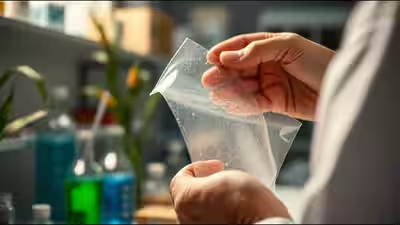
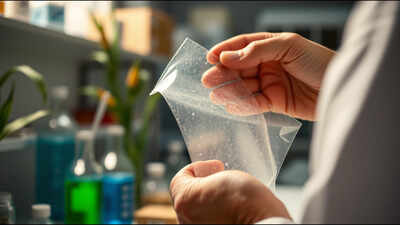
Onndinadaho Rasilwela, a chemical engineering graduate from South Africa, has won top honours at the 2026 Green Youth Indaba for developing a biodegradable plastic from agricultural waste. A member of the Tshwane University of Technology’s Student Women Economic Empowerment Programme, Rasilwela received R150,000 for her project, Biomulchies, which uses materials including sugarcane bagasse and maize stalk to produce biodegradable mulch. The award was announced at Sun City in the North West province, where the Green Youth Indaba was held from 17 to 19 June 2026. Her project focuses on a familiar problem for farmers: plastic mulch is useful for controlling weeds and retaining moisture around crops, but conventional plastic can remain in the soil after it is no longer needed. Rasilwela’s research looks at whether agricultural waste could instead be turned into a material that provides a biodegradable alternative for agricultural use.
How Rasilwela turned agricultural waste into biodegradable plastic
Rasilwela holds an Honours degree in Chemical Engineering and works as a Research Assistant in TUT’s Department of Pharmaceutical Sciences. Her research, titled Comparative Synthesis and Analysis of Bioplastic from Hemp and Maize Stalk, looks at producing bioplastic from agricultural by-products. TUT describes Biomulchies as a biodegradable mulch made using materials such as sugarcane bagasse and maize stalk. The idea is relatively simple: instead of allowing crop residues to become waste, they can be processed into a material with another use. Her research also compares bioplastics made from different plant-based sources, including hemp and maize stalk, to assess their properties and potential for producing useful biodegradable materials. The work is still at the research and development stage, but Rasilwela’s award has brought attention to its potential application in agriculture.
Why farmers use plastic mulch in the first place
Plastic mulch is widely used in agriculture because it can help control weeds, conserve soil moisture and influence the temperature around crops. Those benefits make it useful during the growing season, but disposing of the material after use can create another problem. Conventional plastic does not readily biodegrade, meaning pieces left behind in fields can persist and contribute to plastic waste and environmental degradation. Biomulchies is aimed at addressing that problem by replacing conventional plastic with a biodegradable material made partly from agricultural waste. Rather than introducing another material into the farming cycle and dealing with it as waste later, the project looks at whether crop residues can become part of the solution. Its appeal therefore lies not only in replacing plastic but also in finding another use for materials that would otherwise be discarded.
What Rasilwela’s Green Youth Indaba win means
Rasilwela received R150,000 after winning top honours at the 2026 Green Youth Indaba, an event focused on young South Africans developing responses to environmental and climate-related challenges. Her project was presented through the Innovators Pitch, giving the research an opportunity to reach audiences beyond the university. The award also adds visibility to SWEEP, the TUT programme through which Rasilwela is involved and which supports young women pursuing opportunities in areas including science, technology and the green economy. For Rasilwela, the recognition comes at a point when Biomulchies still has room for further development and testing. The project will need additional work before its commercial potential and performance as a large-scale alternative to conventional mulch can be established. But by combining agricultural waste with bioplastic research, her work offers a practical example of how materials normally treated as waste could be put to another use.