
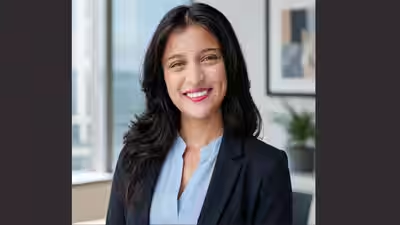
An eighth-grade student from Texas has used artificial intelligence and computer models to screen more than 10 million drug-like molecules in search of possible treatments for frontotemporal dementia. Myreen Ahsan, a student at Friendswood Junior High in Friendswood, Texas, carried out the computer-based study as part of an independent research project on neurodegenerative diseases. Her project examined large chemical databases to find compounds that could interact with specific biological targets linked to the condition. The project earned Ahsan a place as one of 30 national finalists in the 2026 Thermo Fisher Scientific Junior Innovators Challenge, a major science and engineering competition for American middle school students run by Society for Science. Frontotemporal dementia is a group of brain disorders that mainly affect the frontal and temporal parts of the brain. The condition can cause changes in behaviour, language, and the ability to plan and make decisions. Effective treatments that can slow or change the course of the disease remain limited, leading researchers to explore new ways to discover drugs.
High-throughput virtual screening process
Ahsan named her research project “Millions to Molecules: Dual Mechanism Small-Molecule Discovery via HTVS and Machine Learning-Guided Molecular Dynamics for Frontotemporal Dementia”. The study used high-throughput virtual screening (HTVS), a computer-based method that allows scientists to test large collections of chemical structures against biological targets digitally. This can reduce the time and cost involved in physically testing millions of substances in laboratories. Ahsan combined virtual screening with machine learning models and molecular dynamics simulations. This approach allowed her to study how strongly potential drug molecules might bind to target proteins and how stable those interactions could remain over time. Through several filtering steps, her computer-based process reduced the original library of more than 10 million possible molecules to a small group of promising small-molecule candidates. According to research summaries released by the Science and Engineering Fair of Houston, where Ahsan had previously competed, her approach focused on finding small molecules that could potentially work through two different mechanisms. The goal was to address more than one disease-related process at the same time.
Self-taught computational techniques
Ahsan became interested in medical computing through independent learning and by attending specialised neuroscience camps. Speaking about her research at an earlier symposium, Ahsan explained how advanced bioinformatics tools first caught her attention. “While preparing for my science fair project, I came across an article on AlphaFold 3.0 and its role in drug discovery. It felt like two worlds I was passionate about, AI and neuroscience, suddenly clicked together,” Ahsan said. She taught herself how to use complex bioinformatics platforms and datasets by reading scientific research and studying public online resources. “It started with curiosity,” Ahsan explained. “I treated it like a puzzle. I kept learning bit by bit until it made sense. It wasn’t always easy, but it was exciting and that made the hard parts worth it.” Her use of advanced data methods drew attention from academic experts during state and regional presentations.Xiaoqian Jiang, chair of the Department of Health Data Science and AI at UTHealth Houston, praised Ahsan’s interest in advanced medical technology after one of her research presentations. “To see a young person so deeply engaged with cutting-edge topics demonstrates the extraordinary potential of the next generation,” Jiang said. “Her work not only reflects a strong understanding of artificial intelligence in biomedical sciences but also showcases her curiosity and commitment to learning.“
National competition in Washington
Ahsan’s selection among the top 30 finalists in the Thermo Fisher Scientific Junior Innovators Challenge followed a nationwide process that began with thousands of middle school students taking part in local and regional science fairs. After being nominated through the Science and Engineering Fair of Houston, Ahsan was named to the top 300 shortlist announced by Society for Science. She later secured a place among the 30 national finalists. As a finalist, Ahsan will travel to Washington, DC, for the competition’s Finals Week. During the event, students will present their individual projects and take part in team-based problem-solving challenges judged by panels of scientists and engineers. Each finalist receives a $500 cash prize. The top awards at the national competition include more than $100,000 in educational scholarships and prizes. The finalists are scheduled to present their completed research projects to judges and the public during the Washington event in late October.