
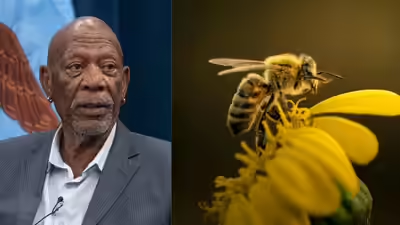
While millions know Morgan Freeman for his iconic voice and award-winning performances, the Hollywood legend has also become an unlikely champion for one of the planet’s smallest yet most important creatures. Concerned by the global decline in bee populations, Freeman transformed his 124-acre ranch in Charleston, Mississippi, into a sanctuary designed to provide bees with a safe habitat. His efforts have drawn attention to the crucial role bees play in pollination and food production, inspiring conversations about how individuals can help protect these essential pollinators.
Who is Morgan Freeman and how he turned his 124-acre ranch into a bee sanctuary
Morgan Freeman is one of Hollywood’s most celebrated actors, known for a career spanning more than five decades. Born on 1 June 1937 in Memphis, Tennessee, he has starred in acclaimed films such as The Shawshank Redemption, Driving Miss Daisy, Se7en, Million Dollar Baby and Invictus.Freeman won the Academy Award for Best Supporting Actor for Million Dollar Baby (2004) and has received numerous other honours, including a Golden Globe Award, a Screen Actors Guild Lifetime Achievement Award and the AFI Life Achievement Award.Away from the film industry, Freeman has long expressed an interest in environmental conservation and sustainable farming.
Why Freeman turned his ranch into a bee sanctuary
Freeman’s journey into beekeeping began in 2014, when he revealed on The Tonight Show Starring Jimmy Fallon that he had recently taken up the hobby after learning about the dramatic decline in bee populations.According to Forbes, he imported 26 beehives from Arkansas to his Mississippi ranch and transformed the property into a safe haven for pollinators. Rather than treating the bees as a commercial venture, Freeman focused on creating an environment where they could live undisturbed. He planted bee-friendly vegetation, including magnolia trees, lavender and clover, providing a continuous supply of nectar throughout the year.Freeman has also said that he does not harvest honey from the hives. Instead, he feeds the bees sugar water when needed and leaves them to carry out their natural role as pollinators.
“They haven’t stung me yet,” says Freeman
One of the most unusual aspects of Freeman’s beekeeping is how closely he interacts with the insects. Speaking about his experience, he revealed that he does not wear a protective bee suit or veil when tending to the hives.“They haven’t stung me yet,” Freeman said, explaining that because he is not trying to take honey from the colonies, the bees are generally unbothered by his presence. As quoted by Forbes, he joked that the bees seem to recognise he is simply bringing them food rather than disturbing their home.Freeman has repeatedly stressed that his goal is not honey production but providing bees with a safe environment in which they can flourish.
Why bees are so important for the ecology
Bees are among the world’s most important pollinators, transferring pollen between flowering plants and enabling them to produce fruits, vegetables, seeds and nuts.According to the Food and Agriculture Organization (FAO), around 80% of the world’s leading food crops depend, at least in part, on animal pollination, with bees playing the dominant role. Crops such as apples, almonds, blueberries, cucumbers and pumpkins all benefit from bee pollination.However, bee populations have declined in many regions because of habitat loss, pesticide use, climate change, parasites and disease. Scientists warn that continued declines could threaten biodiversity and global food security.
How Morgan used his platform to raise awareness about the bees
Freeman’s conservation efforts reflect growing scientific concern over declining pollinator populations. Bees play an essential role in pollinating wild plants and agricultural crops, making them crucial to biodiversity and food production.As Forbes noted, researchers have linked bee declines to a combination of habitat loss, parasites, pesticide use and disease, with concerns about colony collapse disorder drawing global attention in recent years. The publication also highlighted that changes to pesticide regulations and continued environmental pressures have intensified debates about how best to protect pollinators.While Freeman’s 124-acre sanctuary alone cannot solve the global pollinator crisis, it has become a powerful symbol of how individuals can use their land and influence to support conservation. By turning his ranch into a haven for bees, the Oscar-winning actor has shown that protecting nature can begin with a single decision, and inspire millions of others to do the same.