
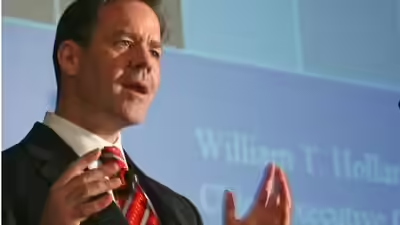

For many people, financial independence marks the end of a working life. For Bill Holland, it marked the point at which a very different career began. He had already earned enough money to stop working before most people had established themselves professionally, yet retirement never appealed for long. As reported by Fortune reports, decades later, his weekday routine still includes travelling into an office in Toronto using public transport rather than retreating into a life built around luxury. His story is less about sudden wealth than about what followed it. While his fortune grew through Canada’s investment industry, many of the habits that shaped his early years remained largely intact, even as his financial circumstances changed beyond recognition.
How Holland‘s early struggles shaped the mindset behind his investing success.
The former CEO of CI Financial Holland did not step into finance with a carefully mapped-out career plan. After graduating from university in Toronto, he moved through a series of ordinary jobs, including factory work, beverage deliveries, and doorman work. Reportedly, his break came at the age of 27 when he joined Mackenzie Financial as a customer service representative. The position was demanding, with constant calls from clients throughout the working day. Holland has since suggested that the workload never bothered him as much as it did some colleagues, arguing that physically demanding labour had given him a different perspective on what counted as difficult work.Within only a few years, Holland found himself in an unusually strong financial position. Canada’s mutual fund business was expanding rapidly at the time, creating opportunities that few could have predicted with certainty beforehand. Rather than presenting his success as the result of exceptional judgement alone, Holland has consistently pointed towards timing. He has openly acknowledged that luck played a significant part in his financial rise, suggesting that many people who achieve extraordinary success benefit from circumstances that happen to favour them at the right moment.Reportedly, by the time he was 32, he had accumulated enough wealth that he no longer needed to work for financial reasons.
Why retirement was never part of the plan
Instead of retiring, Holland joined a much smaller investment business managing only a modest amount of client assets. Over time, that company evolved into CI Financial, one of Canada’s largest investment management firms.Fortune reported, “People would complain about how hard the job was, but unless you are doing something that involves lifting something heavy, it is not hard,” Holland said. His career continued to gather momentum. He became chief executive in 1999 before later moving into the role of executive chair. Under his leadership, the firm’s assets expanded dramatically over the following years. In 2025, the company was taken private through a deal involving a sovereign wealth fund from the United Arab Emirates after growing into one of the country’s biggest asset managers.Although estimates of Holland’s personal fortune have varied over the years, his holdings in the company were worth hundreds of millions of dollars before he eventually sold his remaining stake.
The simple lifestyle behind an enormous fortune
Despite having the means to live almost any lifestyle he wanted, Holland’s daily habits remain surprisingly ordinary. He still travels to his office in Toronto by public transport for much of the working week rather than relying on private drivers or expensive cars. His time is now divided between investment activities, property ventures and managing his family’s charitable foundation. Giving away money has become just as much a part of his later career as making it. Over the years, more than 100 million dollars has been directed towards charitable projects through his philanthropic work.
Familiar habits among very wealthy people
Holland is far from the only wealthy business figure whose lifestyle appears more restrained than people might expect.As reported by Fortune, Warren Buffett, whose fortune ranks among the world’s largest, has spent decades living in the same home he bought in Omaha in 1958 for $31,500. Despite having the resources to purchase virtually any property, he has often said the house holds personal value because it is where his family grew up. His reputation for modest spending extends well beyond housing. Stories about carefully choosing inexpensive breakfasts have become part of the image surrounding the veteran investor, reinforcing his long-standing preference for avoiding unnecessary extravagance.Elon Musk has taken a different route, though one that also moved away from traditional billionaire living. After previously owning several luxury homes in California, he sold much of his property portfolio, saying he wanted to own no house at all.His move to Texas brought him closer to SpaceX’s launch operations, and he later described living in a comparatively small home near the company’s facilities. Earlier this year, his mother, Maye Musk, shared a glimpse of the property’s simple interior, describing sparse furnishings and an almost empty refrigerator.
The philosophy that shaped his extraordinary career
Holland’s experience suggests that reaching financial independence does not automatically lead to a completely different way of living. While his career delivered extraordinary financial rewards, many of the routines established long before he became wealthy remain part of his everyday life.He has also resisted portraying his achievements as entirely self-made. By repeatedly acknowledging the role of fortunate timing alongside persistence, Holland offers a less predictable account of financial success than the familiar stories built solely around determination or talent. His career ultimately became much longer than it ever needed to be. Retirement was an option before his mid-thirties, but continuing to work, invest, and support charitable causes turned out to be the path he chose instead.