
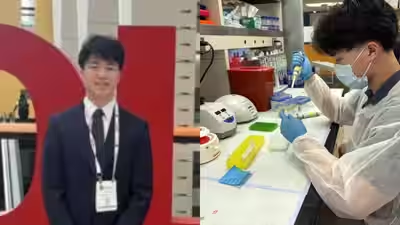
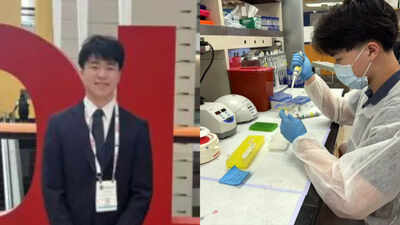
Most teenagers go to a pathology office for a blood test. For Austin Jin, it was the launch pad to address one of medicine’s oldest and most enduring problems: diagnosing tuberculosis. A 16-year-old senior at William A. Shine Great Neck South High School in Great Neck, NY, developed M-CATCH, a diagnostic platform based on CRISPR that can detect tuberculosis from blood and identify drug-resistant strains. According to the Davidson Institute website, his work earned him the 2026 Davidson Fellowship and a $50,000 scholarship. Scroll down to read about his journey.
Another approach to TB diagnosis
Tuberculosis remains a major global health threat with over a million deaths reported annually worldwide. But one of the biggest challenges in fighting the disease comes even before treatment starts: getting an accurate diagnosis. Sputum, the mucus produced deep in the lungs, is used in many standard TB tests. And that creates a particular problem for young children and severely ill or immunocompromised patients, many of whom have difficulty producing a usable sample.But in the online report, Jin’s project takes a different tack. M-CATCH screens the blood serum for circulating bacterial DNA fragments in the blood. The system uses polymerase chain reactions and CRISPR-Cas12a technology to find genetic signatures associated with tuberculosis.
Drug resistance testing
This test is not intended to determine whether tuberculosis exists. It can also look for genetic alterations that make the bacteria resistant to certain drugs and that level of detection can come down to a single change in DNA. Jin engineered CRISPR guide RNAs that can distinguish between these tiny genetic differences and combined them with a microfluidics chip that allows multiple reactions to occur at the same time.The result is a multiplex platform that can screen hundreds of reactions for more than one mutation simultaneously. This could eventually make large-scale testing more practical, especially in places where sophisticated laboratories are not readily available.
Research to broader impact
The path to the finished system had its challenges. Designing good CRISPR guide RNAs was particularly tricky because many candidates that looked good on paper did not work as expected in experiments. Jin had spent weeks testing and tweaking them. He’s interested in more than tuberculosis. He plans to major in biomedical engineering and biochemistry to prepare for a career as a physician-scientist, with the hope of translating laboratory research into useful tools for medicine.Outside the lab, Jin captains his varsity swim team and co-presidents his DECA chapter. He also co-founded Project LIFE, a student-led initiative that has grown to over 20 chapters in eight states, with a mission to improve education and access to the bone marrow registry.His M-CATCH platform could eventually be adapted to detect other infectious diseases and possibly even cancer, suggesting a future where a small blood sample could reveal far more than a single diagnosis.Images Courtesy: Davidson Institute