
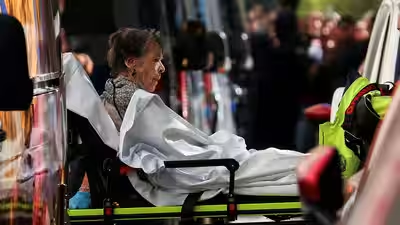
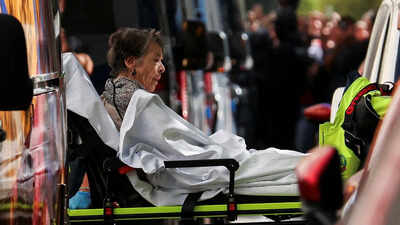
María del Carmen Abascal, the 87-year-old woman whose eviction from her longtime Madrid home triggered nationwide protests and intensified Spain’s housing crisis, died on Wednesday while in hospital.Widely known as “Maricarmen”, Abascal had lived in the apartment for seven decades before she was evicted on September 23.She was carried out on a stretcher after police cordoned off the street and removed protesters who had gathered to oppose the eviction. She was taken to hospital because of her fragile health.Her death was confirmed by her lawyer Beatriz Duro and housing activists. Duro did not disclose the cause of death when confirming it to Cadena Ser radio.Spanish Prime Minister Pedro Sánchez offered his condolences on social media, saying, “All my love to Maricarmen’s family and loved ones. A hug as well to all of us who feel this loss as our own today. Rest in peace.”
Death sparks fresh protests
News of Maricarmen’s death prompted renewed demonstrations, with protesters gathered near Spain’s Parliament chanting, “Maricarmen lives, the fight goes on!”Around 1,000 protesters had also been camping in Madrid’s central Puerta del Sol over the previous week, as anger over housing costs and evictions spread across the country.Iciar López, a 32-year-old psychologist who attended the protest in Madrid, told news agency AP, “A great deal of sorrow. And above all, the thought that she is the cause, the head of this whole revolution that has happened, and that she can’t see it. It makes me very sad that she can’t see if anything comes of it … That’s what angers me the most, honestly.”Maricarmen’s lawyer said the case had drawn international attention and highlighted the impact evictions can have on vulnerable people.“Maricarmen’s case, which captured media attention and traveled around the world, leaves us the image of the shameful violence of these types of evictions and the impact they can have on people’s health,” Duro said.The Madrid Tenants’ Union said an agreement allowing Maricarmen to return to her apartment had been reached, but too late for her to go home.“Although a historic agreement was reached that would have allowed her to return home, this solution came too late,” the union said. “It was an entirely avoidable situation following a harrowing ordeal.”
Her eviction became a national housing flashpoint
Maricarmen had spent almost her entire life in the apartment, first living there with her parents and brother. According to Spanish newspaper El País, she later worked as a secretary for the board of a pharmaceutical company. She said both her parents died in the apartment.After retiring in 1998, she spent much of her time walking around the neighbourhood, running errands and looking after her belongings at home. Family photographs were among the few possessions she had taken with her to hospital.The real estate company that evicted her had sought to rent the property at a much higher price. After sustained public pressure, it eventually agreed to let her return.Her case became a rallying point for renters facing rising housing costs. Protesters across Spain have carried slogans including “Not even one more Maricarmen!” while demanding action from lawmakers.Eugenio Melchor, 22, who attended Wednesday’s protest in Madrid, said: “Maricarmen only wanted to die in her home.She wasn’t asking for anything else. She was dying in her home and she almost did. They have killed her. I mean, there’s no other word for it, and I hope those responsible for this pay and go to trial.”
Housing crisis deepens political pressure
Spain’s housing problems have been building for years, with renters increasingly protesting over rising costs and the limited supply of rental homes.The average rent in Spain has almost doubled over the past decade, according to property website Idealista, with the price per square metre rising from 8.20 euros in 2016 to 15.10 euros this year.Spain’s government said 26% of renters spend an average of 40% of their income on rent and utilities, compared with 18% across the European Union. Government-owned rental properties account for less than 2% of Spain’s available housing stock, compared with an EU average of 8%.The protests have also shaken Spanish politics. Sánchez called an early election after his government failed to secure parliamentary backing for emergency housing measures aimed at stopping evictions and curbing real estate speculation. The election is scheduled for November 29.Housing minister Isabel Rodríguez also expressed her condolences, writing, “I deeply lament the death of Maricarmen. My condolences to those who accompanied her and fought by her side until the end.”Conservative opposition leader Alberto Núñez Feijóo also offered condolences, saying, “I want to express my condolences to Maricarmen’s family and loved ones. No campaign, no party, no use for political advantage. When faced with the death of a person, we must only show respect.”