

Imagine standing on the deck of an ocean liner when a sudden storm tears the ship open. The engine stops, water rushes into the lower parts of the ship, and the vessel begins its unavoidable journey into the dark Atlantic. In the chaos, you manage to get a seat in a small wooden lifeboat with a few other survivors. The ship is gone. No help is in sight. You can either stare at the dark water in complete despair, or you can clear your throat and start to sing.This powerful image lies at the heart of a wquoted saying: “Life is a shipwreck, but we must not forget to sing in the lifeboats.”The statement expresses a basic truth about human life. Suffering, crisis, and eventual death are not unusual problems in human existence; they are part of it. Yet, the quote refuses to accept complete hopelessness. It says that even though we cannot stop the larger problems of life, we still have control over how we respond to them. Singing in the lifeboat is not about pretending that everything is fine or blindly believing that things will get better. It is a conscious and brave choice to resist despair and choose art, friendship, and joy even when life gives us every reason to give up.
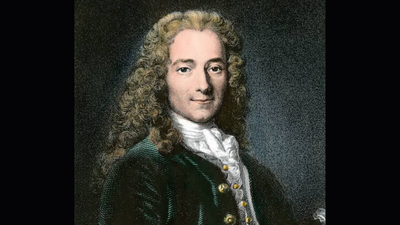
The historian who spoke for Voltaire
While websites, coffee mugs, and self-help books often attribute the line to the famous 18th-century French Enlightenment writer François-Marie Arouet, better known as Voltaire, the historical truth is more complicated. Voltaire never actually wrote or said those exact words.The sentence comes from Peter Gay, a famous German-American historian and professor at Columbia University. In 1963, Gay published a translation of Voltaire’s 1759 masterpiece, Candide, or Optimism. In his introduction to the book, Gay explained Voltaire’s main ideas and expressed them in his own memorable words: “If this life is a desert, it is our duty to make an oasis in it; if this life is a shipwreck, we must rescue as many as we can, and not forget to sing in the lifeboats.”Over the years, writers and commentators took the second part of Gay’s sentence, removed his name, and attached it to Voltaire. By the 1970s, the wrong attribution had become common in American newspapers and books.However, Gay’s version was actually very close to Voltaire’s real philosophy. In a letter written in 1760, Voltaire wrote, “The world, my friend, is one great shipwreck: and man’s motto, ‘Save yourself if you can.’” Voltaire also spent much of his career attacking the simple optimism of thinkers such as Gottfried Wilhelm Leibniz, who believed that we live in the “best of all possible worlds.” After the terrible Lisbon earthquake of 1755, which killed tens of thousands of people within minutes, Voltaire argued that the world was broken, chaotic, and indifferent to human suffering. Yet, at the end of Candide, he famously wrote that “we must cultivate our garden,” meaning that people should focus on small, useful, and constructive actions even when the world around them is falling apart. Gay simply replaced the garden with a song in a lifeboat.
The morality of tragic optimism
Philosophically, the idea of singing in the lifeboat connects closely with modern existentialism and with what Austrian psychiatrist Viktor Frankl called “tragic optimism.”Frankl, who survived the terrible conditions of Nazi concentration camps, including Auschwitz, argued in his 1946 book Man’s Search for Meaning that life can still have meaning and possibilities even under the worst conditions. Tragic optimism means staying hopeful despite the “tragic triad” of human existence: pain, guilt, and death. Frankl observed that prisoners who found small ways to protect their dignity, share food, or sing songs in the barracks during freezing nights could maintain the mental strength needed to survive.This idea is similar to Albert Camus’s famous interpretation of the story of Sisyphus. Sisyphus is punished by the gods and forced to push a heavy boulder up a mountain forever, only to watch it roll back down each time. He faces a task that has no final victory. Yet Camus concludes that “one must imagine Sisyphus happy.” The act of continuing to push the boulder, instead of giving in to hopelessness, becomes a form of victory over an indifferent universe.Singing in the lifeboat is also a form of psychological separation. It accepts that two different truths can exist at the same time: the ship is truly gone, but your voice still works.
Radical acceptance in an unpredictable world
In a time when society faces economic uncertainty, climate change, rapid technological change, and political tension, the idea of the singing lifeboat offers an important way to think about survival and resilience.In modern clinical psychology, this idea connects with Dialectical Behavior Therapy (DBT), especially the concept of “radical acceptance.” Developed by psychologist Marsha Linehan, radical acceptance teaches that suffering becomes worse when we constantly resist reality. When people keep telling themselves that a bad situation “should not be happening,” they can increase their own emotional pain. Accepting that the ship has sunk allows people to stop wasting energy on denial and anger and instead focus on surviving in the lifeboat.Think about modern business leaders during a crisis. When a company suddenly faces a market collapse or a major failure, leaders who panic or refuse to accept the new situation may cause the company to sink further. On the other hand, leaders who accept reality quickly can move into survival mode. They acknowledge the loss, protect the most important parts of the business, support their team, and keep morale alive through small, everyday successes.The same idea appears in sports psychology. Elite marathon runners and endurance athletes often experience extreme tiredness, muscle pain, and exhaustion during difficult races. The athletes who finish are not necessarily those who pretend the pain is not there. Instead, they accept the discomfort, control their breathing, maintain their rhythm, and keep moving forward despite the pain.To live with a clear mind is to accept that every person will eventually face a personal shipwreck, whether it is a serious health problem, a career failure, or the death of someone they love. The wisdom in Gay’s famous statement is that survival requires more than simply holding onto the sides of the lifeboat. It requires the courage to make noise, create meaning, and sing while the dark waters move beneath us.