
A technician inside a nuclear control room looks at a radiation meter that reads exactly 3.6 Roentgen (Unit of measurement for gamma-ray exposure) per hour. Moments after the catastrophic explosion tore through Reactor No. 4 in Chernobyl, he reports this number to his superiors, reassuring them that the situation is stable and the damage is manageable. The managers believe him because the number fits their narrative of state-engineered perfection. The fatal error was that this specific low-capacity meter was designed to max out at precisely 3.6. The actual radiation reading outside the fractured walls, unleashed by the blast, was well over 15,000 Roentgen per hour, a lethal dosage that was already melting through concrete, steel and anything in its way. The radioactive core was split open like a tuna can. In mere hours, harmful radiation was spread hundreds of kilometres across its epicentre. This was one of the largest, if not the largest, man-made nuclear disasters in history.This horrifying miscalculation captures the core warning behind one of the most striking phrases in modern cultural history: “Every lie we tell incurs a debt to the truth. Sooner or later that debt is paid.”This quote shows how truth works in real life and in government. Lies do not change facts; they just delay the moment we have to face them. When a person, a business, or a government hides the truth to avoid look bad or taking blame, they are only borrowing time. Reality always catches up eventually, and when it does, the cost is paid in lost lives, broken trust, and ruined organizations.
A screenwriter’s tribute to a silenced scientist
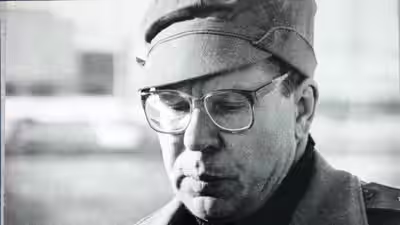
While millions of viewers recognize these words as the defining thesis of the 2019 television series Chernobyl, historical accuracy requires separating the script from the raw archival tapes. The exact phrasing was penned by screenwriter Craig Mazin for the character of Valery Legasov, the chief Soviet chemist tasked with managing the immediate aftermath of the April 1986 disaster.The real Valery Legasov did not utter these exact words during his final testimony. Instead, Mazin listened to hours of audio cassettes that Legasov secretly recorded before hanging himself on 27 April 1988, exactly two years and one day after the Reactor No. 4 explosion.Legasov’s real tapes detailed a systematic campaign of institutional deception enforced by the Soviet state and the KGB. For years, the USSR hid a critical structural flaw in its RBMK reactors (A class of Soviet-designed, graphite-moderated nuclear power reactor) . The control rods, designed to shut down the reactor during an emergency, were tipped with graphite. Under specific conditions, inserting these rods caused an immediate, catastrophic power surge rather than a shutdown. The state classified this information to protect its geopolitical pride, ensuring that plant operators were completely blind to the bomb they were planting for themselves. The energy surge was so huge that it created a peak of around 30,000 megawatts, even though the reactor was designed to operate at only 3,200 MW. Using graphite tips was cheaper for the Soviets but its consequences were very pricey indeed.That first lie came at a devastating cost, forcing the Soviet state to commit even greater atrocities to keep the truth hidden. Thousands of clueless people were deployed into highly radioactive zones with inadequate protection to shovel burning graphite off the roof. Military units were ordered into abandoned villages around Pripyat (the exact site of the plant) to exterminate domestic pets, stray dogs, and farm livestock to prevent the spread of radiation through contaminated fur and meat. Entire topsoil layers were scraped away and buried under thick sheets of concrete.When Legasov broke ranks and exposed the reactor’s design flaws to the international scientific community at a conference in Vienna, the Soviet state moved quickly to punish him. The KGB monitored his movements, stripped him of his scientific honors, and isolated him from his colleagues. His suicide was a desperate strategy to ensure his recorded memoirs would circulate through the scientific underground, bypassing state censors to finally pay the debt his country owed to reality. He was later awarded many honours after his death, including the title of Hero of the Russian Federation in 1996, the Order of Lenin, and recognition from scientific and nuclear communities for his role in investigating the Chernobyl disaster.
The moral mathematics of falsehood
Philosophically, the idea of a debt to the truth is closely linked to responsibility and consequences. It reflects the ideas of thinkers such as Immanuel Kant, who believed that lying damages trust and honest communication. When governments or companies use lies as a regular way to hide the truth, they create a false reality that cannot last forever. Sooner or later, the truth catches up with them.The lasting power of Legasov’s warning comes from its simple message: The truth does not care about politics, power, money, or personal beliefs. A government can claim a disaster is under control, a company can hide environmental damage, and a person can deny their mistakes. But facts do not change. Nature, economics, and human behaviour continue to follow reality, no matter what anyone says.
The ledger of deceit in the modern era
The idea behind this “debt to the truth” can still be seen today. Governments, companies, and other institutions are often tempted to hide bad news or protect their reputation instead of admitting mistakes. But these cover-ups usually make the problem much worse.In business, putting public image ahead of safety can lead to disaster. For example, some car companies have cheated emissions tests, while some aircraft manufacturers have been accused of rushing safety checks to meet production targets. These actions may hide problems for a while, but when the truth comes out, companies can face huge fines, damaged reputations, and major changes.The same warning also applies to public health and social media. False information can spread quickly and convince many people, but it cannot change scientific facts. Hiding or changing data for political reasons only makes the consequences worse when reality eventually becomes clear.Years after the Soviet Union collapsed, former Soviet leader Mikhail Gorbachev said the Chernobyl disaster played a major role in its downfall. He believed the explosion exposed the weaknesses and dishonesty within the Soviet system. In the end, reality broke through years of propaganda, showing that no government or institution can hide the truth forever.For a deeper understanding of this story, the Chernobyl TV series and documentaries about Valery Legasov show the difficult choices made during the disaster and why his warning about the “cost of lies” still matters today.
Lies to cover more lies
To this day, the official death toll recognized from the Chernobyl disaster stands at just 31 people—a rigid figure locked into Soviet records in 1986 that counts only those killed by the immediate physical blast and acute radiation sickness within the first three months. However, because the Soviet state classified medical data and banned doctors from listing radiation on civilian death certificates, international scientists and health organizations estimate the true long-term toll is vastly higher. The World Health Organization (WHO) projects around 4,000 to 9,000 fatal cancers among the most exposed clean-up crews and residents, while independent European studies and environmental groups estimate that radioactive fallout across Europe will ultimately cause between 30,000 and 200,000 premature deaths. Radiation is a slow but certain killer, causing damage that may not appear immediately but can leave lasting consequences.