
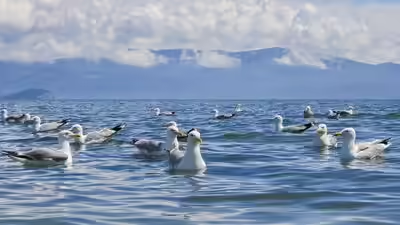
Standing beside a large lake, it is easy to assume that its most impressive feature is its surface area. Yet some lakes hold their greatest secrets far below the waterline. Across the world, there are vast freshwater bodies that stretch thousands of square kilometres, but only one descends to a depth unmatched by any other lake on the planet. Hidden within the landscapes of southern Siberia, this immense body of water has attracted geologists, biologists and climate researchers for generations. Its age, unusual wildlife and extraordinary depth have made it one of the most studied freshwater environments anywhere. The answer to the question of Earth’s deepest lake lies in a place that has been evolving in relative isolation for millions of years.
What makes Lake Baikal the world’s deepest and oldest lake
According to the UNESCO World Heritage Centre, Lake Baikal in south-eastern Siberia is the deepest lake on Earth, reaching a maximum depth of around 1,700 metres. The lake occupies a vast rift basin and covers roughly 3.15 million hectares, making it one of the largest freshwater systems in the world.Depth alone does not explain why scientists regard Baikal as exceptional. The lake is believed to be around 25 million years old, giving it a history far longer than that of most existing lakes. Many large lakes were reshaped or formed during more recent geological periods, while Baikal has persisted through immense environmental changes. Its longevity has allowed ecosystems to develop in ways rarely seen elsewhere.
How Lake Baikal became the world’s largest freshwater reservoir
Lake Baikal contains an astonishing amount of water. As per UNESCO, it holds about 20 per cent of the world’s unfrozen freshwater reserves, a figure that places it in a category of its own among inland water bodies.This vast volume comes from a combination of depth, size and geological structure. More than three hundred rivers and streams feed the lake, while only a single river, the Angara, flows out of it. The result is a freshwater system whose scale is difficult to visualise. In terms of stored liquid freshwater, Baikal contains more water than many countries combined.The lake also plays an important role in regional environmental processes. Its waters influence local climate conditions, support fisheries and sustain ecosystems that extend well beyond the shoreline.
Lake Baikal is a global biodiversity hotspot
Scientists often refer to Lake Baikal as a unique evolutionary environment. According to UNESCO, the lake’s long isolation has produced one of the richest collections of freshwater species found anywhere.Thousands of plants and animals live within the Baikal ecosystem, and many occur nowhere else on Earth. Over millions of years, species adapted to the lake’s specific conditions, creating an unusually high level of endemism. This has made the region particularly valuable for research into evolution, biodiversity and ecological change.Among the most recognised inhabitants is the Baikal seal, the world’s only exclusively freshwater seal species. The lake also supports distinctive fish, crustaceans and microscopic organisms that continue to be studied by scientists seeking to understand how life adapts to isolated environments.
Why Lake Baikal is a UNESCO World Heritage Site
Although its depth often attracts the most attention, Lake Baikal’s significance extends far beyond a numerical record. The site under multiple natural heritage criteria, citing its geological importance, ecological processes and exceptional biodiversity.The surrounding landscape contributes to that value. Protected forests, mountain ranges and nature reserves form part of a broader environmental system linked to the lake. Together, they create habitats for numerous species and preserve one of the planet’s most remarkable freshwater regions.Concerns over pollution and environmental pressures have periodically drawn international attention, reflecting the challenge of safeguarding such an immense natural resource. Even so, Lake Baikal remains one of the clearest examples of how geology, time and isolation can shape an ecosystem unlike any other. Lake Baikal is the deepest lake on Earth, reaching approximately 1,700 metres in depth and containing around one-fifth of the world’s unfrozen freshwater reserves.