
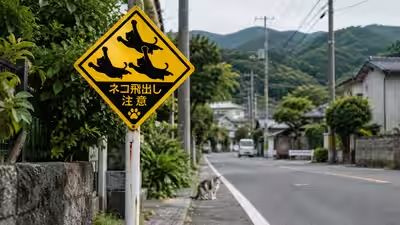
An unusual road-safety idea in Japan is turning an everyday danger into something drivers are unlikely to forget. In parts of the country, signs featuring cats warn motorists that an animal could suddenly run into the road. Some of the designs are deliberately playful, using striking cat illustrations rather than conventional wildlife-warning imagery. The idea is rooted in a genuine road-safety concern. Cats can suddenly enter roads while chasing birds or insects, and their sensitivity to noise and light can sometimes cause them to freeze when confronted by a vehicle. Organisations and local authorities have therefore used visual warnings to encourage motorists to slow down and stay alert. The approach has also been adapted for wildlife conservation, including efforts to protect Japan’s endangered Tsushima leopard cat from road traffic.
Japan installs playful signs to warn drivers about cats
One of the most distinctive examples came from Yellow Hat, a Japanese automotive retailer that launched a road-safety campaign focused specifically on reducing cat traffic accidents. As part of the campaign, the company created a cat warning sign designed to catch drivers’ attention and remind them that cats can suddenly enter the road. The design was developed with supervision from a Kyoto University animal psychology research team specialising in companion-animal behaviour. Rather than relying on a standard warning image, the sign attempted to recreate the expression and posture of a cat about to dash into the road. Yellow Hat said the aim was to create a warning that would be particularly effective at attracting attention. The campaign was launched around Cat Day in February 2022, with a sign installed near a school in Tokyo’s Shibuya area.
The playful designs are based on a real danger for cats
Behind the amusing appearance of these signs is a serious problem. Yellow Hat explained that cats can run into roads because of their natural hunting behaviour, particularly when they chase birds or insects. The company also highlighted another difficulty. Cats are highly sensitive to sounds and light, and when confronted by a vehicle they can sometimes become unable to move instead of escaping from the road. That combination can create dangerous situations for both animals and motorists. The campaign therefore encouraged drivers to pay attention to cats while driving and to approach areas where animals may be present with greater care. The unusual artwork was intended to make the warning stand out rather than disappear among the many conventional signs motorists encounter on roads.

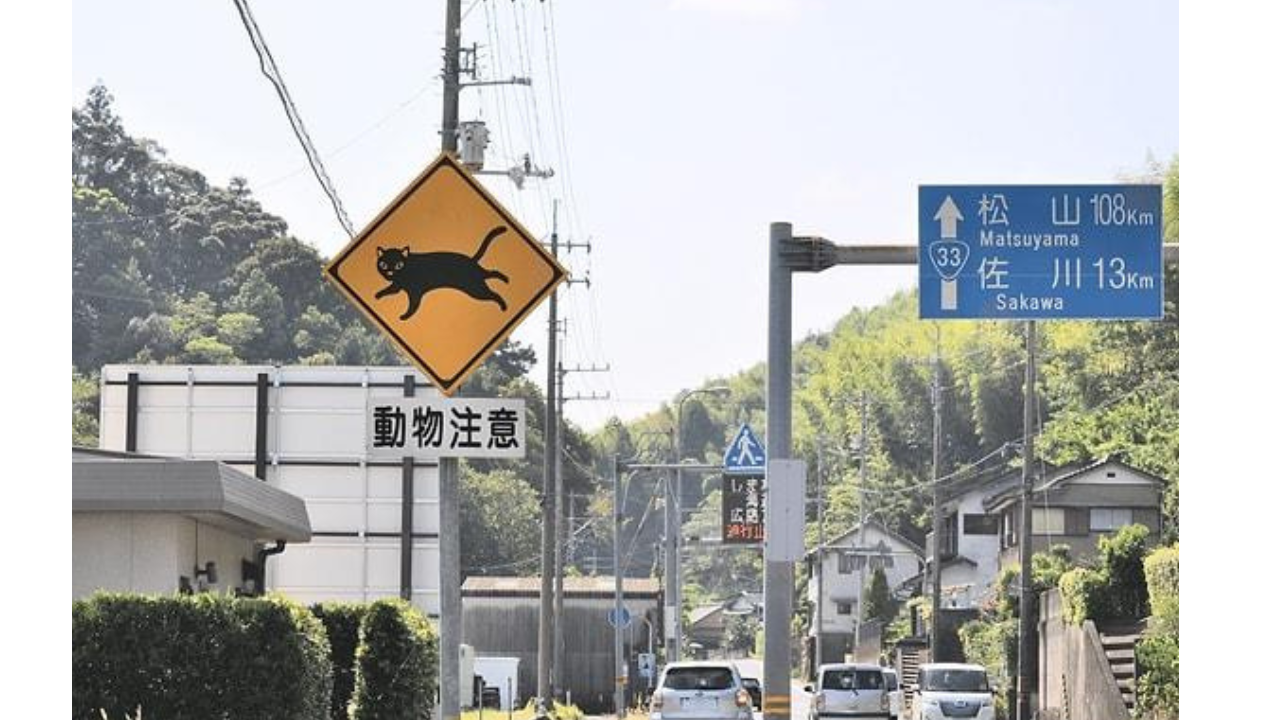
Tsushima uses warning signs to protect an endangered wild cat
The same basic idea becomes even more important on Tsushima, an island in southwestern Japan that is home to the critically endangered Tsushima leopard cat. Japan’s Environment Ministry has repeatedly used warning signs and other measures to reduce vehicle collisions involving the species. The Tsushima Wildlife Conservation Center has installed warning boards near areas where leopard cats are known to occur or where previous accidents have happened. In one documented effort, authorities and local partners installed signs around an area with a history of leopard-cat traffic accidents, including signs designed to reflect vehicle headlights at night. Drivers are encouraged to slow down and remain alert, particularly because the animals are active around roads and can suddenly appear in the path of vehicles.
Japan combines warning signs with other wildlife protection measures
The signs are only one part of a broader strategy. On Tsushima, conservation authorities have also used speed warnings, road markings, fencing, under-road passages and other measures intended to reduce the likelihood of animals entering traffic. The Environment Ministry says road accidents remain one of the most serious threats facing the Tsushima leopard cat, whose population is estimated at around 100 individuals. Historical records have documented numerous traffic-related deaths, while officials continue to run awareness campaigns and monitor accident hotspots. In 2024, the Environment Ministry also conducted a road-safety campaign after a leopard cat was killed during the daytime, highlighting that drivers should not assume the animals are only a nighttime concern.
A simple warning becomes a memorable road-safety message
What makes Japan’s cat-warning signs particularly striking is the way they combine a serious safety message with an approachable visual style. Instead of presenting wildlife as an abstract road hazard, the signs put the animal itself at the centre of the warning. That can make drivers more likely to notice and remember the message, especially when the artwork is unusual enough to stand out from conventional road signage. But the signs should not be mistaken for evidence of a single nationwide programme requiring cat-warning signs on Japanese roads. They represent different local and organisational efforts, ranging from campaigns aimed at ordinary domestic cats to conservation measures protecting endangered wild cats. Together, they show how a simple roadside warning can be made more memorable while addressing a very real problem.