
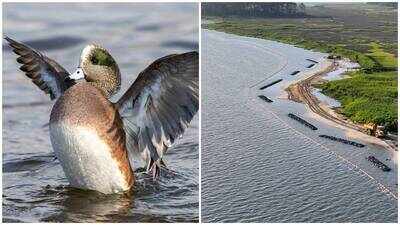
Virginia has completed a major shoreline restoration project on Ragged Island, helping rebuild wetlands and oyster habitat while reducing the amount of sediment and nutrients entering the Chesapeake Bay.The project, funded with $8 million from NOAA Fisheries’ Office of Habitat Conservation, was carried out by the Virginia Department of Wildlife Resources and Ducks Unlimited. According to NOAA Fisheries, project partners installed breakwater structures along 1.09 miles of shoreline to protect the marsh from erosion and restore habitat.
Ragged Island shoreline has faced decades of erosion
Ragged Island is a 1,500-acre brackish marsh where the James River meets the Chesapeake Bay. For decades, wind, waves and rising sea levels have gradually eaten away at the shoreline.Since 1937, hundreds of feet of marsh have disappeared. In some areas, erosion has left exposed walls of black soil several feet high, while saltwater has killed trees and other vegetation farther inland.The loss of marsh has also contributed to sediment and nutrient pollution entering the Chesapeake Bay. This can fuel algal blooms, reduce water quality and create conditions that are harmful to fish and other marine life.“In the past, when I drove along the shoreline in my boat, the water looked like chocolate milk,” said Chad Boyce, a fisheries biologist with the Virginia Department of Wildlife Resources.“Suspended sediment can cause their gills to be irritated and fish often leave these areas to seek better water quality. Turbid water also makes it difficult for predator fish like red drum to find prey,” he added.
Breakwaters are helping rebuild the shoreline
In 2025, construction crews installed 62 low rock breakwaters offshore from the marsh. The structures reduce the energy of waves before they reach the shoreline while still allowing tides, fish and other aquatic species to move through gaps between the rocks.Excavators placed sand behind the breakwaters, creating shallow mounds known as “tombolos”. These areas trap sediment and gradually build new marsh habitat.The project has created approximately 2.6 acres of new marshland and 2.2 acres of oyster reef. The restored areas provide habitat for fish, crabs and other wildlife while helping protect existing marsh.The breakwaters are also keeping about 260 tons of sediment and nutrients from entering the Chesapeake Bay each year.Overall, the project is expected to prevent more than 500,000 pounds of suspended sediment, 70 pounds of nitrogen and 400 pounds of phosphorus from entering the bay annually.
Baby oysters are already growing
A visit to the project site in May 2026 showed early signs that the restoration is working. At low tide, baby oysters could be seen growing on the reef shelves, while sand was accumulating behind the breakwaters.Cordgrass planted along the shoreline is also taking root. As the plants grow, their roots will help hold sediment in place and strengthen the new marsh.The developing oyster reefs are expected to provide important habitat for a variety of fish.“Along with the fisheries habitat in the marsh, the new oyster reefs are a mecca for fish,” said David Norris, regional wildlife manager for the Virginia Department of Wildlife Resources.“Baby fish love the structure of oyster reefs where they can get in and hide. A lot of the commercially viable fish populations will use it — red drum, croaker, flounder — along with other species,” Norris added.Striped bass, river herring, blue crabs and even endangered Atlantic sturgeon can also use the habitat as it continues to develop.
Restored marsh could benefit birds and wildlife
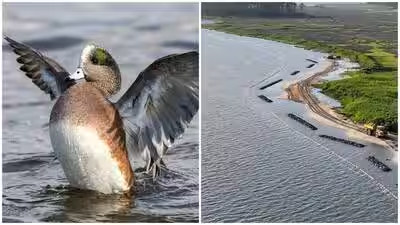
The restoration is expected to provide benefits beyond fish and oysters. As submerged aquatic vegetation returns, it could create additional feeding habitat for waterfowl.“Submerged aquatic vegetation is probably the most important food resource in the Chesapeake Bay for waterfowl,” said Ed Farley, manager of conservation programs for Ducks Unlimited.“As the marsh goes away, really important habitat for wildlife also disappears,” he added.The restored area could eventually attract waterfowl species including canvasbacks, greater scaup and blue- and green-winged teal.
Project could reduce pollution in Chesapeake Bay
Shoreline erosion in watersheds that feed the Chesapeake Bay accounts for approximately 57% of all sediment entering the bay, according to the Chesapeake Bay Program.The sediment can contribute to algal blooms that reduce oxygen levels in the water and place additional stress on marine life.“The Chesapeake Bay has had issues for the last 50 years with algal blooms caused by sedimentation,” Norris said. “Algal blooms can lead to low oxygen conditions, and cause major stress or even kill the organisms living there.”By slowing erosion and trapping sediment, the Ragged Island project is helping address part of that larger problem.
Restoration also stores carbon and reduces flooding
The restored marsh is expected to provide climate and flood protection benefits as well. Wetlands store carbon in their soils, preventing it from being released when the land erodes.“We are also storing hundreds of thousands of tons of carbon right in this area that would have been released to the atmosphere as soon as it eroded away,” Norris said.“Not only are we protecting existing carbon, but every year there’s more carbon being added to the marsh,” he added.The marsh also helps reduce flooding around nearby properties. During heavy tides and storms, wetlands can absorb and hold water, reducing the amount that reaches surrounding neighborhoods.
‘It’s really fun to see’
The restoration has also helped improve opportunities for fishing and hunting in the area.“I’ve heard that the fishing’s been excellent since the project’s been completed,” Farley said. “It’s really fun to see.”Norris said the project’s location makes its progress particularly visible to the public.“I’m incredibly proud of this project, not only because of the habitat we are protecting but also because of the location,” he said.“We’re at the foot of the James River Bridge across from Newport News, Virginia. Thousands of people drive across the bridge every day and can see the work we’re doing. Not only do people get to see it, but they also get to use it,” Norris added.NOAA Fisheries is funding dozens of habitat restoration projects across the Chesapeake Bay. Together, these efforts aim to rebuild habitat for fish, oysters, blue crabs and other marine species while supporting the communities, fishing activities and tourism industries that depend on a healthy bay.