
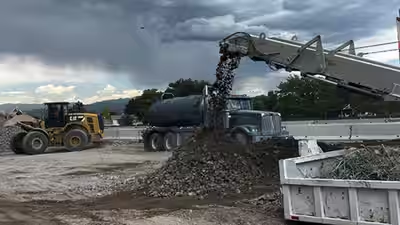
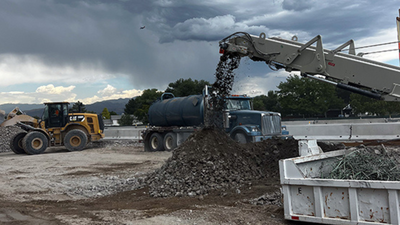
What if an old highway could become part of the new one? In Utah, that is exactly what happened. The Utah Department of Transportation (UDOT) recycled around 15,000 cubic yards of concrete from the old Bangerter Highway in 2024, crushing it on site and reusing it as road base for new highway interchanges. The amount of concrete was roughly equivalent to the volume of two Goodyear Blimps, according to UDOT. Rather than sending the decades-old pavement away as construction waste, crews processed it where it was removed, reducing the number of truck journeys needed to transport the material.
A 30-year-old highway gets a second life
The concrete came from sections of Bangerter Highway that had been in place for about three decades. As part of a major upgrade, crews needed to remove portions of the old roadway to make way for new freeway-style interchanges. Instead of treating the demolished pavement as waste, UDOT turned it into raw material for the replacement infrastructure.The recycling process took place over roughly five months. Heavy equipment first broke the existing concrete into manageable pieces. The material was then fed into a large crushing machine, where it was reduced to smaller fragments. A magnet inside the crusher separated the steel reinforcing bars, or rebar, from the concrete. The recovered metal was also recycled. The crushed concrete was subsequently processed into road base, the structural layer placed beneath pavement and other roadway surfaces. In effect, part of the old Bangerter Highway became the foundation for its replacement.
Why recycle concrete on site?
Construction projects can generate enormous quantities of material that must otherwise be hauled away. Moving that material requires repeated truck trips, adding transportation costs, traffic and fuel consumption.By crushing and reusing the concrete at the construction site, UDOT avoided transporting thousands of cubic yards of material elsewhere. The agency said the approach was intended in part to reduce truck trips around the project area.The project also demonstrates how demolished infrastructure can become a resource rather than simply entering the waste stream. Concrete and asphalt are among the major materials used in road construction that can be recovered and reused, although the exact recycling process depends on the material and project.
The bigger Bangerter Highway transformation
The concrete recycling was part of a much larger effort to transform Bangerter Highway, a major north-south route through Salt Lake Valley. For more than a decade, UDOT has been working to replace traffic-signal-controlled intersections along the highway with freeway-style interchanges. In 2024, four interchanges were under construction at 13400 South, 9800 South, 4700 South and 2700 West. The overall programme was valued at about $415.3 million.Bangerter Highway carried roughly 60,000 vehicles a day, making the corridor particularly important to commuters and other travellers in the rapidly growing western part of the Salt Lake Valley. The interchange projects were designed to eliminate additional traffic lights, allowing vehicles to move through the corridor with fewer stops while improving the highway’s capacity and safety. And there was another unusual detail to the construction: some of the material being used to build that future highway had already spent decades serving the same road.
From old pavement to new infrastructure
The idea is simple but striking: break down the old road, separate what can be recovered, process it and put it back into the new one. The 15,000 cubic yards of concrete recycled at the 4700 South project therefore did not simply disappear when the old pavement was demolished. Much of it was given another role, this time beneath the infrastructure being built to replace it. It is a small example of a larger shift in construction: sometimes, the material needed to build the next road is already sitting underneath the one being torn down.