
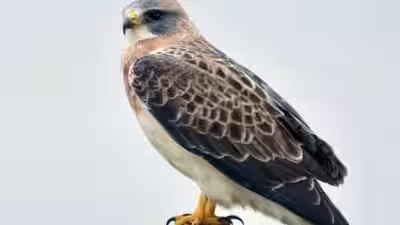
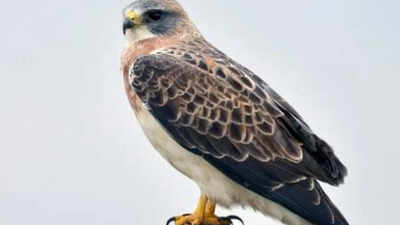
A piece of abandoned farmland in California, once covered with weeds and unwanted grasses, has become home to a rare bird that had not been confirmed nesting in the area for about 30 years. In 2023, conservation workers began restoring 150 acres of land near the Sacramento River. They planted more than 32,000 native trees and plants, and three years later, Swainson’s hawks have been found raising their young there.The discovery was made in Shasta County, where wildlife biologist Tobias Felbeck spotted the birds in a tall sycamore tree. Looking through his binoculars, he found a female hawk in a nest, along with an adult male and two young birds. It was the first confirmed nesting of Swainson’s hawks in the county in roughly three decades, according to conservation organisation River Partners.Swainson’s hawks are listed as threatened under California’s Endangered Species Act. They are more commonly found further south, particularly between Sacramento and Stockton.The finding is encouraging, although scientists say one nesting pair is not enough to confirm that the species is making a wider comeback. What makes the discovery interesting is that other rare birds have also started breeding in the same restored area. The changes offer an early indication of what can happen when damaged land is given the conditions needed to support wildlife again.
What happened to the land before the birds returned?
The restoration site, known as Rancho Breisgau, covers 306 acres near the point where Battle Creek joins the Sacramento River. Much of this land was previously used for farming, particularly walnut orchards. Over time, parts of the property were abandoned, allowing invasive weeds and grasses to spread.The problem was not simply that the land looked neglected. The unwanted plants had made it difficult for native trees and other vegetation to grow naturally. This also meant fewer suitable places for animals to find food, shelter and move between habitats.The location matters because it connects larger stretches of natural land along Battle Creek and the Sacramento River. When one section loses its native vegetation, animals that depend on these connected areas can struggle to move through them.To address this, River Partners began working with the US Bureau of Land Management (BLM) in autumn 2023. The first phase covered 150 acres. In October 2024, a large planting effort was organised with support from the Shasta Chapter of the California Native Plant Society.More than 32,000 native trees and plants were eventually introduced. The aim was to replace the damaged farmland with vegetation that naturally belongs in the area and provide better conditions for wildlife.The project is also intended to benefit fish. Battle Creek is one of California’s remaining streams that support all four runs of Chinook salmon, as well as steelhead. Restoring land beside the river is part of the effort to improve their habitat.

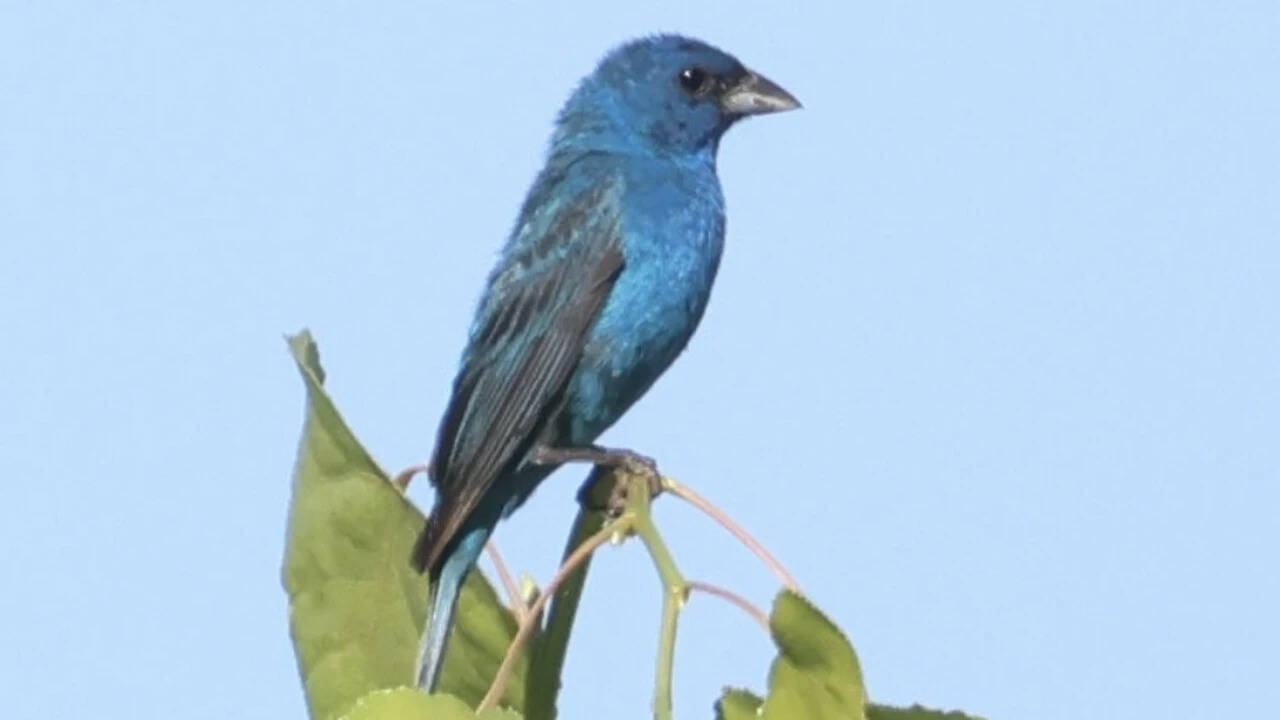
Nesting indigo buntings at Rancho Breisgau near Redding were the fifth recorded in Shasta County (Photo:BLM)
How did the hawks find their way back?
As the newly planted vegetation began growing, insects returned to the area. These included grasshoppers and dragonflies, which Felbeck believes may have helped attract the Swainson’s hawks.The birds could have discovered the location while searching for a suitable nesting site. Although researchers cannot say exactly why they chose it, the presence of food and suitable nesting conditions offers a possible explanation.River Partners Director of Restoration Michael Rogner said the discovery could indicate that the hawks are beginning to move back into parts of their former range.“Seeing a little bit of range expansion into Shasta County could be some evidence that they are recolonizing more of their historic range,” he said.The hawks were not the only surprise. Later that summer, Felbeck heard an indigo bunting, a bird usually found in eastern parts of the United States. When conservationists investigated, they discovered that two indigo buntings were breeding at Rancho Breisgau.The pair was around 500 miles outside the species’ established range. It was also the first confirmed breeding pair in Shasta County, where indigo buntings had previously been recorded only four times.
Rare birds returning elsewhere in California
Rancho Breisgau is not the only restored location where unusual wildlife sightings have been reported. In July 2026, endangered least Bell’s vireos were spotted at two sites in San Diego County. Two appeared at Otay Delta on July 21, while another was recorded at San Dieguito River Park two days later.Both locations had undergone restoration years earlier. River Partners planted 19,000 native trees and plants across 55 acres at Otay Delta in 2014. At San Dieguito River Park, 20,000 were planted across 100 acres in 2018.Least Bell’s vireos were once found across much of California’s Central Valley, but their numbers declined as natural riverside vegetation disappeared. Their survival was also affected by brown-headed cowbirds, which lay eggs in other birds’ nests, leaving those birds to raise their young.The vireos have gradually been expanding their breeding range northwards. Conservationists hope that restoring more connected stretches of natural habitat could eventually help them return to areas where they were previously common.Other animals have benefited from similar efforts. Endangered riparian woodrats were found in a restored forest in the San Joaquin River National Wildlife Refuge in 2024, while riparian brush rabbits have also been reported doing well in restored habitat nearby.