
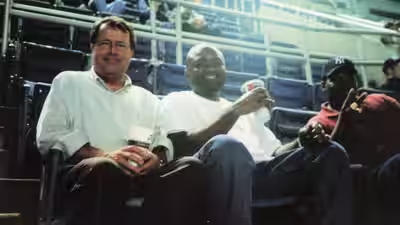
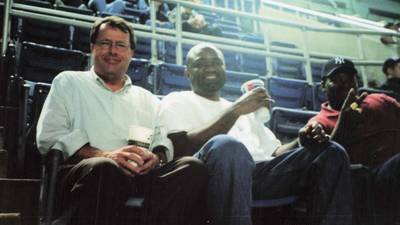
When the World Trade Center was engulfed in smoke and flames on September 11, 2001, a security guard carrying a flashlight and bullhorn appeared to six people who were struggling to find a way out of the South Tower. He was Dereck Lovell, who was filling in that day and had never previously worked on their floor. Lovell guided the group towards a functioning staircase, helping them escape from a building that would collapse minutes later. Nearly 25 years on, the man those survivors credit with saving their lives is facing a different fight. In interviews with PEOPLE, Doug Brown recalled how Lovell helped the group escape, while Lovell revealed that he is battling kidney cancer and now needs a transplant.
A chance assignment on a day that changed everything
Lovell, now 68, was working as a security guard at the World Trade Center on September 11, 2001. He had been filling in as a security guard on the 70th floor of the South Tower when the second hijacked plane struck the building. The impact sent Lovell flying from his chair towards an elevator. He suffered a shoulder injury but was able to continue helping people evacuate. As smoke spread through the tower, he carried a flashlight and bullhorn while directing workers towards a usable staircase.Among those searching for an escape route were Doug Brown and five colleagues from Morgan Stanley. Brown, who was then an associate national sales director, recalled that the group was surrounded by smoke, flames and collapsing ceilings. The stairways they knew about had been destroyed, leaving the group disoriented. Visibility was so poor that Brown could see only about an arm’s length ahead. Then he heard Lovell’s voice.“Follow me,” the security guard told them, according to Brown’s recollection. Lovell led the six people to a staircase only about 15 feet away. Brown had never known the stairwell was there and initially mistook it for a broom closet. That small discovery became critical to their survival.
The guard kept helping even after finding an escape route
Lovell did not simply direct Brown and his colleagues towards the stairs and leave. After helping the group get into the stairwell, he continued searching the floor and found three more employees whom he also guided towards safety before beginning his own descent.For Brown, the encounter remained one of the defining moments of his life. “If Dereck hadn’t been there,” Brown told PEOPLE, “I think best-case scenario we would’ve had dumb luck and found that stairwell.” Brown and his colleagues later managed to identify the security guard who had helped them. Days after the attacks, they tracked Lovell down and invited him to Morgan Stanley’s temporary offices in Jersey City, New Jersey, where they thanked him personally.Lovell recalled the meeting, saying that everyone hugged him and thanked him. The connection between Lovell and Brown did not end that day. The two have remained in contact for almost 25 years.
A second rescue unfolded during the escape
Brown’s own journey to safety also involved another life-saving act. While descending the tower, Brown and a colleague encountered Silvion Ramsundar, an investment executive who had been on the 78th floor. Ramsundar was severely wounded and covered in blood. The two survivors fashioned a makeshift compress from a handkerchief to slow the bleeding from a wound near his heart. They then helped Ramsundar descend roughly 60 floors before reaching an ambulance, only minutes before the South Tower collapsed.Doctors later found that a piece of metal about the size of a playing card had lodged near Ramsundar’s aorta. He also suffered a broken collarbone and a collapsed lung. Ramsundar has previously told PEOPLE that he remains grateful to Brown for helping him survive that morning. The stories of Lovell, Brown and Ramsundar illustrate how survival on September 11 often depended on strangers helping one another amid conditions that were changing by the minute.
Nearly 25 years later, Lovell needs help
The relationship between Lovell and Brown has taken on a new meaning as the 25th anniversary of the attacks approaches. According to PEOPLE, Lovell was diagnosed with kidney cancer last September. He had previously battled prostate cancer that he believed was connected to his exposure to 9/11 toxins.In 2026, both of Lovell’s kidneys were removed. He now undergoes dialysis three days a week while waiting for a kidney transplant. Lovell is listed as a transplant candidate through SUNY Downstate and NYU Langone. He said the waiting process could take years unless a suitable donor can be found through another route.Now Brown is trying to help the man he credits with helping him survive one of the darkest days in American history. He is raising awareness of Lovell’s need for a kidney donor and encouraging people to learn about his situation. Lovell, however, remains modest about what happened in the South Tower. Despite the gratitude of the people he helped, Lovell does not describe himself as a hero. “I did my job that day,” he said.Brown sees it differently. Nearly a quarter-century after Lovell appeared through the smoke with a flashlight and led his group towards a hidden staircase, Brown still believes the security guard gave him the chance to keep living. For Brown, the man who helped him escape the burning World Trade Center was more than a security guard doing his job. He was, as Brown put it, a “guardian angel”. Now, after all these years, the survivors Lovell once helped are hoping they can return the favour.