


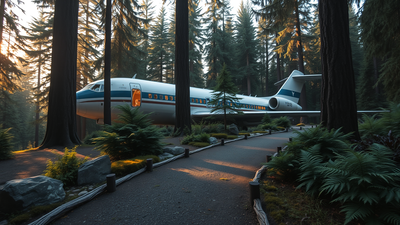
In 1999, retired electrical engineer Bruce Campbell paid 100,000 dollars for a decommissioned Boeing 727-200 that had spent its working life flying for Olympic Airways in Greece, then had the aircraft flown to Oregon and hauled in pieces to a wooded property near Hillsboro, where it was reassembled and slowly converted into his home. More than two decades later, Campbell still lives inside the aircraft’s roughly 1,066 square foot cabin and flight deck, a space that retains much of its original cockpit, wiring and structural design. What began as one engineer’s unconventional housing experiment has since turned into a long-running personal project and public attraction, one that Campbell hopes will encourage others to see decommissioned aircraft as usable buildings rather than scrap.
Why Bruce Campbell chose to live inside a retired jetliner
Campbell, who trained as an electrical engineer and worked in building services and environmental engineering, has said his decision to live inside an aircraft grew out of a long-standing fascination with aeronautical design. According to his own account on Airplane Home, the website documenting his project, Campbell has argued that aircraft represent a far more advanced and durable form of construction than a conventional wood framed house, built to withstand extreme pressure, speed and structural stress in ways ordinary residential buildings never need to.Before buying the 727, Campbell had spent years living simply and avoiding debt, deliberately saving money so that he could eventually purchase a home outright rather than take on a mortgage. His interest in aircraft as living spaces was also shaped by earlier examples of similar conversions, including a Boeing 727 that another owner had turned into a lakeside home in Mississippi during the 1990s, an example that helped convince Campbell his own version of the idea was achievable.
How the aircraft was transported and rebuilt in Oregon
Moving a retired jetliner from a foreign airport to a rural property was itself a significant undertaking. The aircraft was flown from Athens to the Portland Hillsboro Airport before being disassembled, with its wings removed for transport, then towed piece by piece to Campbell’s land and reassembled on site, wings reattached, in what had previously been a walnut orchard. Beyond the roughly 100,000 dollars Campbell paid for the aircraft itself, he spent significant additional funds transporting the plane and preparing a site to temporarily house it during the move.Once in place, Campbell began the slow process of converting the aircraft’s interior into a livable space, work that has continued for more than two decades. Rather than fully renovating the cabin into a conventional home layout, Campbell has largely preserved its original tube-like shape, choosing not to subdivide the space into separate rooms and instead retaining features like the aircraft’s original wiring and structural beams, some of which he has deliberately left visible beneath clear flooring panels.
What life looks like inside the converted 727
Campbell’s home retains many of the aircraft’s original features, including its cockpit, flight controls and rows of aluminium and titanium structural elements. Over time, he has added his own furnishings, basic plumbing and electrical systems, while removing most of the original passenger seating to create functional living space. The aircraft’s roughly 1,066 square feet of usable cabin and flight deck area is supplemented by additional storage space in the plane’s cargo holds and equipment bays.Rather than keeping the project private, Campbell has spent years opening the aircraft to visitors, offering informal tours to curious travellers who make their way to the property. According to his own account, he prefers unannounced, spontaneous visits over scheduled appointments, treating the home as much as a demonstration project as a personal residence.
Do you think living in a decommissioned aircraft is a viable housing option?
3k+ users shared opinion today
5k+ users already voted today
3k+ users shared opinion today
Why Campbell wants to change how retired aircraft are treated
Campbell has framed his project as more than a personal housing choice, describing it as an attempt to demonstrate a broader alternative use for the large number of commercial aircraft retired from service each year. He has pointed out that a significant number of aircraft are decommissioned regularly worldwide, with most simply sent to scrapyards to be dismantled, despite representing well-engineered structures that could, in his view, be repurposed as homes, small businesses or emergency shelters instead.More than 25 years after buying his first retired jetliner, Campbell continues to live in and maintain the aircraft, treating the project as an ongoing demonstration of what he believes decommissioned aircraft could offer if more people were willing to consider them as buildings rather than waste. His home remains one of the more unusual and enduring examples of adaptive reuse in residential architecture, a case study in turning something built to fly into somewhere built to live.