
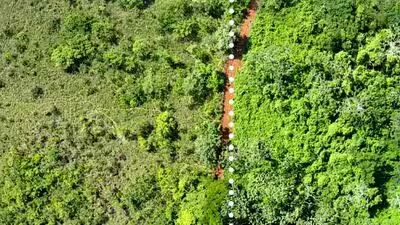
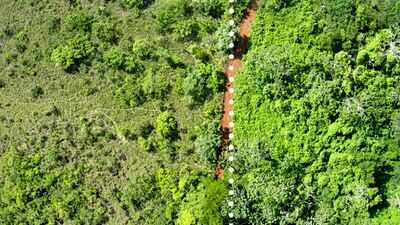
In the late 1990s, an unusual conservation experiment began in Costa Rica when ecologists proposed using orange peels and pulp to help restore a badly degraded piece of land inside a national park.For this, orange juice company Del Oro and ecologists Daniel Janzen and Winnie Hallwachs, worked with the Area de Conservacion Guanacaste (ACG), or Guanacaste Conservation Area. According to Princeton University, the company had recently started production near the northern border of the conservation area and was looking for a way to deal with its orange waste.Janzen and Hallwachs proposed a deal wherein Del Oro would donate some of its forested land to the ACG. In return, the company could take its orange peel waste to a degraded pasture inside the park, where it could break down naturally.After the agreement was signed, around 1,000 truckloads of orange peels and pulp, totalling about 12,000 metric tonnes, were spread across the degraded land.Over the next several years, the area changed dramatically. A place that had once been covered by exposed rock and dead grass became a dense forest filled with trees, vines and other vegetation.
A forest emerges
The site was largely forgotten after the orange waste was deposited. A rival orange juice company, TicoFruit, later sued Del Oro, arguing that the company had defiled a national park. The case reached Costa Rica’s Supreme Court, which ruled in favour of TicoFruit.The legal dispute meant that the site received little attention for about 15 years. That changed in 2013, when Princeton University researcher Timothy Treuer was discussing possible research projects with Janzen.Janzen mentioned the orange-peel site to Treuer and said that although taxonomists had visited the area, it had not received a thorough evaluation. Treuer decided to visit it during another research trip to Costa Rica.When he arrived, the site looked completely different from what he expected. The vegetation had grown so densely that Treuer could not initially see the large sign marking the experiment.“It was so completely overgrown with trees and vines that I couldn’t even see the 7-foot-long sign with bright yellow lettering marking the site that was only a few feet from the road,” Treuer said, as quoted by Princeton.The contrast became even clearer when Treuer compared the orange-peel site with the nearby untreated pasture. The treated area had become a thick forest, while the neighbouring land remained much more open.“It was just hard to believe that the only difference between the two areas was a bunch of orange peels. They look like completely different ecosystems,” Treuer explained.
Researchers assess forest
Treuer worked with Jonathan Choi, who was then a Princeton student studying ecology and evolutionary biology. The researchers compared the area that had received the orange waste with a nearby pasture that had not. They collected and examined soil samples from both periods of the experiment to understand whether the orange waste had changed the soil.They also measured vegetation in both areas. The team established 100-metre-long lines, known as transects, through the forest. Trees growing within three metres of these lines were measured and identified. The same approach was used in the untreated pasture across the road.The differences were substantial. The soil in the orange-waste area was richer in nutrients. The area also had greater tree biomass, more tree species and a more closed forest canopy.The study found a 176% increase in aboveground biomass within the three-hectare area that was examined. Aboveground biomass refers to the wood and other plant material growing above the soil, including the trees.The researchers also found a major difference in tree diversity. While the surrounding areas were dominated by one type of tree, the former orange-waste site had about two dozen species of vegetation.
Wildlife returned to restored area
The changes were not limited to plants. Researchers also found signs of a more developed ecosystem at the site. Among the discoveries was a tayra, a dog-sized mammal related to weasels, Diario AS reported. The researchers also found a huge fig tree that had grown in the area.Jonathan Choi described the site as even more impressive in person than he had expected. “While I would walk over exposed rock and dead grass in the nearby fields, I’d have to climb through undergrowth and cut paths through walls of vines in the orange peel site itself.”The size of the fig tree was another indication of how much the area had changed. Choi said the tree was about three feet in diameter and described it as massive. “You could have had 20 people climbing in that tree at once and it would have supported the weight no problem. That thing was massive,” he said.The researchers published their findings in the journal Restoration Ecology in a paper titled “Low-Cost Agricultural Waste Accelerates Tropical Forest Regeneration”.Timothy Treuer said the experiment was unusual because it showed that forest restoration and waste management could potentially work together. “This is one of the only instances I’ve ever heard of where you can have cost-negative carbon sequestration,” Treuer said. “It’s not just a win-win between the company and the local park; it’s a win for everyone.”The researchers, however, did not suggest that companies should simply take their waste and dump it in natural areas. Treuer specifically warned against such an approach. “We don’t want companies to go out there willy-nilly just dumping their waste all over the place,” Treuer said. “But if it’s scientifically driven and restorationists are involved in addition to companies, this is something I think has really high potential.”