
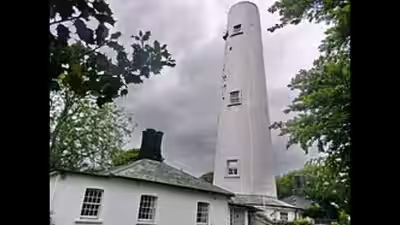
Standing on Berrow Road in Burnham-on-Sea, Somerset, Burnham High Lighthouse looks more like a giant white chimney than a house. Built for Trinity House in the 1830s, the circular brick tower was designed by Joseph Nelson to work alongside Burnham’s Low Lighthouse and guide ships through the shifting waters of the Bristol Channel. Sources differ slightly on its height, with figures ranging from about 30 metres to 33 metres, so it is safest to describe the tower as around 110 feet tall. By the 1990s, its working life was coming to an end. The lighthouse was deactivated and sold by Trinity House, eventually passing to a member of the Rothschild family. In 1996, it was put up for auction, where it failed to reach its reserve. Patrick O’Hagan, then a young television journalist who had been sent to cover the sale, became interested enough to investigate the building himself. He eventually bought it and began the much more difficult task of turning a former lighthouse into a home.
The lighthouse was little more than an empty shell when Patrick O’Hagan bought it
The tower that O’Hagan acquired was very different from the finished house seen today. The Standard, recounting O’Hagan’s story from his earlier Guardian account, describes the building at the time as an empty shell, with its floors connected by vertical steel ladders. The lighthouse had originally been designed for keepers rather than as a conventional residence, and its compact circular floors meant that almost every aspect of the building had to be reconsidered before it could become a home. The conversion eventually involved architect Elspeth Beard, and the work took years rather than happening immediately after the 1996 purchase. One of the major changes was replacing the ladders with a proper staircase, while the sixth floor was removed during the conversion. The completed property has eight floors, with rooms arranged vertically inside the narrow tower. It includes three bedrooms, a living room and a bathroom fitted with a cast-iron roll-top bath. Rather than trying to hide the building’s former purpose, the renovation retained many of its maritime and historic features, including the original lantern room and Fresnel lenses.
Its working life ended in the 1990s, but the tower still acts as a navigational landmark
Burnham High Lighthouse was built in 1832 and originally used a paraffin lamp. Its purpose was closely tied to the difficult coastline around Burnham-on-Sea, where shifting sands and the large tidal range of the Bristol Channel created hazards for ships. The lighthouse was automated in the 20th century, although sources differ on the exact date and on how that automation should be described. The U.S. Lighthouse Society records it as automated in 1920, while local historical material describes it as one of the first lighthouses in England to be automated in the early 1950s. Because of that discrepancy, it is safer simply to say that the lighthouse was automated during the 20th century, rather than calling it Britain’s first automated lighthouse. Its light was eventually deactivated in the 1990s after the Low Lighthouse was recommissioned. The High Lighthouse itself is no longer a functioning lighthouse, but its distinctive red stripe continues to serve as part of a day range used for coastal navigation. The building was also listed Grade II by Historic England on May 31, 1985, recognising its architectural and historic importance.
The former lighthouse eventually became a holiday home
O’Hagan’s unusual conversion eventually turned Burnham High Lighthouse into a property that could earn money as well as provide a place to stay. When the lighthouse was marketed for sale in 2018, Country Life reported that it was being operated as a holiday let with an occupancy rate of around 90 per cent and an annual income of about £50,000. Those figures belong specifically to the 2018 property listing and should not be treated as current earnings. At the time, the eight-storey home was being offered with its original lighthouse character intact, including the lantern room and views across the Bristol Channel towards South Wales and Exmoor. The property was listed for £575,000 by Country Life, while other contemporary reporting gave a guide price of £525,000. What makes Burnham High Lighthouse unusual is not simply that an old lighthouse became a house. It is that the building’s original form dictated almost everything about the home that came after it. The tower remains narrow, circular and vertically organised, with its former navigation equipment and exterior appearance still recognisable. The structure that once helped ships navigate the Bristol Channel is now a private residence and holiday property, but it has not been stripped of the features that made it a lighthouse in the first place. Nearly two centuries after it was built for Trinity House, Burnham High Lighthouse continues to stand as a landmark on the Somerset coast only now, people climb its stairs to reach a bedroom or a Victorian-style bath rather than to tend a light.