
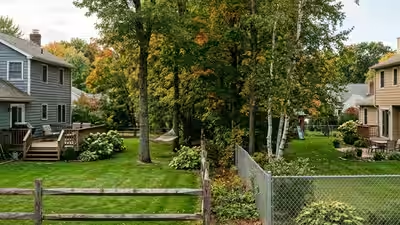
A New York couple who bought their home in 1996 believing that a line of trees marked the boundary with their neighbour’s property have spent years fighting over the same stretch of land. What began as a disagreement over where one property ended and the other began eventually involved allegations of trespass and surveillance cameras recording their backyard.Nearly 30 years after the purchase, a New York appeals court has revived the couple’s privacy claim after they alleged that their neighbours’ cameras captured thousands of images and videos, including footage of their swimming pool and young daughter.According to details of the case available on Justia, the ruling, delivered on Thursday, concerns Timothy J. Riley and his co-plaintiff, who own a home in the Town of Malta, Saratoga County, and their neighbours, John C Daly and his co-defendant. Both properties are part of a four-plot residential development, with the Rileys living on the northern side and the Dalys to the south.The Rileys purchased their property from the developer in December 1996. At the time, they understood that the trees between the two plots marked the boundary. The original neighbour appeared to share that understanding. He watched them maintain the wooded area on their side and later helped them build a garage about 15 feet from the trees.Things began to change in 2004 when the neighbour sold his property to the Dalys. Two years later, the new owners built a chain-link fence between the tree line and the Rileys’ garage. The Rileys believed the fence stood on their land. In 2011, they installed their own fence about two feet away. Over time, the disagreement grew into a dispute involving approximately 230 feet of the boundary.
Disagreement over trees led to surveillance cameras
By 2018, the dispute had reached the courts. Both households accused each other of wrongdoing in the contested area. The Rileys wanted the boundary they had recognised for years to be legally accepted, while the Dalys maintained that the land belonged to them.But the disagreement was no longer limited to fences and property lines. The Dalys had also installed surveillance cameras, which became a major part of the Rileys’ lawsuit.The Dalys told the court that they had installed the cameras to monitor their property following alleged incidents of trespass, theft and harassment. They maintained that the purpose was to prevent further problems, not to harass their neighbours.The Rileys, however, raised concerns about what the cameras were recording. They submitted photographs showing their backyard and swimming pool, including an image of their daughter, who was a minor.They also claimed that information obtained from one of the cameras and during the legal proceedings showed that thousands of photographs or videos had been captured. According to them, the recordings extended beyond the disputed strip of land into other parts of their backyard.
Why court allowed privacy claim to continue
New York has a law that protects homeowners against certain types of unwanted surveillance by neighbours. It allows people to seek damages if cameras are installed on adjoining property to record activities in their backyard without written permission and with the intention of harassing, alarming or threatening them.The lower court had earlier dismissed their privacy claim. However, the appeals court disagreed, finding that the photographs and allegations about the recordings raised questions that needed further examination and reinstated the Rileys’ invasion of privacy claim.
What happened to the original property dispute?
While the cameras became an important issue, the question that started the disagreement remained unresolved: Where exactly was the boundary between the two homes?The Rileys argued that the tree line should be recognised because it had been treated as the boundary for years. Under New York law, a boundary accepted by neighbouring owners for more than 10 years can, in certain circumstances, become legally recognised.However, the court found that the Rileys had not provided enough evidence to establish that both households had accepted the trees as the boundary for the required period. The Dalys’ decision to build a fence on the Rileys’ claimed side of the trees also raised doubts about such an agreement.The Dalys, meanwhile, relied on land surveys to support their ownership claim. But the Rileys pointed out differences between the surveys, arguing that these could shift the boundary by approximately 10 feet.They also alleged that wooden survey stakes and the original natural boundary had been removed before a surveyor inspected the property in 2018.The appeals court found that these differences could not be ignored. It thus overturned the lower court’s decision to settle the boundary according to the Dalys’ survey.Another disagreement involved allegations that the Rileys had cut or removed trees from the disputed land. The judges found that this issue also required further examination because ownership of the area had not been conclusively established.