
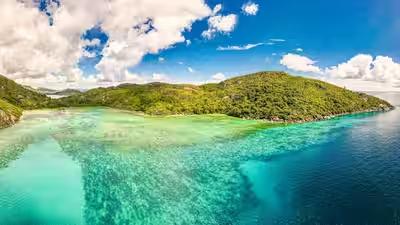
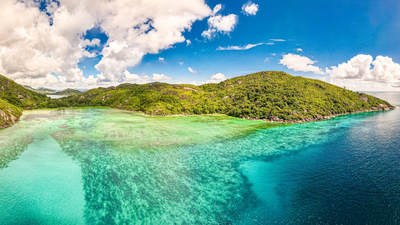
In 1987, British naturalist Ian Bullock arrived on remote Aride Island in the Seychelles to become its first professional warden. Just one year later, the groundwork he established helped make possible an important conservation project: 29 endangered Seychelles warblers were moved to the island, creating a second population and helping save the species from extinction.Details of Bullock’s pioneering work were recorded in his obituary in The Guardian. The scientific details of the warbler transfer were published by Cambridge University Press in Bird Conservation International, while BirdLife International maintains historical records of the species.Before the 1988 transfer, the entire global population of the Seychelles warbler (Acrocephalus sechellensis) lived on just one island, Cousin Island. The population had once fallen to only 26 birds.Conservationists saw the danger of having the entire species in one place. A disease outbreak, natural disaster or other environmental problem could have wiped out the whole population. Aride Island had been cleared of introduced predators, making it a suitable location for a second population.
Establishing a conservation base on Aride Island
As Aride’s first warden, Bullock helped create the conditions needed to protect endangered wildlife. His work included monitoring species, mapping habitats, training field staff, stopping poaching and managing visitors.According to Eric Howell’s obituary of Bullock in The Guardian, his work on the isolated island helped create the stable conditions needed for more complex conservation projects.Baseline surveys and habitat management were particularly important. Moving a small population of insect-eating songbirds to a new island carried significant risks, so conservationists needed detailed information about the island’s wildlife and environment before the transfer.Between 23 and 29 September 1988, 29 adult Seychelles warblers were moved by motorboat from Cousin Island to Aride. The birds, 16 males and 13 females, were fitted with color rings so researchers could identify and monitor them.The project became a major success. Data from BirdLife International and studies published in Bird Conservation International show that the Seychelles warbler population has since grown to more than 3,000 birds across several island sanctuaries. The species has also been moved out of the highest threat categories.
A career in field conservation
Bullock spent 25 years with the Royal Society for the Protection of Birds (RSPB), managing remote nature reserves across the United Kingdom and carrying out population surveys of threatened birds. He died from melanoma in March 2025 at the age of 73.His work in the Seychelles also continued beyond his time as a warden. He co-wrote and illustrated Birds of the Seychelles, part of the Princeton Field Guide series, giving researchers and wildlife enthusiasts a detailed reference to the region’s birds.Colleagues said Bullock’s careful fieldwork in places such as Aride helped establish approaches that are now widely used in island conservation.The success of the Aride translocation showed that moving a threatened species from an island where it was concentrated could reduce its risk of extinction. The approach has since been used in other conservation projects across the Seychelles.
A lifetime protecting remote ecosystems
Bullock was born in Cambridge and studied zoology at Bangor University. He began his conservation career in Africa, working with Voluntary Service Overseas in Kenya and the Wildlife Conservation Society of Zambia.He joined the RSPB in 1978 and later managed several important island reserves, including Ramsey Island in Pembrokeshire, Coll in the Inner Hebrides and Fetlar in Shetland.At Ramsey Island, where he was warden from 1993 to 2003, Bullock worked on rat eradication to help endangered Manx shearwaters increase in number. On Coll, he helped develop early recovery plans for the corncrake.From 1990, Bullock also worked as a naturalist guide for Lindblad Expeditions and Noble Caledonia. He led wildlife and research trips to remote areas of the Arctic, Antarctic and Pacific and Atlantic oceans.He was also a skilled wildlife artist. His detailed drawings of seabirds and marine mammals have continued to appear in publications and have been used by conservation charities to help raise money for wildlife protection.Bullock’s work on Aride was only one part of a long career in conservation, but the foundation he helped build there contributed to one of the Seychelles’ most successful bird recovery projects.