
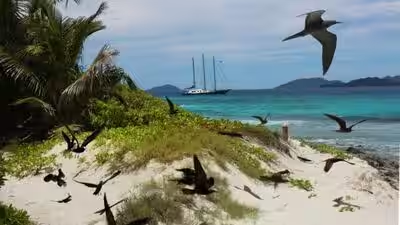
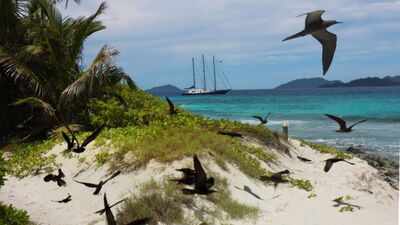
For decades, the small island of Aride in the Seychelles was treated less as a wildlife sanctuary and more as a source of income. Its forests were cleared for cultivation, coconut plantations covered parts of the island and its seabirds became a resource that could be harvested. Sooty tern eggs, in particular, were collected in huge numbers and shipped to other islands. Then, in 1973, British conservationist Christopher Cadbury stepped in.Cadbury, a member of the family behind the Cadbury chocolate company, provided £40,000 to enable the Society for the Promotion of Nature Reserves, now the Royal Society of Wildlife Trusts, to acquire Aride and protect it as a nature reserve. That sum would be equivalent to almost £1 million today, according to Silhouette, the Air Seychelles magazine. More than five decades later, the 74-hectare island has become one of the most important seabird colonies in the Indian Ocean. Around one million breeding seabirds belonging to 10 species are now associated with Aride, while its restored forests provide habitat for endemic birds, reptiles and plants. The transformation is striking because Aride was far from untouched when Cadbury helped secure its future.
From exploitation to protection
Aride is the northernmost of the granitic Seychelles islands and lies roughly 10 km from Praslin. Its landscape was dramatically altered during the period when the island was commercially exploited.Research published in Bird Conservation International records that Aride was once a coconut plantation. Vegetation on the hills was also repeatedly cleared to create suitable breeding grounds for Sooty Terns, whose eggs were harvested. The coconut plantation was eventually removed and native vegetation was gradually restored after the island was purchased in 1973.The scale of egg collection had been enormous. Historical records show that between 1948 and 1967, an estimated 171 to 173 cases of Sooty tern eggs were exported from Aride every year on average. In 1954 alone, as many as 312 cases, containing about 225,000 eggs, were harvested. Commercial egg collection finally stopped in 1967.The island had also suffered from the introduction of animals such as cats. Its original forest had been cleared and seabird eggs were collected and transported to Praslin. Yet Aride had one extraordinary advantage: rats never reached the island. Its lack of streams also made it less attractive to permanent settlement, while difficult landings limited access. Those factors helped preserve a foundation from which the island’s ecosystem could eventually recover.
A different kind of investment
Cadbury recognised that potential and invested in protecting an ecosystem. After the acquisition, conservation efforts began to reverse decades of ecological damage. Coconut palms were removed and native trees were replanted. The vegetation on the island gradually recovered, creating habitat for species that had disappeared or declined.Aride was subsequently given legal protection as a Special Reserve under Seychelles law. Sources differ on the exact year of the designation, with conservation records citing 1975, while other accounts record the formal Special Reserve status as 1979.The management of the island eventually moved into local hands. The Island Conservation Society, a Seychelles-based conservation organisation, took over responsibility for managing Aride, and today its conservation staff are the only permanent inhabitants of the island.
An island ruled by birds
Today, Aride supports approximately one million breeding seabirds across 10 species, making it one of the most significant seabird colonies in the Indian Ocean. The island is particularly important because its value is not limited to sheer numbers. It supports several species that are endemic to the Seychelles, meaning they are found nowhere else in the world.Among them is the Seychelles magpie-robin, a bird that once came dangerously close to extinction. A 2016 study in Bird Conservation International notes that the species had fallen to just 12 individuals on a single island in 1960. By 2015, intensive conservation programmes had helped increase its population to around 280 birds across five islands. Aride is among the islands involved in the species’ recovery programme.The island also provides habitat for Seychelles fodies, Seychelles blue pigeons and Seychelles sunbirds, along with reptiles and a remarkable variety of plant life. The Key Biodiversity Areas database records about 100 vascular plant species on Aride, including species of particular conservation importance. Its importance extends beyond land. The protected area includes marine habitat around the island, adding another layer to its ecological significance.
What £40,000 changed
The story of Aride is ultimately about what can happen when land is valued for something beyond its immediate commercial potential. In the early 20th century, seabirds were a resource to be harvested and forests were cleared for plantations. By 1973, the island had already endured decades of exploitation. Cadbury’s intervention changed its trajectory.Instead of another plantation, Aride became a protected refuge. Instead of eggs being removed by the thousands, seabirds were allowed to breed. Instead of cleared hillsides, native vegetation returned. The transformation did not happen overnight. It required decades of habitat restoration, monitoring and protection. But the result is an ecosystem where wildlife has reclaimed the island on a remarkable scale.More than 50 years after Christopher Cadbury helped secure Aride for conservation, the island is no longer defined by what humans can extract from it. It is defined by what can survive there. And every year, roughly a million breeding seabirds provide perhaps the clearest measure of how dramatically that decision changed the island’s future.