
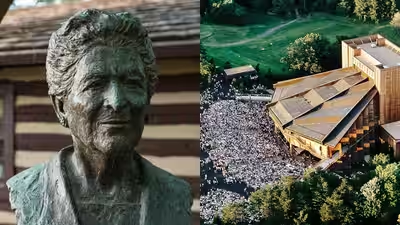
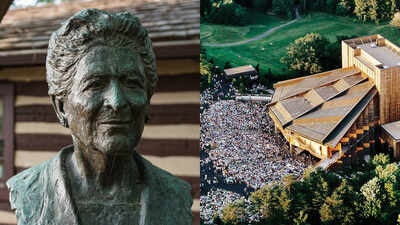
Before it became a stage beneath the stars, Wolf Trap was simply a Virginia farm. But in the 1960s, one woman had a very different dream for the land: a place where music, theater and the performing arts could be part of America’s national park system. Meet Catherine Filene Shouse, a prominent Washington arts advocate and a political insider. A generous gift of land and money helped her vision become a reality: Wolf Trap National Park for the Performing Arts in Fairfax County, Virginia, the only national park in the United States dedicated to the performing arts. Scroll down to read the details.
A vision born of an arts renaissance
According to the Wolf Trap website, Shouse came up with the idea of a performing arts park in 1964, when excitement about culture was building in Washington, DC. The movement had been gathering momentum during the administration of President John F. Kennedy who championed the arts as an important aspect of American public life. One early harbinger of that change occurred at Kennedy’s 1961 inauguration, when the poet Robert Frost was asked to take part in the ceremony. Shouse was well-connected in Washington’s political and cultural circles. Later, she sat on the original Board of Trustees of the Kennedy Center, which gave her the interest and contacts to take on an ambitious national arts project. According to experts, her proposal came at a time when public institutions were looking for ways to open up the arts to wider audiences.
Secretary Udall’s Role in Support of the Arts

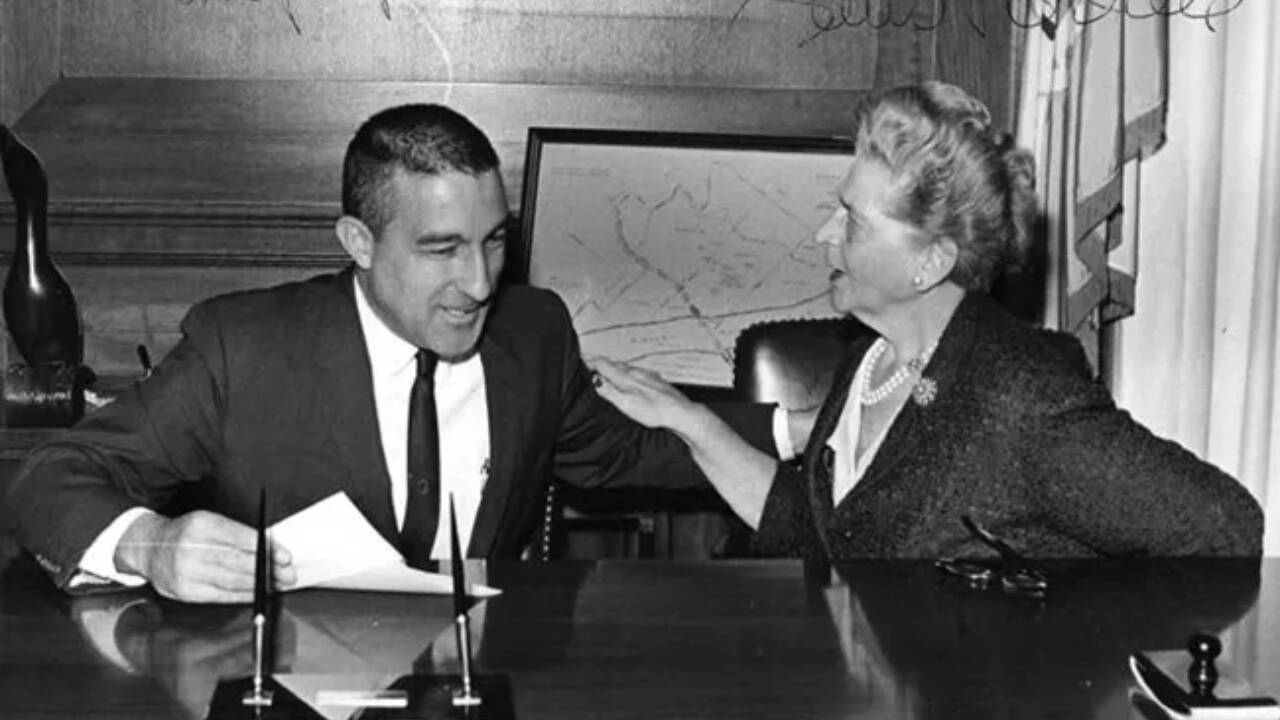
Secretary Udall and Catherine Filene Shouse Image Courtesy: Schlesinger Library at the Radcliffe Institute, Harvard University
Another major player in Washington’s cultural transformation was Secretary of the Interior Stewart L. Udall. Udall, who worked for both Kennedy and President Lyndon B. Johnson, advocated for more government funding for the arts and humanities. His work also included historic venues and major institutions of culture.One of his significant undertakings was the reopening of Ford’s Theater. The building had been used mainly as a museum since President Abraham Lincoln was assassinated in 1865 and its stage had been closed for more than a century. Working with Senator Milton R. Young, Udall secured funds for rehabilitation. Ford’s Theater was eventually reopened in 1968, 103 years after the assassination. Udall was also involved in the development of the eventual John F. Kennedy Center for the Performing Arts.
New stages were filling Washington
Shouse’s idea came during a broader expansion of performing arts venues across Washington. The Merriweather Post Pavilion in Columbia, Md., was built and opened in 1967. The outdoor space was associated with the National Symphony Orchestra, and had permanent seating and a large lawn. Washington already had major venues, such as Constitution Hall and the Carter Barron Amphitheater. Constitution Hall opened in 1929 and became an important concert hall. The Carter Barron Amphitheater opened in Rock Creek Park in 1950. In its heyday, the outdoor theater featured some major performers including Ella Fitzgerald, Louis Armstrong and Diana Ross and the Supremes among others. It is run by the National Park Service. But Shouse wanted something else: a permanent performing arts destination attached directly to the national park system.
Virginia Farm to National Park
According to the website, before she approached the National Park Service, Shouse had offered Wolf Trap Farm to the National Symphony Orchestra as a performing arts park. The proposal was rejected partly due to concerns about the property’s accessibility. Shouse didn’t give up. Eventually her plan gained support from Washington’s cultural and political establishment. On October 15, 1966, Congress approved legislation establishing Wolf Trap Farm Park in Fairfax County, Va.The legislation designated the site as a location for performing arts, educational programming and recreation. At the age of 71, she donated nearly 100 acres of her farm and contributed to building an amphitheater, turning private land into a public cultural center.
A stage like no other national park
Wolf Trap eventually became known for its outdoor performances and its unique relationship between nature and the arts. The park’s most famous venue, the Filene Center, offers shows in an open-air setting where music and theater are enjoyed by audiences steeped in the landscape. It was a curious extension of the national park idea to create it. Wolf Trap showed that the arts themselves could be the main reason for a national park, not simply the preservation of historic sites, dramatic landscapes or natural wonders. Today, the Washington area has an immense variety of cultural venues ranging from historic theaters to concert halls, clubs and large entertainment arenas. These include the National Theater, Howard Theater, the Fillmore, 9:30 Club, Capital One Arena and other major performance venues. However, Wolf Trap remains the only national park in the United States devoted to the performing arts, advancing the concept Shouse first put forth more than six decades ago. What started as a woman’s dream for a Virginia farm became a national treasure for audiences to enjoy performances under the open sky.Images Courtesy: Wolf Trap Instagram and Dumbarton Oaks