
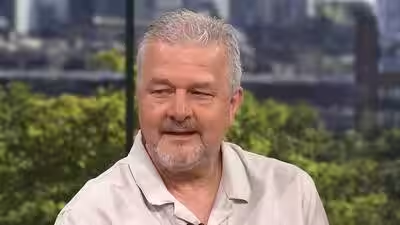
David Stevenson has spent more than six decades searching for answers about his past after he was abandoned as a two-day-old baby in London in 1960. He recently appeared on This Morning alongside his cousin Saskia Van Der Hoeven, where he opened up about his extraordinary journey to discover his biological family more than six decades after being abandoned as a baby.Stevenson was found in the corridor on the third floor of a block of flats when he was just two days old. Although his adoptive parents told him from childhood that he had been adopted and found as a baby, he said he did not think much about his past while growing up.
Becoming a father changed everything for David Stevenson
Stevenson revealed that his desire to find his biological parents became stronger after he became a father himself. Holding his son for the first time made him think differently about his own story.“As you saw in the programme that was shown last night, it was really the moment when I became a father and I held my son for the first time,” he said.“For a lot of abandoned children and adoptees generally, it’s that moment when it changes from just being you to also being a parent yourself. That really drove me to want to learn more about where I’d come from,” he added.Stevenson also said his adoptive parents were supportive of his decision to search for his biological family. He described his childhood as a happy one and said he had no resentment towards his birth mother.“I always realised that my birth mother must have gone through a very difficult time in her life. She was probably a young woman, and I sort of imagined the circumstances,” he said.
David says he had no resentment towards his birth mother
Reflecting on the social circumstances of the late 1950s and early 1960s, Stevenson said being an unmarried mother was heavily stigmatised at the time.“In the late 50s, early 60s, you know, being an unwed mother was truly a terrible thing,” he said.He added that the social stigma made it particularly difficult for young women to seek help.“It made it very difficult for young women in that situation to reach out and get help,” Stevenson said.In 2009, Stevenson and his wife also launched a national campaign to find more information about his biological family. Despite investigating people who had lived in the block of flats where he was found and following various clues, the campaign initially failed to produce answers.
DNA helped David find his biological family
The breakthrough eventually came through DNA research conducted as part of Long Lost Family. His cousin Saskia Van Der Hoeven explained how the family discovered the connection.According to Van Der Hoeven, the programme’s DNA investigation established a connection to the Netherlands. After her aunt and niece provided DNA samples, the family realised that David’s biological mother was likely Petra, Van Der Hoeven’s aunt.She recalled receiving a phone call from her brother with the unexpected news.“My brother called me and said, ‘Saskia, please sit down. I’ve got something to tell you,’” she recalled.The family then created a group chat called “Rainbow Baby David”. When a photograph and newspaper article about the abandoned baby were shared, Van Der Hoeven said she immediately recognised the connection.“When I saw it, there was no doubt in my mind,” she said.Van Der Hoeven also said Petra had worked as an au pair in France and later in London, which matched the timeline of David’s abandonment.
David was heartbroken to learn his biological mother had died
While the DNA discovery finally answered some of his questions, Stevenson faced another emotional revelation: his biological mother had already died.He said meeting his newly discovered relatives in Rotterdam was nevertheless an incredibly meaningful experience. Van Der Hoeven helped him build a picture of the mother he never had the opportunity to meet.“I really got a picture of a woman who was very kind and generous and loving, and it just makes me very sad that I never got to meet her,” Stevenson said.Petra’s sister is still alive and can provide more information about her life and personality, giving Stevenson an opportunity to learn more about his biological mother.
‘It was an incredible experience’
Stevenson said his newly discovered family welcomed him warmly, despite having only learned about his existence weeks earlier.“The afternoon we spent together when I met them was such a joy because this family was incredibly welcoming and accepting of me,” he said.“They’d only known about me literally for weeks, whereas I’d had years to come to terms with the idea of a birth mother. So, it was an incredible experience. It really was, and one that will stay with me for the rest of my life,” he added.Stevenson is now planning to return to Rotterdam to meet more of his biological relatives.“I’m planning to go back to Rotterdam in a couple of weeks to meet more of the family, more of my cousins. So, it’s very, very exciting,” he said.For Stevenson, the decades-long search has finally brought a sense of peace and a chance to build new memories with the family he never knew he had.