
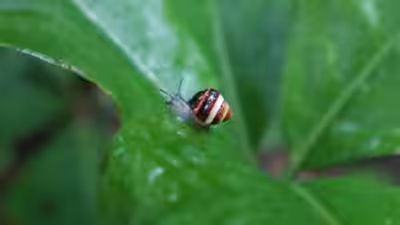
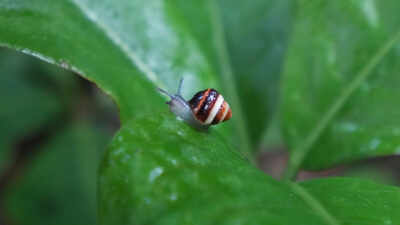
For more than three decades, the tiny Achatinella fuscobasis (snail) existed only under human care. Then, in a carefully prepared corner of O‘ahu’s Ko‘olau Mountains, the rare Hawaiian tree snail finally encountered its natural home again. The first group was recently released into the Honolulu Watershed Forest Reserve after more than 33 years in captivity. The reintroduction marks an important step in the effort to bring a species back from the brink after it was believed to have disappeared from the wild in 1991, adds the report. The release was carried out by Hawaii’s Department of Land and Natural Resources Snail Extinction Prevention Program (SEPP), alongside the U.S. Fish and Wildlife Service, University of Hawai‘i at Mānoa and the DLNR Division of Forestry and Wildlife.
A conservation story shaped by an old mistake
As per the release, the snail’s recovery is inseparable from a decision made decades ago. In 1955, Hawaii introduced the rosy wolfsnail in an attempt to control invasive giant African snails. Instead, the predatory species developed a taste for Hawaii’s native tree snails. For species such as Achatinella fuscobasis, the consequences were devastating. By 1991, only 11 known individuals remained. University of Hawai‘i researcher Michael Hadfield collected the final survivors from their known O‘ahu populations and brought them into captivity. That intervention prevented the species from disappearing entirely. What began as an emergency measure eventually became the foundation for a long-term recovery effort.
From 11 snails to more than 1,000
Today, more than 1,000 Achatinella fuscobasis are housed at the SEPP laboratory in Pearl City. The growth in numbers has made it possible to attempt something that seemed impossible in 1991: establishing a wild population again. The new forest habitat is a quarter-acre fenced enclosure designed specifically to keep predators out. Five-foot polyethylene walls, angled flanges, copper wire mesh and a hood barrier help prevent rats, Jackson’s chameleons and rosy wolfsnails from entering. For the captive-bred snails, however, the surroundings will be dramatically different. Instead of controlled laboratory conditions, they will encounter mist, trade winds, cloud cover and sunshine as they gradually adapt to life in the forest.
Five years of preparation
The release itself may have been a single event, but preparing the habitat took years. The conservation team spent roughly five years developing the enclosure and restoring its surroundings. Staff, partners and community volunteers contributed around 600 hours to searching for and removing predators. They also cleared weeds and invasive plants and replanted native vegetation, creating a safer environment for the snails to establish themselves. The enclosure is essentially a protected bridge between captivity and the wider forest: a place where the animals can experience natural conditions without immediately facing the predators that helped drive their species toward extinction.
Building a future in the wild
The reintroduction is only one part of the recovery strategy. Bishop Museum and Honolulu Zoo are also establishing captive snail laboratories, where Achatinella fuscobasis will be reared and made accessible to the public. The conservation programme ultimately aims to maintain both captive and wild colonies. The immediate priority is preventing extinction; the longer-term ambition is more ambitious—to see stable, thriving populations once again living in the forests of O‘ahu.For a species that once stood at just 11 known survivors, its return to the Ko‘olau Mountains is a reminder that conservation can sometimes work on a remarkably small scale. A fenced quarter-acre, a restored patch of native forest and a few thousand tiny lives can represent the beginning of an entire species’ second chance.Image Courtesy: DLNR)