
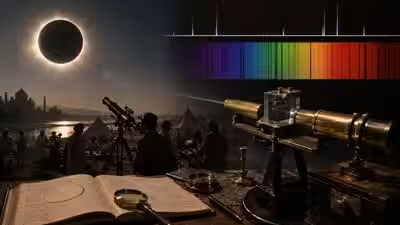
In August 1868, the Sun briefly became a laboratory for astronomers gathered in India to watch a total solar eclipse. Among them was the French astronomer Pierre Jules Janssen, who turned a spectroscope towards the bright prominences rising around the eclipsed solar disc. Their light contained a yellow spectral line that seemed to sit close to the familiar sodium lines, yet did not quite match them. At the time, nobody could say what produced it. The observation would eventually be linked to helium, an element that was then unknown on Earth. But the story is slightly different from the familiar version. Janssen saw the mysterious line, but he did not identify helium, and the substance itself would remain a solar mystery for decades.
How the 1868 solar eclipse revealed a mysterious yellow spectral line
According to the study published in ResearchGate, titled ‘Observations of the total solar eclipse of 18 August 1868 carried out by Jules Janssen at Guntoor, India ’, the eclipse of 18 August 1868 gave astronomers an unusual opportunity to examine the Sun’s prominences through spectroscopy. Instead of relying only on their visible appearance, they could break their light into its component wavelengths and look for the characteristic lines associated with different substances. Janssen was particularly interested in finding a practical way to study these glowing structures even when the Moon was no longer completely covering the Sun. His observations during the expedition proved highly successful, and he developed what later became known as the prominence method.The yellow feature in the spectrum was noticed by the observers during the eclipse, but its exact position was not established at the time. This matters because the line appeared close to the two well-known yellow sodium lines, D1 and D2. It was only after returning to the problem that the English astronomer Norman Lockyer examined the evidence more carefully and concluded that the unidentified feature did not coincide with sodium. He designated it D3, distinguishing it from the sodium doublet, and noted that it had a shorter wavelength. Janssen later confirmed that the line lay very close to the sodium lines but was slightly more refrangible.
Pierre Janssen did not discover helium during the 1868 solar eclipse
It is tempting to reduce the 1868 expedition to the discovery of helium, but the historical record does not support that version. Janssen is often credited with discovering helium during the eclipse, yet he did not. His role was instead tied to his observational skill and to the method he developed for examining the Sun’s prominences. The eclipse gave him the setting in which that method could demonstrate its value.Janssen had also found a way to observe the prominences without having to wait for another total eclipse. His approach involved manipulating the spectroscope so that a particular wavelength could be isolated, producing a monochromatic image of the solar prominence. In later descriptions, he outlined a principle that effectively anticipated the spectrohelioscope and, eventually, the spectroheliograph. The technique was refined in the following decades by astronomers including George Ellery Hale and Henri Deslandres. For Janssen, the significance of the 1868 eclipse therefore extended well beyond one unexplained yellow line.
How Norman Lockyer investigated the mysterious D3 spectral line
The unidentified D3 line continued to attract attention after the eclipse. Lockyer wanted to determine what produced it and worked with the chemist Edward Frankland to investigate whether it might belong to hydrogen. Their laboratory attempts failed to reproduce the line under the conditions they tested. That failure did not make the observation disappear; instead, it strengthened the possibility that the Sun was displaying the signature of something not yet recognised in terrestrial chemistry. Lockyer eventually gave the unknown solar element the name helium, derived from Helios, the Greek personification of the Sun.The naming was made while the element existed only as a spectral clue. There was no sample of helium sitting in a laboratory flask, and no terrestrial mineral had yet yielded the gas. The distinction between seeing an element’s spectral signature and physically isolating the element was an important one. In this case, spectroscopy had pointed towards something apparently new before chemistry had found a way to handle it directly. The yellow D3 line had become evidence for an element whose existence was first inferred from the light of the Sun.
William Ramsay’s discovery confirmed helium existed on Earth
The mystery lasted until 1895, when Scottish chemist William Ramsay extracted helium from the mineral cleveite. This provided the missing terrestrial evidence: the element whose spectral signature had first been recognised in solar observations was also present in material on Earth. The point at which helium was established as a terrestrial element was nearly three decades after the 1868 eclipse.The later history also changes how Janssen’s part in the discovery should be understood. He never claimed helium as his own discovery and appears to have shown little interest in the element’s name for much of his later career. He did eventually refer to helium on several occasions, including in connection with the Académie des Sciences’ Janssen Prize in 1896 and in later lectures about the Sun. His lasting achievement from 1868 was the prominence method that opened a new way of observing the solar atmosphere. The yellow line was part of that story, but helium itself belonged to a longer chain of observations, interpretation and laboratory work that stretched from the eclipse in India to Ramsay’s laboratory nearly 27 years later.