
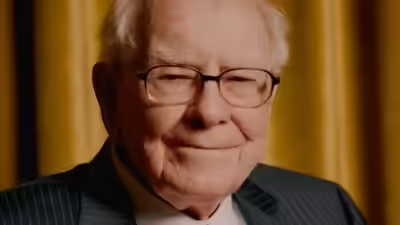
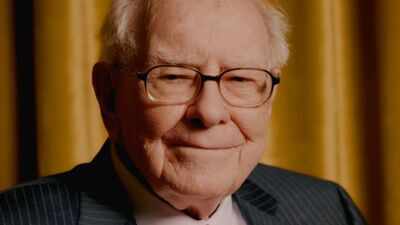
Warren Buffett has spent decades being celebrated as one of history’s greatest investors, building a fortune estimated at around $147 billion through Berkshire Hathaway. Yet the billionaire says the biggest reason for his success was never stock-picking or business instinct alone. Ahead of his 96th birthday, Buffett reflected on a lifetime of investing and argued that luck shaped nearly every stage of his journey, from the family he was born into to discovering the stock market as a child.His latest remarks come as he also reshapes his philanthropic legacy, ending a nearly two-decade giving relationship with the Gates Foundation and setting a new timeline for distributing the rest of his fortune.
Warren Buffett says he owes much of his success to luck
Speaking ahead of his 96th birthday, as reported by Fortune, Buffett said, “Out of eight billion people, I may be one of the 10 luckiest in the world.” He joked that his mind had served him for longer than he felt entitled to expect, describing that as another example of fortune rather than achievement. His comments fit a pattern that has appeared throughout many of his public speeches and shareholder letters over the years, where he has often questioned the idea that success can be explained entirely by talent or determination.Buffett has long argued that the circumstances people are born into often shape their opportunities long before hard work enters the picture. In previous letters to Berkshire Hathaway shareholders, he acknowledged that being born in the United States gave him opportunities that billions of people elsewhere never receive.He has also spoken openly about benefiting from growing up as a white male during a period when social and economic barriers limited opportunities for many others. Rather than presenting wealth as proof of individual brilliance, Buffett has repeatedly said that favourable starting conditions played a significant part in allowing his abilities to develop. Years ago, he introduced the idea he calls the “ovarian lottery” to explain this belief. The phrase refers to the random circumstances of birth, arguing that family background, nationality and timing can influence a person’s future just as much as intelligence or ambition.
A childhood that pointed him towards the stock market
The path into investing began unusually early. Buffett’s father, Howard Buffett, worked as a stockbroker, giving his son access to financial markets while he was still a child. At the age of 11, Buffett bought his first shares, purchasing stock in Cities Service. In an interview with CNBC, he said, “Fortunately I got exposed, partly accidentally, to what I liked to do very early on, and that was just an accident.”“If my father had been a plumber, I would not have.” That early exposure allowed him to discover work he genuinely enjoyed while most children were still years away from making career decisions.
How Buffett built Berkshire Hathaway into a global giant
Buffett’s investing career stretched across several generations before he stepped aside from Berkshire Hathaway’s chief executive role last year. Although he no longer leads the company day to day, he continues to take an active interest in its affairs. His successor is long-time vice chairman Greg Abel, who had spent years preparing for the transition. By the time leadership changed hands, Buffett had already become one of the wealthiest individuals in the world, with Bloomberg placing him among the ten richest people globally and estimating his fortune at around 147 billion dollars.His reputation was built gradually rather than through rapid gains. Buffett earned his first million dollars in his early thirties and spent the following decades expanding Berkshire Hathaway into a vast group of businesses with investments spanning insurance, railways, energy, consumer brands and financial services.
Buffett’s fortune is now funding a new generation of charities
As reported by Fortune, giving away his fortune has become almost as significant as accumulating it. Buffett joined the Giving Pledge in 2010, publicly committing to donate almost all of his wealth during his lifetime or after his death. For nearly twenty years, the Bill and Melinda Gates Foundation received the largest share of those annual donations. Since 2006, Berkshire Hathaway shares worth more than 47 billion dollars had been transferred to the organisation. That relationship has now come to an end.This year’s annual donation excludes the Gates Foundation entirely. Instead, Buffett has directed Berkshire Hathaway shares to four charitable organisations connected to his family. The largest allocation goes to the Susan Thompson Buffett Foundation, named after his late wife, while additional gifts are being made to the Sherwood Foundation, the Howard G. Buffett Foundation and the NoVo Foundation.
Why Buffett wants his children to oversee his remaining fortune
Buffett had already indicated last year that the Gates Foundation would not continue receiving donations after his death, leaving his children with responsibility for distributing the remainder of his fortune. He has since accelerated those plans.As reported by Fortune, he wrote in a press release,“My children are unfortunately growing older. I have every hope that the three of them can carry out the disposal of my shares by December 31, 2034”.For someone whose investment career has lasted almost nine decades, the latest changes suggest that Buffett is now focused less on building wealth than deciding how it will ultimately be used. Even so, his view of how that fortune came into existence remains unusually modest. Instead of describing his success as evidence of extraordinary judgement alone, he continues to argue that timing, family, health and simple chance shaped his life just as much as the decisions that made him famous.