


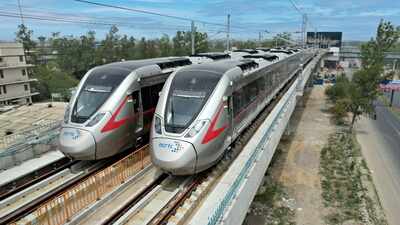
Namo Bharat trains are completing a journey between Delhi and Meerut in just under an hour, with maximum operational speeds of 160 kmph.
A train travelling at 160 kmph is speeding up the transformation of cities around Delhi-NCR, and helping decongest the national capital, one semi-high speed journey at a time. The Regional Rapid Transit System or RRTS is an ambitious project aiming to connect Delhi to cities around 150 kilometres away with a transit system that provides comfortable travel at average speeds of around 90 kmph.Even as India looks to manufacture its first bullet trains, and Vande Bharat trains crisscross across the country, the Namo Bharat trains are completing a journey between Delhi and Meerut in just under an hour, with maximum operational speeds of 160 kmph. But, the Delhi-Meerut RRTS corridor is just the first stepping stone to a much larger urban mobility plan that aims to transform connectivity in and around Delhi-NCR, with an ambition to develop satellite cities as hubs for growth and development.The project is being executed by the National Capital Region Transport Corporation (NCRTC). The funding for the projects work on a simple logic: the central government and the participating states and union territories contribute apart from some funds from development institutions.Also Read | Why India making its own bullet trains is a big deal – explainedWhat’s special about the Namo Bharat RRTS project, which are the future routes on which the trains will run and what are the benefits and challenges of a project of this scale? We decode.
Delhi-Meerut RRTS
Stretching over 80 kilometres, the Delhi-Meerut RRTS provides seamless connectivity to other transport nodes such as Meerut Metro, Sarai Kale Khan ISBT and Indian Railways stations. And that is the important part about these projects: they have been planned as multimodal transport options with integration that provides last mile connectivity. According to Shalabh Goel, MD of NCRTC since the inauguration of the entire stretch in February 2026, there has been a steady and encouraging increase in ridership.“At present, around one lakh passengers are travelling on the corridor every day, and cumulative ridership has crossed about 3.5 crore passenger journeys,” he told TOI.

Delhi-Meerut RRTS route map and stations
He says that a public transport system is truly successful only when people are willing to choose it over private vehicles. While speed and comfort are important factors, such a shift can be encouraged only through seamless connectivity and ease of access. Keeping this in view, NCRTC has focused on integrating Namo Bharat stations with other modes of public transport, including Indian Railways, metro systems, ISBTs and city bus services, wherever feasible. Sarai Kale Khan, New Ashok Nagar, Anand Vihar and Ghaziabad stations are few of the stations on the corridor providing seamless connectivity. “One of the most encouraging trends being witnessed is demographic shift- professionals and students relocating from Delhi to their native cities across NCR while maintaining capital-based employment or continuing study in Delhi. For many, this means affordable housing choices, more time with family and an improved quality of life,” he adds.

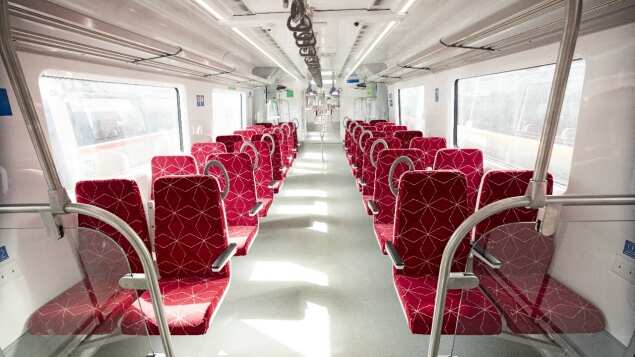
Namo Bharat RRTS train interior
What the RRTS network does is drastically reduce the travel time between two major cities, making it a viable option compared to road travel for daily commute. The importance of the fall in travel time and the resulting economic impact is crucial.For example, as per plans on upcoming corridors, you will be able to travel from Kashmere Gate in Delhi to Murthal in just 30 minutes! Several more RRTS corridors are in the planning stage and once approved, will see the light of the day in the coming years. Let’s take a look:
Delhi-Panipat-Karnal Namo Bharat Corridor:
Delhi-Panipat-Karnal is among the three prioritized corridors that have been planned for Phase 1. The 136 kilometres long corridor will reduce the travel time from Delhi to Karnal to just 1.5 hours. Indraprastha to Sonipat journey will be just 35 minutes, and Kashmere Gate to Panipat will be under an hour.

Delhi-Karnal RRTS route
Around 100 kilometres of the corridor will be in Haryana, 36 kilometres will be in Delhi. It is proposed to originate from Sarai Kale Khan in Delhi and conclude at Karnal New ISBT in Karnal, Haryana with a total of 17 stations planned along the route.
Delhi-Gurgaon-Bawal Namo Bharat Corridor:
The Delhi–Gurgaon-Bawal Namo Bharat corridor is also one of the prioritized corridors of Phase 1. It will pass through Gurgaon and Manesar, and also connect the Delhi airport with the Namo Bharat network. The travel time from Delhi to Bawal will come down from three hours to around 70 minutes.

Delhi-Bawal RRTS route
Around 22 kilometres will go through Delhi and 71 kilometres through Haryana. The corridor will have 13 stations, apart from Sarai Kale Khan.Also Read | With better than Rajdhani experience & 160 kmph speed, can Vande Bharat sleeper trains be a game-changer for Indian Railways?
Ghaziabad-Jewar Namo Bharat Corridor:
This has been envisaged to provide connectivity to the recently inaugurated Noida International Airport at Jewar, with the hinterland. The Detailed Project Report has been prepared by NCRTC. The proposed 72-km long Ghaziabad- Jewar Namo Bharat RRTS cum Metro corridor will start from Ghaziabad Namo Bharat Station and conclude at Noida International Airport.
Gurgaon-Faridabad-Noida- Gr. Noida Namo Bharat Corridor
A semi-high speed regional rail Namo Bharat corridor is proposed between the major cities of Gurgaon, Faridabad, Noida and Gr. Noida and a Detailed Project Report is ready.
How RRTS corridors aim to transform cities
To understand the importance of RRTS, one needs to see them not as transport projects, but as regional economic development projects. This also explains why the government is now going ahead with the proposal to develop Namo Bharat cities around RRTS corridors.Two main benefits that arise from such corridors are: faster and reliable travel options that do away with the need to stay in Delhi for jobs as daily commuting from hometowns like Meerut, Karnal becomes seamless.

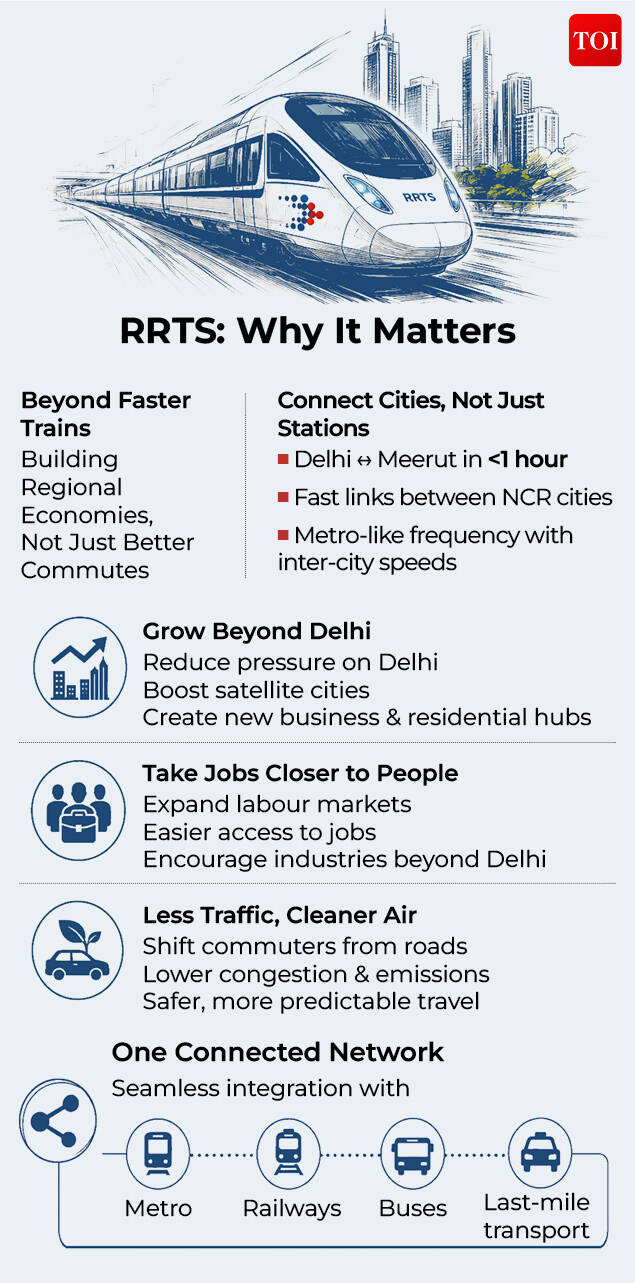
Why RRTS project matters
The second benefit is the impact it has on Delhi’s infrastructure – the strain is reduced, and so is the congestion on roads for vehicular traffic, which in turn helps reduce travel time for NCR residents and also aids in emission reduction.Jagannarayan Padmanabhan, Senior Director and Global Head-Consulting, Crisil Intelligence tells TOI that from an economic perspective, RRTS delivers multiple benefits:
- Expands the labour market by allowing people to commute from satellite cities without relocating.
- Reduces congestion on highways such as NH-9, NH-44 and the Delhi-Gurugram Expressway by encouraging a modal shift from private vehicles.
- Promotes transit-oriented development (TOD) around stations, creating new commercial, residential and mixed-use hubs.
- Improves regional productivity, as shorter and more reliable commute times translate into higher economic efficiency.
- Supports environmental goals by lowering vehicular emissions and reducing dependence on private transport.
Vivek Agarwal, Partner and Lead, Head – Public Infrastructure at KPMG in India points out that businesses gain flexibility to relocate or expand into Tier-2 cities along the corridors, as seamless connectivity ensures access to talent and markets without being physically concentrated in Delhi.“This helps distribute economic activity more evenly across the region, fostering planned urban growth rather than overburdening a single city,” he tells TOI.But while the ambition is on point, implementation challenges and the resulting impact needs to be watched.
Challenges ahead
Experts say that the biggest win for RRTS would lie in its ability to make satellite towns as growth hubs rather than just bringing Delhi closer to the cities.Devayan Dey, Partner – Transport, logistics and infrastructure sector, PwC India says that the real test is how effectively the Indian ecosystem evolves around them.“The first question is whether the corridor addresses an existing mobility constraint. If it shifts significant traffic from congested roads and conventional rail (diverted traffic), the benefits are immediate,” he tells TOI.But, if it primarily generates new travel into Delhi (new generated traffic) without decentralising economic activity, congestion could simply increase in and around Delhi due to influx of “new work population”. “Therefore, RRTS must be accompanied by last-mile connectivity, commercial districts, housing, education, healthcare and industrial/service clusters around stations,” Dey says.Secondly, he says that the objective should not simply be moving people out of Delhi or bringing more people into Delhi. It should be about moving jobs and economic activity closer to where people live.

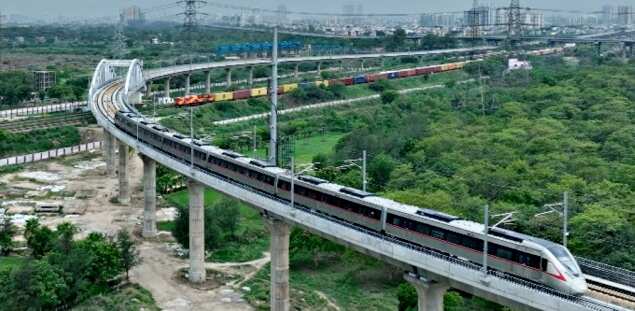
Namo Bharat train
“Unless businesses, institutions and services develop along these corridors, RRTS risks becoming an expensive commuter railway instead of a catalyst for balanced regional growth,” Dey cautions.Finally, policymakers should closely monitor whether RRTS reduces or widens regional disparities. “Well-planned satellite cities with quality social infrastructure can attract residents across income groups. Not just middle class and below, but even upper middle class and above moving into satellite cities is the ideal outcome from a regional equity point of view. Without that broader planning, the benefits may remain uneven,” he adds.
Road ahead
The impact of projects like RRTS and whether they prove to be successful in the long-run will be important to help understand whether the model can be replicated across the country for major cities.Jagannarayan Padmanabhan of Crisil Intelligence sees RRTS as a viable option for metropolitan regions where there is substantial daily intercity commuting within a radius of approximately 50–150 km.According to him, potential regions include:
- Bengaluru Region – Bengaluru–Mysuru, Bengaluru–Tumakuru, Bengaluru–Hosur.
- Chennai Region – Chennai–Sriperumbudur–Kanchipuram–Vellore and Chennai–Chengalpattu.
- Hyderabad Region – Hyderabad–Warangal and Hyderabad–Nizamabad corridors.
- Pune Region – Pune–Chakan–Talegaon and Pune–Nashik in the longer term.
- Ahmedabad–Gandhinagar with potential extensions towards Sanand and Mehsana.
- Kolkata Metropolitan Region, connecting emerging satellite towns.
However, he advises that RRTS investments should be driven by rigorous demand assessment rather than city size alone.“Given the significant capital investment involved, RRTS is best suited to densely populated metropolitan clusters where long-term passenger demand can justify the infrastructure,” he adds.Overall, RRTS is seen as a transformative and ambitious infrastructure initiative. But, ultimately, its long-term success will be dependent on factors such as regional planning and economic development.


NCRTC Managing Director tells TOI
Once this learning matures, the model can then be replicated in other large metropolitan regions, where similar regional travel patterns already exist and the need to decentralize economic growth is a need.As Devayan Dey of PwC India sums up: The success of RRTS projects should ultimately be measured not only by ridership, but by whether they create multiple thriving economic centres across the NCR rather than simply enabling longer commutes into Delhi.Just like metro projects, RRTS too is a project to watch out for, to see if a pan-India implementation will help reduce infrastructure stress on major economic hubs.