
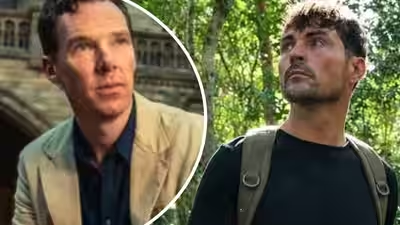
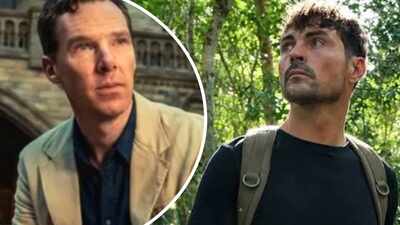
Field biologist and wildlife filmmaker Dan O’Neill has had work take him from the Amazon rainforest to tracking wild cats in the Himalayas. For his latest documentary, How to Live on Earth, he was taken into a setting he was less accustomed to — a hyper-urbanised city.The feature documentary, presented by Benedict Cumberbatch, explores humanity’s relationship with nature through three central stories, with O’Neill examining what nature means to our physical and mental wellbeing. The film takes a deliberately hopeful approach to the environmental crisis, focusing not only on what humanity stands to lose, but on examples of people already finding ways to work with nature for a sustainable future.In a conversation with ETimes, O’Neill reflects on his experience working with Hollywood star Benedict Cumberbatch, whose commitment to environmental causes extends well beyond the screen. He also shares his thoughts on the growing role of celebrities such as Priyanka Chopra and Leonardo DiCaprio in bringing conservation stories to wider audiences. He also discusses the importance of getting film stars to shine a light on conservation issues while working alongside, rather than overshadowing, the voices of scientists, conservationists and communities living closest to wildlife.How important was the decision to make How to Live on Earth available on YouTube, rather than following the traditional documentary route? Was reaching as many people as possible always central to the film’s mission?Dan O’Neill: I think the most important part of this: it’s on YouTube. It’s a massive, ambitious project, but it’s being given to everybody for free at the same time.That is one of the things I’m most proud of about being part of this documentary, because I just do not think a film titled How to Live on Earth, that’s about how our global community is going to live on this planet, should ever be kept to any platform that means that certain people somewhere in the world can watch it and others cannot.I’m super passionate about making sure that when my projects, anything that I work on that goes on screen, if we film in a location where the animal in question is difficult to conserve, has issues that affect local communities. If that film or that content isn’t seen in that location, then what is the point in doing it?I did a project with snow leopards across Central Asia. But I just didn’t want to do it unless in Mongolia and Kyrgyzstan, where we filmed, the project would go out in local languages so that people could watch it. So that’s why I’m really proud of this film.How did the project first come to you?Dan O’Neill: I first found out about the project because the director, Fredi Devas, who did the original Planet Earth 3 and Planet Earth 2 documentaries, which are so inspiring and so brilliant, alongside Jonnie Hughes, the producer, I was just about to go to my research site in Mexico, which is in the film, and I bumped into Fredi in the street.He said, “Oh, where are you off to?” And I said what I was doing, my biodiversity monitoring project there. He was like, “Oh, interesting, could we chat about maybe you being a part of this film?” And I heard a bit about it, and I saw some of the sequences they’d already cut with Xiye Bastida, and I just thought it was such an inspiring project, and I wanted to be a part of it.You spend so much of your life in the wild. What surprised you about the film once you started making it?Dan O’Neill: Oh yeah, totally. I mean, I’m always out in the wild, and one of the things they made a conscious choice to do within my own section of the film was to take me out of my comfort zone, and take me into cities and urban environments, and look at hyper-urbanised areas.I did find that quite difficult, because you know, I’m inspired by animals, and I’m inspired by nature, I’ve spent my whole life trying to learn more about nature, and surrounding myself by it, so it was a really interesting thing to go and see what the reality of the planet is.But it felt super inspiring to then go and see parts of the world where nature’s been brought back in, and that made me feel serious hope that there isn’t this separation between urban and nature, and actually they can be brought hand in hand, and that gave me a lot of hope.Another thing that I didn’t expect is that they would ask us to be so authentically ourselves. I felt like it’s a real representation of who we are as people, and hopefully people can connect to that on a human level. I think that’s what’s really important about this film, that it doesn’t, it’s not trying to make people feel like they’re being told, it’s a journey that everybody’s a part of.Benedict Cumberbatch has played Doctor Strange, a superhero who saves the multiverse. In this film, he’s helping audiences think about saving the planet. Did you see a parallel between the two?Dan O’Neill: Oh yeah, I mean, but the truth is, Benedict is that person.He is so committed to the planet, and he’s not just committed to protecting it, and to being involved in these conversations, he is so smart, and knows so much of the hard science, he knows the conservation issues, he knows the on-the-ground projects, and between him and his wife, Sophie Hunter, they do a lot of conservation work.So I would say, you can play a superhero, you can be a detective, but he is doing real work that is kind of what those roles encompass in a real person, because, you know, he’s got a huge amount of power, he’s got a huge amount of potential sway by being in the position that he is, as a two-time Oscar-nominated actor, and I think he’s using that for a really positive thing.And you know, he wanted to be a part of this project, just like all the rest of us. We’re so lucky to have somebody like him, that is so authentically interested in this topic, and so and so passionate about making a difference, and giving his voice to it. And obviously, because he’s such a talented actor, and he’s so amazing, that cheekiness that he puts on screen, that really makes you feel like you’re in some kind of Hollywood movie, when you’re watching it. Yeah, he’s a superstar.Benedict isn’t the only celebrity using his platform for environmental causes. What can stars such as Benedict, Priyanka Chopra and Leonardo DiCaprio bring to these stories that scientists and field workers sometimes cannot?Dan O’Neill: I think one of the most important things about it, is it all has to come back to ethics, and it has to come back to authenticity.People like Priyanka Chopra, as you’ve mentioned, she’s a huge advocate for like displacement of peoples, she cares deeply about the environment. I think that we historically have had quite a zeroed-in understanding of who should, or should not get to tell the kind of stories they do. I think authenticity is important, but outside of that, we shouldn’t be siloing who gets to talk, and whose power is valuable, because I think by involving some of these people who want to give their platform to these issues, they’re bringing in audiences that maybe wouldn’t be as inspired.Maybe the audience is not going to go and look at something that has just one person involved, but then maybe you get Benedict, or Priyanka Chopra, or Leonardo DiCaprio, and then people who watched their films, or engaged with the other projects, at first, maybe they didn’t really want to get involved, but then they’ll give it a watch for that person. And I think that’s really important.I do think it’s always important to not separate those things, because it’s a combined effort. We need the people that have been living and breathing this their whole life, whether that’s a scientist or a local person, and giving them a platform, whether that’s alongside the Benedicts, the Priyankas, the Leonardos. I think everybody’s needed.India has a particularly strong wildlife filmmaking community. What would you like Indian audiences to take away from the film?Dan O’Neill: India has some of the best and most amazing wildlife film community in the world. It’s just such an immense amount of ability and power to come from India, with these kinds of messages. I’m really excited and hope everybody in India loves the film.