
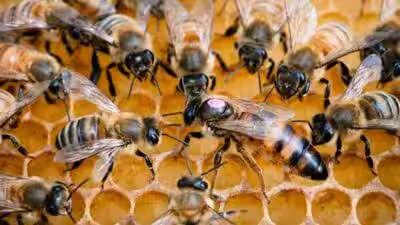
Only three Hawaiian producers currently meet the United States’ organic honey certification rules, but scientists now say those rules may be stricter than necessary, according to a new study.Researchers have found that honey produced by organically managed bee colonies on farms in the northeastern US had pesticide contamination levels similar to certified organic honey already sold in the market. The findings could support a review of existing rules and help more American beekeepers enter the organic honey market.The study was carried out by researchers at Cornell University and published in the journal Science of the Total Environment, Science X reported.According to the researchers, current US organic certification rules make it almost impossible for most beekeepers in the continental US to qualify, even when they follow organic beekeeping practices.“Consumers are willing to pay 20% to 30% more for certified organic honey than nonorganic honey,” says Scott McArt, associate professor of entomology at Cornell University and senior author of the study. “If organic honey was possible to produce in the continental US, it would open up a huge market for our country’s beekeepers, who are really struggling right now,” he adds.At present, the US Department of Agriculture requires beekeeping sites seeking organic certification to have a 6.4-kilometre, or nearly four-mile, buffer zone made up of certified organic or natural land where bees can collect nectar and pollen. The US Food and Drug Administration also sets maximum residue limits for pesticides that organic honey must meet.According to the researchers, meeting the land requirement is the biggest challenge. Large areas of certified organic or completely natural land are rare across the continental US. As a result, only three honey producers in Hawaii currently meet the country’s organic honey certification framework. Most organic honey sold in the US is imported from countries such as Brazil.
Researchers track bee foraging
The researchers wanted to find out whether the existing land requirement matches the way honey bees actually behave. To answer this question, they studied bee foraging behaviour. Foraging is the process in which worker bees leave the hive to collect nectar, pollen and water before returning with these resources.The team tracked bees to measure how far they usually travel. They found that the median foraging distance was around 750 metres, or about 2,500 feet. This is much shorter than the 6.4-kilometre buffer zone required under current organic certification rules.“Our research shows that beekeepers in the Northeastern US may only need a small fraction of that land to produce honey with pesticide contamination as low as imported USDA organic honey,” says Benedict ‘Ben’ DeMoras, the study’s first author.The researchers say this suggests that the current rules may not reflect the normal behaviour of honey bees. If bees usually collect food much closer to their hives, then requiring such a large surrounding area may be stricter than needed.
Testing organic honey
To test this idea, the researchers established 72 bee colonies across six large organic farms in the northeastern United States. Instead of placing the bees in existing hives, they started with empty hive boxes in 2023 and introduced bees into them. Over time, the bees built fresh wax honeycombs and began producing honey. By starting with new combs, the researchers reduced the chance of older chemical residues affecting the results.The colonies were managed using organic beekeeping methods. Around each hive, the land within a three-kilometre radius consisted of between 56% and 93% natural or semi-natural habitats, including forests, wetlands and fallow fields.In 2024, the researchers collected the honey and tested it for 96 different pesticide residues at Cornell University’s Chemical Ecology Core Facility. They then compared the results with 20 brands of honey bought from shops, including both certified organic and conventional honey.

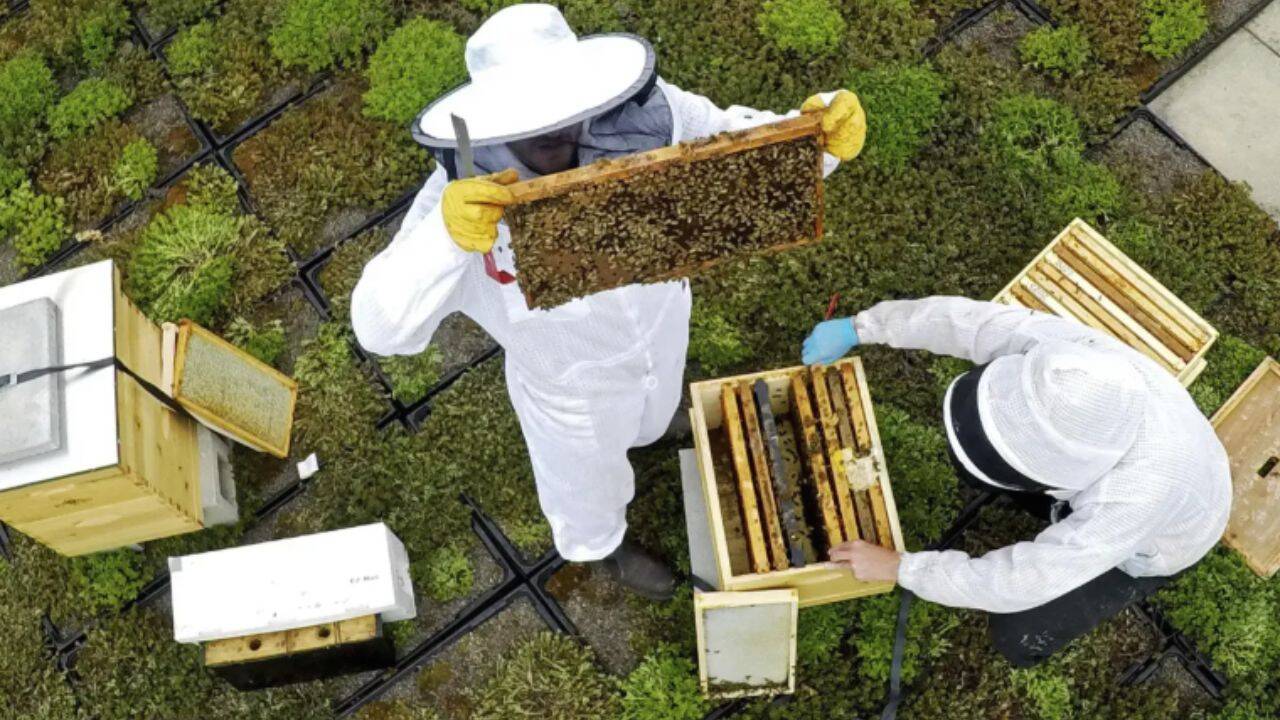
Tests showed northeastern honey matched certified organic honey for pesticide contamination.
Hive management matters
One important part of organic beekeeping involves controlling Varroa mites. These tiny parasites are considered the most damaging pest affecting honey bees and are a major cause of colony losses.Conventional beekeepers commonly use the insecticide amitraz to control Varroa mites. While it is effective against the pest, chemical residues can remain in beeswax for long periods.Beeswax is expensive for bees to produce because it requires a great deal of energy. For this reason, beekeepers often reuse the same wax combs year after year. If those combs contain chemical residues, the contamination can remain inside the hive.Organic beekeepers instead use naturally occurring compounds, including organic acids or concentrated hops, to control Varroa mites. According to the researchers, these treatments do not leave long-term chemical residues in the wax or honey.
Honey met standards
When the honey samples were analysed, the researchers found that pesticide contamination levels in the northeastern honey were similar to those found in certified organic honey imported into the US and certified organic honey produced in Hawaii. Only one sample from the northeastern farms exceeded the maximum residue limits. By comparison, conventional honey contained much higher levels of pesticide residues.“When we looked at the pesticide residues in the honey produced from those colonies compared to the certified organic imports and certified organic Hawaiian honey, they were low and comparable,” McArt said.“This study demonstrates that it is possible to produce clean honey that could meet the standards for USDA organic certification in the continental US, even though the apiaries were placed on relatively small organic farms,” says Margarita Lopez-Uribe, associate professor of entomology at Pennsylvania State University and a senior author of the study.
What findings mean
The researchers say the results suggest that many more American beekeepers could qualify for organic certification if the rules were updated to better reflect bee biology.According to DeMoras, about one in five beekeepers already manage their hives using organic methods.“One in five beekeepers already manage their hives with organic methods, so with revised organic standards, many could still benefit economically,” he said.The team now plans to carry out similar studies in other parts of the United States to see whether the findings hold true across different regions.