


NEW DELHI: In a major boost for India’s semiconductor startup policy, govt is redesigning its support framework under Semicon 2.0 and intends to move away from one-time grants to a model of larger, milestone-linked funding coupled with equity investments, alongside venture capital (VC) firms.On Wednesday, the cabinet approved Semicon 2.0 with an outlay of Rs 1,27,500 crore, expanding India’s semiconductor strategy beyond fabrication and assembly. India Semiconductor Mission (ISM) chief executive Amitesh Kumar Sinha told TOI that the new framework reflects the unique capital requirements of semiconductor companies, whose funding needs to be extended well beyond the design stage.

Works On A Model Of Larger, Milestone-Linked Funding
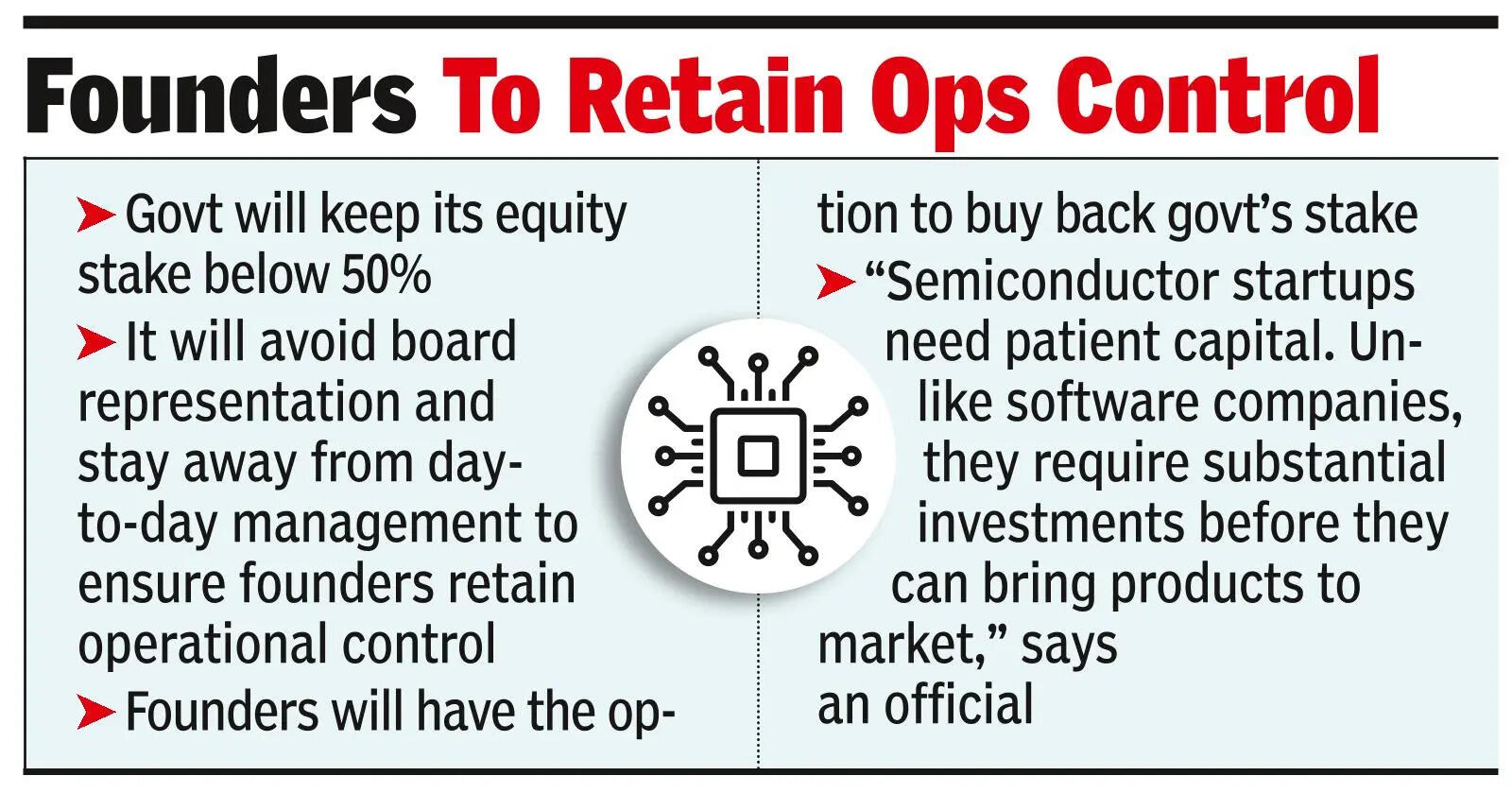
“Govt is not here to make money. Our objective is to support startups and build the ecosystem,” Sinha said. “Semiconductor startups need patient capital. Unlike software companies, they require substantial investments before they can bring products to market.”One of the biggest lessons from the Design Linked Incentive (DLI) scheme, he said, was that while several startups successfully developed chip designs and proof-of-concepts, many struggled to raise the hundreds of crores needed for product qualification, commercialisation and large-scale deployment.“The real challenge begins after the design stage. That’s where capital requirements become very large, and traditional startup funding models often fall short,” Sinha said.To address this, govt is working on a phased funding structure, under which startups will initially receive seed capital, followed by significantly larger investments as they achieve predefined technical and commercial milestones. An internal committee is finalising the contours of the programme.Sinha said the Centre will generally keep its equity stake below 50%, avoid board representation and stay away from day-to-day management so that founders retain operational control.As startups mature, founders will have the option of buying back the govt’s stake, while companies will remain free to raise fresh capital or pursue acquisitions. “We will exit at the prevailing valuation, recover our investment and reinvest that capital into the next generation of semiconductor startups,” Sinha said.The proposed model comes at a time when govts globally are increasingly experimenting with equity-based support for strategically important technology companies instead of relying solely on grants and subsidies. In the US, the Trump administration converted a portion of Intel’s CHIPS Act grants into an equity investment, taking a passive 9.9% stake, while leaving management control with the company.