


An enormous Atlantic bluefin tuna weighing 746lb (338kg) has been caught off the Yorkshire coast, marking the species’ return to the region after nearly 90 years and drawing fresh attention to its resurgence in British waters. Scientists say warmer seas, recovering fish stocks and tighter fishing controls may all be contributing to the species’ comeback.The huge tuna was landed at Whitby Harbour on Sunday by the five-person crew of The Dominator. The 338kg specimen is believed to be the first bluefin tuna landed at the Yorkshire port in decades.Crew member Jack Gardner, 28, said the fish was caught about 10 miles (16km) from Whitby Harbour. Speaking to the BBC, Gardner recalled the moment the fish surfaced.“It jumped out of the water, we all just looked at each other in awe,” he said.The crew reportedly had to drag the fish for around five miles before bringing it aboard. They caught another bluefin tuna the following day, with that fish also weighing more than 300kg.
Why are bluefin tuna returning to British waters?
Scientists believe rising sea temperatures could be one reason Atlantic bluefin tuna are appearing farther north around Britain.Grace McNicholas, a PhD student at Trinity College Dublin who led a study on bluefin tuna distributions, said research showed early signs that the species was moving farther north than expected.“Our results provide early indications that the fish are moving further north than would be expected, and we believe this is due to warming seas,” she said.According to the Met Office, 2025 was particularly unusual, with marine heatwave conditions persisting for more than three-quarters of the year. Similar conditions were recorded in 2022 and 2023, while sea temperatures in 2026 have again remained significantly above average.
Warmer seas are only part of the explanation
Climate change may not be the only factor behind the bluefin tuna’s return.Dr Lucy Hawkes, an ecologist at the University of Exeter, told the Daily Mail that bluefin tuna have probably always been present in British waters but were heavily overfished across their range.She said stocks had largely collapsed by the 1950s and 1960s, after which the fish were no longer commonly seen off the Yorkshire coast.According to Hawkes, bluefin tuna began returning to British waters from at least 2014, initially becoming more common off Devon and Cornwall and, more recently, along the North East coast.She also pointed to stricter fishing controls introduced in 2007 as an important factor in the species’ recovery.
An abundance of smaller fish is attracting the giant predators
Food availability could also be helping bluefin tuna thrive around Britain.Research from the University of Exeter found that bluefin tuna caught around the UK had been feeding heavily on small oily fish, including anchovies, sardines and sprats.Hawkes said the presence of bluefin tuna could also provide an indication of the health of marine ecosystems.“Bluefin tuna are also top predators who can only be in these waters if the ecosystems underneath them are healthy,” she said, according to the University of Exeter research team.
Bluefin tuna were once famous around Whitby

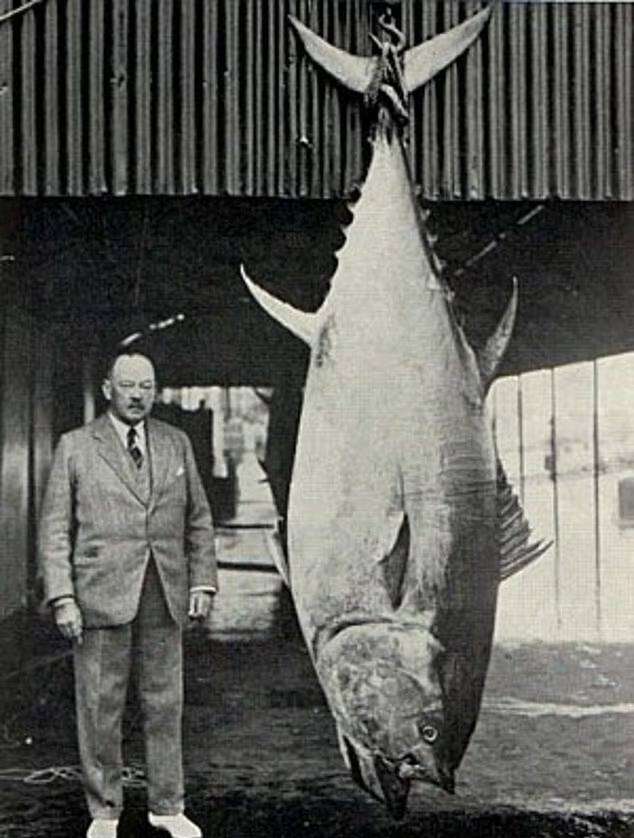
Whitby made fishing history in 1933 when an 851lb (386kg) bluefin tuna was caught off the Yorkshire coast, setting a British record that still forms part of the region’s remarkable tuna legacy. (Photo: BNPS)
The latest catch has particular historical significance because Whitby and Scarborough were once renowned destinations for bluefin tuna fishing.During the 1930s, the fish were known as “tunny”, and big-game anglers travelled to the Yorkshire coast to pursue them. Celebrities including John Wayne and Errol Flynn were among those who visited the region.A British record was set in Whitby in 1933 when a 386kg (851lb) bluefin tuna was caught.The sport declined after World War Two, while increased commercial fishing pressure contributed to the depletion of tuna stocks and their prey.
Researchers are tagging the returning tuna
Scientists are now trying to establish where the newly arrived bluefin tuna have come from and whether UK waters could become a more permanent part of their range.Since 2018, researchers from the University of Exeter have tagged 165 bluefin tuna along the Atlantic coast of England, Wales and Jersey.A University of Exeter spokesperson said the fish found off Whitby were “considerably larger” and may be genetically distinct from those previously tagged.Researchers have now tagged six bluefin tuna off Whitby to track their movements, feeding patterns and migration routes.Dr Katie Smith of the Marine Biological Association told The Times that there was a high likelihood of seeing more bluefin tuna in UK waters as conditions become increasingly favourable.
Warmer waters could also bring ecological risks
Scientists have also warned that warmer seas can have negative consequences for Britain’s marine ecosystem.Professor Matt Frost of the Plymouth Marine Laboratory told the BBC that while the arrival of species such as Atlantic bluefin tuna can be exciting, warming waters can also contribute to declining numbers of species such as cod and allow other species to enter British waters and potentially displace native wildlife.Meanwhile, UK fishing vessels operate under a limited annual bluefin tuna quota. Commercial fishermen are permitted to catch 120 tonnes of bluefin tuna in UK waters this year, spread across a maximum of 30 vessels.The return of the giant tuna is therefore being viewed as both a sign of recovering marine life and a potential indication of how Britain’s changing sea temperatures are reshaping the distribution of marine species.