
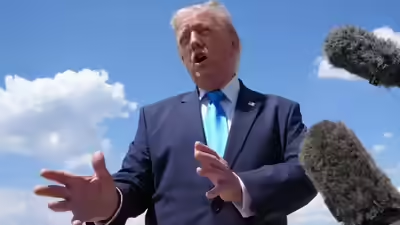
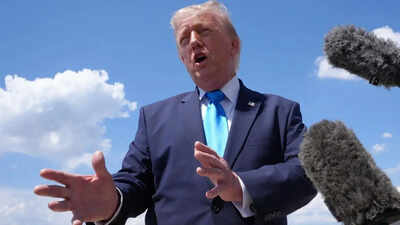
US President Donald Trump is set to arrive in France shortly for the G7 summit but, before he even touches down on the tarmac, a long history of his own sharp words stands to welcome him.The seven leaders gathering in Évian-les-Bains all have been on the receiving end of Trump’s ire, or found themselves having to navigate his more combustible moments with visible discomfort.“It’s not unlike a family holiday gathering where there’s an uncle you don’t quite like,” said Max Bergmann of the Center for Strategic and International Studies. “No one wants a confrontation, even if things get quite passive-aggressive. But there’s always the possibility that things might snap.”
United Kingdom: Keir Starmer
Trump has managed to insult both the British prime minister and Britain’s martyrs within the space of a few months.When Starmer initially declined to allow US military jets to use a British Indian Ocean base for the bombardment of Iran, Trump made harsh comments against Starmer saying, “This is not Winston Churchill that we’re dealing with.”When the UK later placed the aircraft carrier HMS Prince of Wales on advanced readiness for potential deployment to the Middle East, Trump lashed out on social media: “We don’t need people that join Wars after we’ve already won!”Trump also told Fox News that NATO allies had stayed “a little off the front lines” during the war in Afghanistan, a claim widely condemned as false. Starmer called the remarks “insulting and frankly appalling,” joining veterans and politicians across the British political spectrum in demanding an apology. Prince Harry said the sacrifices of those who served “deserve to be spoken about truthfully and with respect.“
Canada: Mark Carney
Trump has been openly annexationist about Canada since returning to office, regularly suggesting it should become the 51st state, and has taken to referring to Prime Minister Mark Carney as “governor.”The sharpest exchange came at Davos in January, when Carney condemned coercion by great powers against smaller nations, Trump replied stating that “Canada lives because of the United States,” he told the audience. “Remember that, Mark, the next time you make your statements.”Carney has declined to respond and described Trump as “an exceptionally active user of social media”.
France: Emmanuel Macron
During an Easter lunch at the White House, Trump brought up viral footage showing Brigitte Macron appearing to push her husband’s face away as they deplaned in Vietnam. He told guests that Brigitte treats Macron “extremely badly” and that the French president was “still recovering from the right to the jaw.” Macron afterwards said the couple had been joking and called the comments “neither elegant nor appropriate.“On trade, Trump regularly regales audiences with supposed conversations with Macron, mimicking the French president in an exaggerated accent.
Italy: Giorgia Meloni
As recently as October, Trump called Meloni a successful and beautiful politician at a post-Gaza summit in Egypt. The relationship turned after Italy declined to assist the US in the Iran war and after Meloni chastised Trump for his feud with Pope Leo XIV.Trump then said, “Do people like her? I can’t believe it. I thought she had courage. I was wrong.”
Japan: Sanae Takaichi
During her first White House visit, a Japanese reporter asked why Trump had not forewarned allies before attacking Iran. Trump’s response, with Takaichi standing beside him: “Who knows better about surprise than Japan? Why didn’t you tell me about Pearl Harbor, OK?”The remark landed heavily in Japan, where American presidents have long avoided any harsh references to the 1941 attack, choosing instead to emphasise the depth of the postwar alliance. Takaichi, a hard-line conservative, let the comment pass and received a mixed reception in Japan for her silence.
Germany: Friedrich Merz
Merz triggered Trump in April when he said the US was being “humiliated” by Iran and had entered the war without a strategy. Trump fired back on social media, telling the chancellor to focus on “ending the war with Russia/Ukraine” and “fixing his broken Country, especially Immigration and Energy.” Days later, the Pentagon announced the withdrawal of 5,000 US troops from Germany, with Trump hinting the drawdown could go “a lot further.“When Merz visited the White House last year on the eve of the D-Day anniversary, Trump interjected that D-Day was “not a pleasant day for you.” The chancellor reminded him that it also marked “the liberation of my country from Nazi dictatorship.” Trump acknowledged he had a point.