
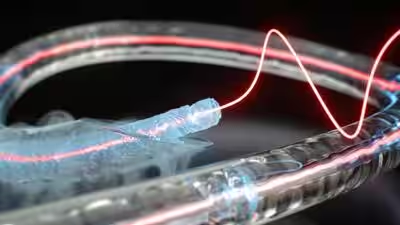
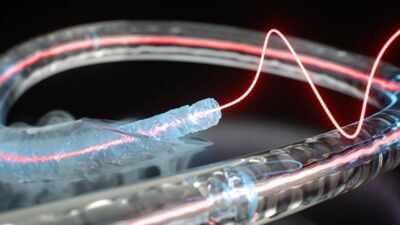
Freezing liquid inside an optical fibre has helped scientists create an unusual environment where light and sound can interact more than 1,000 times more strongly than they do in ordinary optical fibres.According to Science Daily, scientists from the Max Planck Institute of the Science of Light (MPL) in Erlangen, Leibniz University Hannover (LUH) and the Leibniz Institute for Photonic Technologies (IPHT) in Jena, cooled the liquid inside a special optical fibre to -196°C using nitrogen.The extreme cold changed the material in the fibre’s core from a liquid into a solid. The surprising part was that freezing the liquid did not stop the fibre from guiding light. The researchers also found that both the liquid and frozen sections of the fibre could guide hypersonic sound waves.The team used this effect to demonstrate optoacoustic memory. In simple terms, the system can transfer information carried by light into much slower sound waves, hold that information temporarily and then convert it back into light. The researchers say this could eventually help in developing lower-energy photonic computing systems and technologies linked to quantum information.
What happens inside optical fibre
Optical fibres are widely used to carry information because they can send light over long distances. The information is carried by light travelling through the fibre’s core.Scientists have also developed specialised optical fibres for several other uses. These include fibre lasers, fibre endoscopes and fibre sensors. Some hollow-core fibres can be filled with gases or liquids. This allows them to be used for applications such as mapping temperature distributions or carrying out chemical experiments on a very small scale.The new research focuses on a type of fibre known as a liquid-core optical fibre, or LiCOF. Instead of having only a solid material in its core, these fibres can contain a liquid.The change from liquid to solid can alter important physical properties of a material. These properties include its density and refractive index, which affect how sound and light travel through it.
Frozen fibre creates stronger light-sound interaction
The researchers cooled the liquid inside the fibre to -196°C. At this temperature, the material in the core changed from a liquid into a solid. However, the frozen section continued to guide light. It could also guide hypersonic sound waves. This was important because the researchers were interested in how light and sound behave together inside the fibre.


Project leaders of the collaborative project: Jun.-Prof. Mario Chemnitz,Prof. Birgit Stiller, Prof. Markus A. Schmidt (from left to right). (Picture: Max Planck Institute)
The researchers then used a phenomenon called Brillouin-Mandelstam scattering. This effect is already known to occur in conventional optical fibres and involves an interaction between light and sound.In the frozen liquid-core fibre, however, the conditions were very different. Freezing the liquid created an environment that was described as exceptionally dense and tightly confined. As a result, the interaction between light and sound became more than 1,000 times stronger than in standard optical fibres.
How the optoacoustic memory works
Light and sound travel at very different speeds. Light moves extremely quickly, while sound waves are much slower. The researchers used this difference for storing information.Information carried by a rapidly moving light wave can be transferred to a much slower sound wave. The information can then remain temporarily in the sound wave before being converted back into light.The strong interaction made possible by freezing the fibre’s core is important because efficient interaction between light and sound can be useful for photonic computing. Photonic systems use light to process or carry information.The researchers said the approach could potentially reduce the amount of energy needed by future photonic computing systems.
Possible uses in future technologies
The research builds on a long-running collaboration between the teams involved. Prof. Markus Schmidt and Prof. Mario Chemnitz from IPHT Jena had previously pioneered research involving liquid-core optical fibres.The addition of the freezing process allowed the researchers to produce much stronger nonlinear effects inside the fibre. Nonlinear effects describe situations in which a material responds to light in a way that is not simply proportional to the strength of the light. The researchers see the frozen fibre as a new platform for studying and using these effects.The demonstration of optoacoustic memory is an early step, but the researchers said the strong coupling between light and sound could have several possible applications. These include neuromorphic computing, quantum information processing, microwave photonics and high-precision sensing.The study, published in Optica, is titled ‘Giant Brillouin gain in frozen CS2 capillaries‘. It was authored by Simon Seiderer, Andreas Geilen, Luan N. Sliwa, Linqiao Gan, Xue Qi, Mario Chemnitz, Markus A. Schmidt and Birgit Stiller.