
Can you imagine history getting the identity of a ruler wrong for centuries? What we often accept as settled historical fact can sometimes be far more complicated than it appears. Recent archaeological research is now raising questions, arguing that an Iron Age ruler identified as a king in history may actually have been a woman.The ruler in question is Verica, a leader of the Atrebates, a British tribe whose territory covered parts of what are now Hampshire and West Sussex in southern England. Verica has long been associated with the events leading up to the Roman invasion of Britain in AD 43. However, Dr Miles Russell, Director of Archaeological Fieldwork at Bournemouth University, who is leading the research, argues that the ruler historians have understood to be male was actually a woman. His interpretation, announced by Bournemouth University on November 5, 2026, challenges the way Verica’s identity and position in early British history have been understood.Around AD 40, Verica was driven out of power and fled across the English Channel to seek assistance from the Roman emperor Claudius. According to the account of the Roman historian Cassius Dio, Verica’s appeal played a significant part in persuading Claudius to launch an invasion of Britain. Three years later, Roman forces crossed into Britain, beginning a conquest that would eventually bring much of the island under Roman rule.Verica’s position was therefore rather unusual. The ruler was not simply someone who witnessed the expansion of Roman power from the other side of the Channel, but a figure whose appeal for assistance may have helped set the events in motion. For Dr Russell, reconsidering Verica’s identity also means reconsidering the role women could have played in the political relationships between Iron Age Britain and Rome.
What the name and coins reveal
One of the first clues in Russell’s argument comes from Verica’s name itself. He points out that the name ends in the letter ‘a’, a pattern commonly associated with female names in Iron Age Britain. Other female rulers from approximately the same period include Boudica of the Iceni and Cartimandua of the Brigantes. Both these names follow a similar pattern, but this alone cannot help determine someone’s sex.The coins issued in Verica’s name offer another interesting piece of evidence. Some carry the Latin title ‘REX’, traditionally translated as king, which has been one of the reasons Verica was understood to be male. However, Russell argues that the term was not necessarily restricted to men and could be used as a title of rulership regardless of gender. He points to Cleopatra of Egypt as an example of a female monarch recognised within the Roman political world.The imagery on these coins is another part of his interpretation. Rather than depicting the obviously male warriors commonly associated with other Iron Age British rulers’ coinage, some of Verica’s coins show a slender, bare-breasted figure riding a horse and carrying a spear. Russell interprets this figure as a female warrior, suggesting that the imagery may offer another indication of the ruler’s identity.There is also the question of the inscriptions connecting Verica to Commius, who is traditionally identified as the ruler’s father. Certain coins bear abbreviated inscriptions such as ‘COM F’ or ‘COMMI F’. These have generally been read as *Commios filius*, meaning son of Commios. Russell suggests that the abbreviation could instead represent *Commios filia*, meaning daughter of Commios. The distinction is significant because the abbreviated inscription does not, by itself, settle whether Verica was male or female.
Could this change how we remember Iron Age Britain?
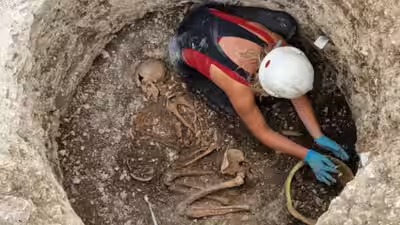
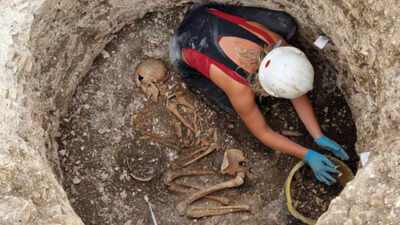
A separate study reported by Bournemouth University in January 2025, involving archaeologists from Bournemouth University and geneticists from Trinity College Dublin, examined ancient DNA from more than 50 individuals buried in Dorset. The findings pointed towards a community organised around the female line of descent, with evidence suggesting that husbands moved to live within their wives’ communities.But Russell’s argument is not without its own critics. Some specialists have questioned whether the figures on the coins can confidently be identified as representations of Verica, while the Roman historian Cassius Dio’s account has traditionally been interpreted as referring to a male ruler. The masculine form of the name Berikos in the historical account has also been raised as a point of disagreement.While the argument put forth is an interpretation of existing evidence, it nudges researchers to question how identities that have long been understood in a certain way can change the way we understand the social fabric of a time. If Russell’s interpretation is correct, Verica would then join the ranks of Britain’s early female rulers, not merely as another name in the historical record, but as someone whose appeal to Rome may have helped change the course of British history.