
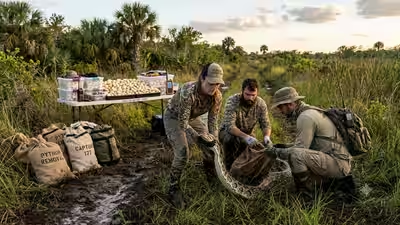
A season of tracking Burmese pythons across the difficult terrain of southwest Florida ended with 177 snakes removed and more than 4,100 eggs taken out of the ecosystem. The work, carried out by the Conservancy of Southwest Florida and its python action team, covered about 200 square miles of Collier County between November 2025 and April 2026, as reported by the Conservancy of Southwest Florida. Together, the captured snakes weighed 8,080 pounds, or just over four tons. The programme has been running for more than a decade, using radio-tagged male pythons to locate breeding snakes in places that can be difficult for people to reach. This season produced the largest total biomass removed by the organisation since the programme began in 2013.
Florida Burmese python removal began with a 17-foot female
The first capture came in November, when a tagged male known as Snaquan led the tracking team to a large female python. She measured 17 feet and weighed 148 pounds, setting the tone for a season in which several of the snakes recovered were substantial animals.By April, the team had removed 177 Burmese pythons from the study area. The females captured during the season averaged about 95 pounds, while the heaviest reached 153 pounds. Several measured more than 16 feet.For the people following them through the landscape, size was only part of the challenge. Large females can spend time in remote areas, making them difficult to locate without a way of narrowing down where they are moving.
How Florida’s python removal programme uses tagged scout snakes
The Conservancy’s method centres on radio telemetry and a group of around 40 tagged male pythons. These animals are used as what the organisation calls scout snakes. During the breeding period, researchers monitor their movements. When a tagged male begins spending time around other pythons, the location can point the team towards a mating group. That allows biologists to reach the area and search for additional snakes, including females carrying eggs.It is a very different approach from simply searching for snakes across the Everglades landscape. The tagged animals provide a moving signal, helping researchers decide where to concentrate their efforts. Ian Bartoszek, a wildlife biologist and science project manager with the Conservancy, said, “This was our first four-ton removal season. Our tagged scout snakes helped us locate large breeding snakes deep in the landscape before they had a chance to lay eggs.”
More than 4,100 eggs were removed
According to Conservancy of Southwest Florida, the programme’s work this season extended beyond adult snakes with more than 4,100 python eggs also removed. The reproductive figures found inside captured females give some indication of why the team pays particular attention to breeding animals. Females examined during the season carried an average of about 70 eggs, according to the Conservancy.Some of the snakes had also been feeding on native animals. The organisation reported that around a quarter of the females captured contained remains of white-tailed deer. Burmese pythons are established in southern Florida, where their presence has raised concerns about predation on native wildlife. The Conservancy’s work is aimed in part at reducing reproduction by finding breeding females and removing them before they can produce another generation.

Florida python programme removed 8,080 pounds of snakes
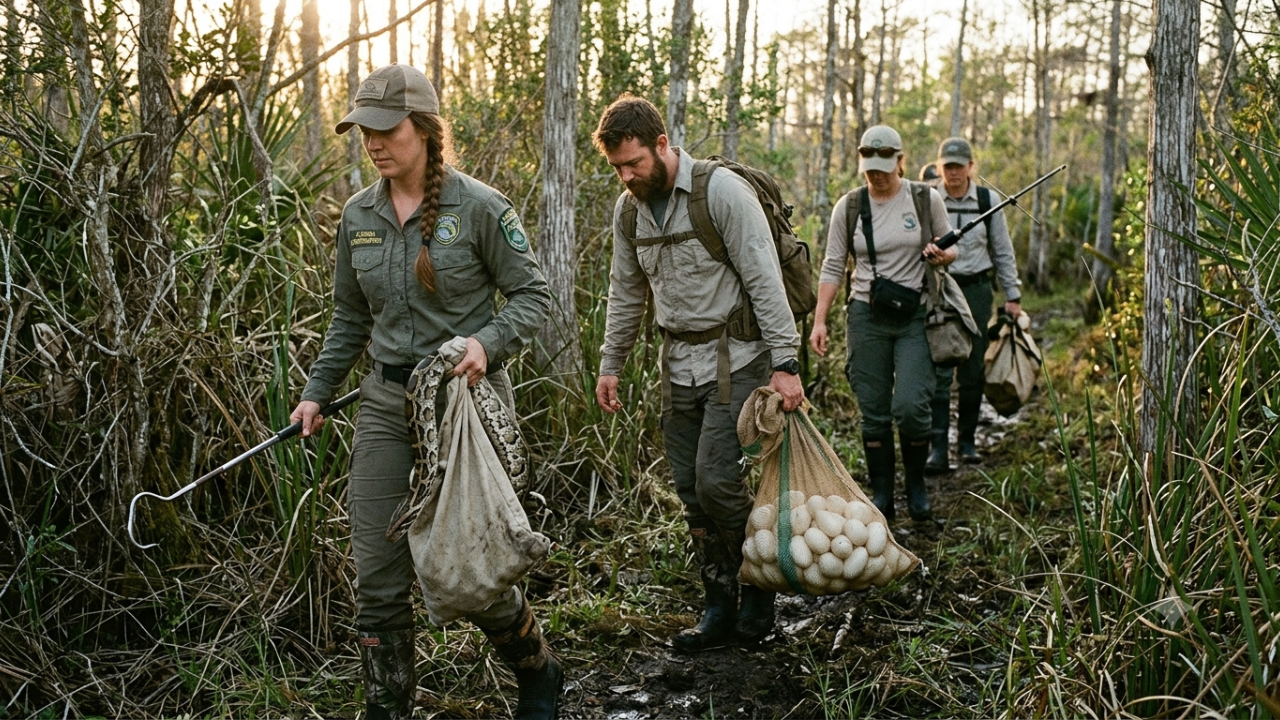
The scale of some captures means the fieldwork is not simply a matter of picking up a small reptile and carrying it away. Several females recovered during the season weighed well over 100 pounds. Photographs from the programme show researchers working with large snakes found after scout males were tracked through southwest Florida. Reportedly, one of the snakes located by scout number 103, known as Lincoln, measured 16 feet and weighed 140 pounds.The largest female captured during the season weighed 153 pounds. Snaquan’s first lead had produced a 148-pound female. These individual animals account for a significant portion of the total biomass removed. Across all 177 snakes, the combined weight reached 8,080 pounds.
The programme has been running since 2013
The latest season brought the programme’s cumulative total to about 1,750 Burmese pythons removed since it began in 2013. Those snakes have weighed more than 53,000 pounds altogether. The project has also generated research beyond the individual captures. The Conservancy said its work has contributed to 25 scientific publications examining areas such as python behaviour, habitat use and reproduction.The organisation works with several research partners, including the Rookery Bay National Estuarine Research Reserve, the US Geological Survey, the University of Florida and the South Florida Water Management District. The programme is funded through a combination of private donations, grants and conservation organisations.
Burmese python removal continues across southwest Florida
The end of the April field season does not mean Burmese python sightings have stopped. The Conservancy continues to ask people in the area to report snakes so they can be assessed and, where appropriate, removed. For the Conservancy’s tracking team, the next stage will build on information collected during another breeding season. Each tagged scout snake adds to the understanding of where pythons move and how they use the landscape.The 2025-26 season ended with 177 adult snakes removed, thousands of eggs taken out and more than four tons of python biomass recorded. The figures now form part of a much longer effort that has been underway in southwest Florida for more than 13 years.