
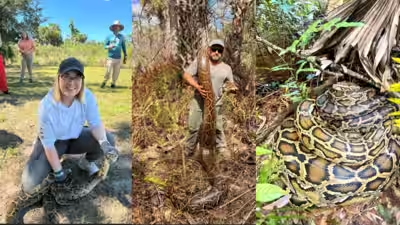
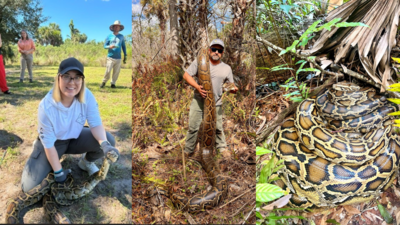
Florida biologist Ian Bartoszek and his team are using 40 radio-tagged male Burmese pythons as “scout snakes” to locate breeding females, helping remove a record 8,080 pounds of invasive pythons from Southwest Florida in a single season. The Conservancy of Southwest Florida said its team removed 177 pythons between November 2025 and April 2026, the highest seasonal removal by weight since its programme began in 2013. The tagged males help researchers track down large females before they lay eggs. The team also removed 4,100 python eggs during the season as part of its efforts to suppress the invasive population and protect native wildlife.
How 40 radio-tagged male pythons help Florida biologist find breeding females
According to the Conservancy, its science team uses 40 radio-tagged male Burmese pythons to locate breeding snakes during the mating season. Researchers track the males using radio telemetry, following their movements through the landscape to locate female pythons they are mating with. This allows biologists to capture the females before they lay eggs.The programme uses the tagged males as tracking tools rather than relying solely on searching for pythons directly. The Conservancy said the scout snakes helped its team locate large breeding females deep in the landscape during the latest season. The approach is part of its long-term research and removal programme, which has been operating since 2013.
Florida team removes record 8,080 pounds of pythons
The Conservancy of Southwest Florida said its team removed 177 invasive Burmese pythons weighing a combined 8,080 pounds during the November 2025 to April 2026 breeding season. The organisation described this as the greatest biomass of pythons removed in a single season by its tracking team and volunteers since the programme began.The removed female pythons weighed an average of 95 pounds, while the largest female captured during the season weighed 153 pounds and measured 17 feet long. The Conservancy said the females carried an average of 70 eggs, and a quarter of them contained the remains of white-tailed deer.
Florida team removes 4,100 Burmese python eggs in record season
The team also removed an additional 4,100 Burmese python eggs from the ecosystem during the season. The Conservancy said the removal effort was intended to prevent the eggs from hatching and adding more invasive snakes to the landscape.“This was our first four-ton removal season. Our tagged scout snakes helped us locate large breeding snakes deep in the landscape before they had a chance to lay eggs,” Ian Bartoszek, wildlife biologist and Conservancy Science Project Manager, said. He added that the science-based management efforts were suppressing local python reproduction and that the organisation hoped removal numbers would decline over time with continued pressure.
Burmese python population spreads to another Florida county
Since 2013, the Conservancy’s python research and removal programme has removed 1,750 pythons weighing more than 53,000 pounds from Southwest Florida. The programme has also contributed to 25 collaborative scientific publications examining Burmese python biology and behaviour. Its research involves collaboration with Rookery Bay National Estuarine Research Reserve, the US Geological Survey, the University of Florida and the South Florida Water Management District.Burmese pythons are invasive predators in Florida, and efforts to remove them are aimed at reducing their impact on native wildlife. In a separate October 2026 report, the University of Florida’s Institute of Food and Agricultural Sciences (UF/IFAS) said an established Burmese python population was also present in Charlotte County, where authorities suspect the snakes initially escaped or were released from captivity. Residents are encouraged to report sightings to the Florida Fish and Wildlife Conservation Commission (FWC) through the IveGot1 app or its invasive species hotline.