
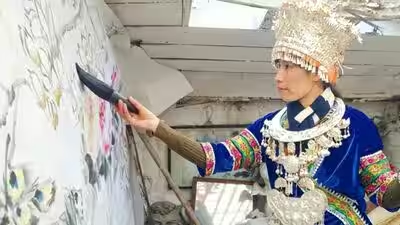
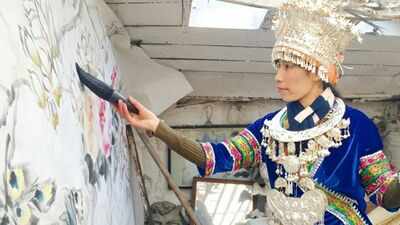
In 1995, a routine day at a funeral home in southern China took an extraordinary turn when a worker noticed that a young woman who had already been declared dead was still alive. Without any identification, no family beside her and barely any signs of life after collapsing days earlier, she had been mistaken for a corpse. That brief moment of attention prevented a fatal mistake and changed the course of her future. More than three decades later, Chen Cuiju is known not for the incident that almost ended her life, but for a career in traditional Chinese painting that grew from an unexpected act of kindness and years of determined work. Her remarkable journey from the brink of cremation to becoming an award-winning artist has since inspired countless people across China and beyond.
How a funeral home worker noticed she was still alive
Chen Cuiju grew up in a poor family in Guizhou province. At 18, she left home in search of work, joining the large manufacturing workforce in Dongguan, Guangdong province. Long shifts, poor living conditions and inadequate nutrition gradually weakened her health.While suffering from a fever one day, she collapsed near a river and lost consciousness. She remained there until a passing boatman found her several days later. With no identification documents and almost no visible signs of life, she was believed to have died. Her body was taken to a local funeral home as that of an unidentified person.Preparations for cremation were already under way when a funeral home employee, identified in reports only by the surname He, spotted a slight movement in one of her feet. The discovery immediately halted the procedure. Police were contacted and Chen was rushed to hospital instead.
Months of treatment and an unexpected reunion
As reported by South China Morning Post (SCMP), doctors later diagnosed Chen with severe malnutrition, dehydration and multiple organ failure. Although she arrived without identification, money or relatives to speak on her behalf, hospital staff continued treating her.Her recovery was slow. It took more than three months before she regained consciousness, after which local authorities helped trace her family and arrange a reunion. The unusual circumstances surrounding her survival attracted widespread attention across China. Many people who had never met her wrote letters offering encouragement, employment opportunities and practical support as she began rebuilding her life.
A letter that changed everything
Painter and art teacher Chen Zhonglian invited her to Jinhua in Zhejiang province, offering not only to teach her painting but also to cover her living expenses while she studied. He later explained that learning a skill could provide her with independence and stability that had previously been missing from her life.In 1996, Chen accepted the invitation and moved to Jinhua with her younger brother. Even after leaving hospital, the emotional effects of her experience remained. She reportedly struggled with confidence and found it difficult to move beyond the perception held by some people that her survival had brought misfortune.Her teacher encouraged her to spend time with fellow students and gradually recognised an artistic ability that deserved attention. He persuaded her to enter painting competitions, giving her opportunities to develop both her skills and self-belief.
Recognition in Chinese art
A turning point came in 1999 when Chen received her first major painting award. The recognition opened the door to wider opportunities, and she gradually established herself in the field of traditional Chinese painting.Over the following years, her work appeared in national and international exhibitions. Reports say she received dozens of awards, while several paintings entered the collections of art institutions. She was later recognised as a national first-class artist specialising in traditional Chinese painting.Her mentor described her work as reflecting emotional depth and careful observation, qualities he believed had become evident during her years of study.
Returning to thank the people who saved her
More than a decade after the incident, Chen returned to Dongguan to meet those whose actions had allowed her to survive.In June 2006, she visited both the hospital staff who treated her and the funeral home worker who noticed she was still alive before the cremation began. To mark the occasion, she presented a painting featuring blooming peonies growing beside broken, withered branches. The artwork symbolised renewal after hardship and reflected her gratitude for the second chance she had been given.Reportedly, her story later inspired a Cantonese opera titled Cai Ju Returns Home. Although the production was created to encourage resilience among younger audiences, Chen has not publicly spoken about the adaptation.