
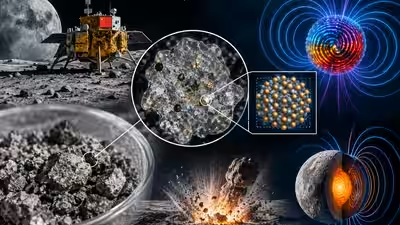
A study of soil brought back from the Moon’s far side by China’s Chang’e-6 mission has uncovered a form of metallic iron never before found in natural lunar samples. Researchers from the Chinese Academy of Sciences reported the discovery after examining tiny particles preserved inside impact glass collected by the mission. The material, known as face-centred cubic γ-Fe, has unusual magnetic properties that could make it useful for studying the Moon’s ancient magnetic environment. The finding, published in the Proceedings of the National Academy of Sciences, also offers clues about the extreme conditions created by impacts on the lunar surface.
An unusual form of iron
The discovery centres on γ-Fe, also called gamma iron. Iron can exist in several different crystal structures, depending on temperature and pressure. γ-Fe normally forms under high-temperature conditions and is not expected to remain stable once temperatures fall. Yet researchers found nanoscale γ-Fe particles inside impact-glass grains from the Chang’e-6 samples. Their presence suggests that something unusual happened when the material formed and cooled.The researchers believe powerful impacts on the Moon may have played a major role. When an asteroid or another space object strikes the lunar surface, the collision can generate enormous heat and pressure, briefly melting parts of the surrounding material.
Impact glass may have preserved the particles
The lunar samples contained small pieces of impact glass, a material created when the heat generated during an impact melts surface material before it rapidly cools and solidifies. That rapid cooling could be important to the survival of γ-Fe. Instead of having enough time to transform into another form of iron, the material may have become trapped inside the glass.Researchers suggested that trace amounts of carbon and other elements could have helped stabilise the unusual iron structure. This combination of extreme impact conditions, chemical composition and rapid cooling may explain why γ-Fe survived in the Chang’e-6 material. The discovery therefore tells scientists something about more than the iron itself. It also points to the intense physical and chemical processes that have affected the lunar surface over billions of years.
The particles have unusual magnetic behaviour
What makes the finding particularly interesting is the magnetic behaviour of the tiny iron particles. Using off-axis electron holography, researchers examined the magnetic structures of individual γ-Fe nanoparticles. Some of the larger particles were found to have a single-vortex magnetic state, in which the magnetic arrangement forms a vortex-like pattern. The particles also showed a stable magnetic response when an external magnetic field was applied.Such characteristics matter because magnetic minerals can retain information about the magnetic environment in which they formed or cooled. If the γ-Fe particles preserved such information, they could potentially serve as microscopic records of conditions on the ancient Moon.
Could they hold clues to the Moon’s lost magnetic field?
The Moon does not have a global magnetic field today, but evidence from lunar rocks indicates that it once did. Scientists have been trying to establish how strong that ancient field was, when it existed and how the lunar dynamo responsible for generating it changed over time. The Moon’s magnetic history is closely connected to its interior, including the movement of material within its core.The newly identified iron phase could provide another material for investigating that history. Its magnetic characteristics may help researchers distinguish signals associated with the Moon’s ancient magnetic field from those created by later impacts. That distinction is important because the lunar surface has experienced countless impacts. A magnetic signal preserved in a mineral could potentially reflect either the environment present when the material originally formed or the intense conditions produced during a later collision.
A rare look at the Moon’s far side
The discovery also highlights the scientific importance of Chang’e-6. The mission collected samples from the Moon’s far side and returned them to Earth, giving researchers access to material from a region that had never previously been sampled directly. The landing site is within the South Pole-Aitken Basin, one of the oldest and largest impact structures in the solar system. Because of its age and violent geological history, the region provides an opportunity to study processes that occurred early in the Moon’s development.Researchers have already found that material from the far side can differ from lunar samples collected during earlier missions, making each new discovery potentially useful for understanding the Moon’s geological history.
A tiny clue to a much bigger history
For now, scientists still need to determine precisely how the γ-Fe particles formed and how much magnetic information they can retain. The particles are extremely small, and further analysis will be needed before researchers can establish how reliably they record ancient magnetic conditions. Even so, the discovery gives scientists a new material to work with. A few microscopic particles of iron, sealed inside glass created by an ancient lunar impact, could contain information about events that happened billions of years ago.The finding shows how much can still be learned from lunar soil. Material that appears insignificant to the naked eye may preserve evidence of the Moon’s violent impacts, unusual chemistry and, potentially, the magnetic field it lost long ago.