
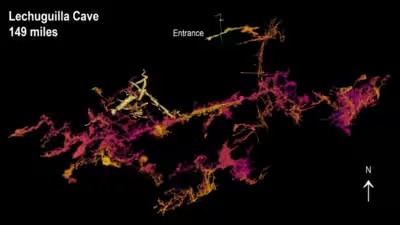
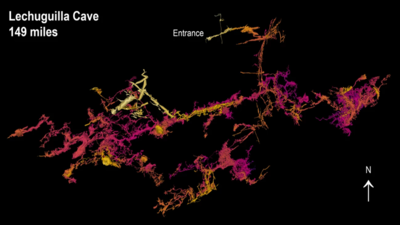
For decades, Lechuguilla Cave was just a footnote in New Mexico’s Guadalupe Mountains: a 90-foot entrance pit leading to 400 feet of dry, dead-end passages that had once been mined for bat guano. But in the 1950s, cavers began noticing something strange: wind roaring up from the rubble-choked floor, hinting at hidden passages below. Acting on that hunch, a team of Colorado cavers obtained permission from the National Park Service and began digging in 1984. On May 26, 1986, they broke through into vast walking passages, launching one of the most significant cave discoveries in modern history. This article draws on the National Park Service’s official history of Lechuguilla Cave.From a forgotten pit to a world-class caveBefore 1986, Lechuguilla was considered a small, fairly insignificant historic site in the backcountry of what is now Carlsbad Caverns National Park. A mining claim filed in 1914 supported a year of guano extraction from the entrance passages, after which the cave was visited only infrequently. The persistent sound of wind moving through the rubble convinced different cavers over the years that there had to be more cave below, even though no obvious route existed.When the Colorado team started digging in 1984, they were chasing that sound, and the possibility of a major system. Their breakthrough in 1986 opened not just a new passage, but a new chapter in American speleology. What followed has been described as some of the world’s most exciting cave exploration, taking place in one of the finest known caves on the planet.145 miles of mapped passages and a record-breaking depthSince that first breakthrough, explorers have mapped more than 145 miles (233 km) of passages in Lechuguilla Cave and pushed its known depth to 1,604 feet (489 m). As of July 2019, Lechuguilla ranks among the ten longest caves in the world and is one of the four longest in the United States. It also holds the distinction of being the second deepest limestone cave in the country.These numbers tell only part of the story. The cave’s sheer scale, combined with its intricate network of rooms, shafts, and corridors, has drawn cavers from around the globe. They come for the challenge of unexplored passage and for the chance to move through a landscape of never-before-seen beauty, carefully surveying and mapping each new section as they go.A gallery of rare formations and otherworldly beautyLechuguilla Cave quickly revealed that its importance went far beyond length and depth. Explorers found large deposits of gypsum and lemon-yellow sulfur, along with a fantastic array of rare speleothems, cave formations created by mineral deposition. Some of these features had never been documented anywhere else in the world.Among the highlights are 20-foot gypsum “chandeliers,” delicate 20-foot gypsum hairs and beards, and soda straws reaching 18 feet in length. The cave also contains hydromagnesite balloons, cave pearls, subaqueous helictites, rusticles, and unusual looped formations known as u-loops and j-loops. In terms of size, depth, and variety of speleothems, Lechuguilla surpassed its nearby sister, Carlsbad Cavern, though no single room discovered so far in Lechuguilla is larger than Carlsbad’s famous Big Room.A natural laboratory for geology and microbiologyBeyond its visual splendor, Lechuguilla Cave has become a valuable scientific laboratory. For the first time in the Guadalupe Mountains, a cave extends deep enough to allow scientists to study five separate geologic formations from within the same system. The abundance of gypsum and sulfur supports the idea that much of the cave was formed by sulfuric acid dissolution, a process in which acidic waters dissolve limestone to create large voids.Researchers also believe the cave hosts rare, chemolithoautotrophic bacteria, microbes that essentially “eat” rock by feeding on sulfur, iron, and manganese minerals. These organisms may play a role in enlarging the cave and shaping some of its unusual speleothems. Other studies suggest that some of these microbes could have medicinal qualities beneficial to humans, adding another layer of importance to protecting the cave’s fragile ecosystem.Why access is tightly controlled and why that mattersLechuguilla Cave lies beneath a designated wilderness area within the park, but its passages come very close to adjacent Bureau of Land Management (BLM) land. Oil and gas drilling on BLM-managed areas could potentially leak gas or fluids into the cave, killing cave-adapted life, destroying delicate formations, and threatening the safety of people inside.To minimize these risks, the National Park Service actively manages the cave and surrounding karst resources. Access to Lechuguilla is limited to approved scientific researchers, survey and exploration teams, and NPS management-related trips. This restrictive policy helps preserve both the cave’s extraordinary geology and its unique biological communities, ensuring that the system revealed by that roaring wind in the 1950s remains intact for future study and, in carefully controlled ways, exploration.