518 million years ago, one tiny sea creature may have started the evolution of the fangs seen in spiders today | World News

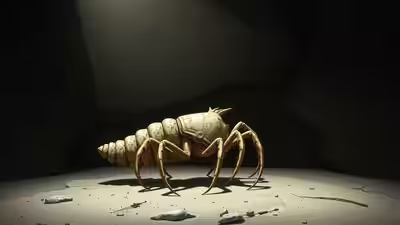
Scientists have identified the earliest known evidence of spider fangs in a 518 million-year-old fossil recovered from southern China, tracing the origin of one of the animal kingdom’s most feared biological tools back to a small marine creature that lived long before spiders existed. The fossil belongs to a species called Urokodia aequalis, examined by…
Read More

200 years after the first dinosaur, scientists use brain scans on a 100-million-year-old snake fossil from Brazil |

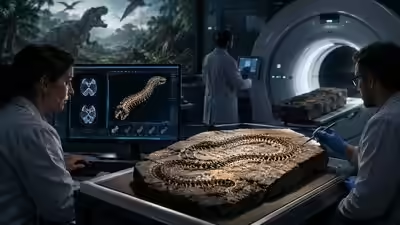
Two centuries ago, a British geologist gave the world its first named dinosaur. Megalosaurus, described from a handful of fossilised bones, marked the birth of an entire scientific field. Back then, researchers worked with little more than fragments, guesswork and imagination to picture prehistoric life. Fast forward 200 years, and palaeontology looks unrecognisable. Scientists no…

Read More

Poachers killed their mothers and left six young rhinos orphaned; after up to five years of rehabilitation, every one has now given birth in the wild

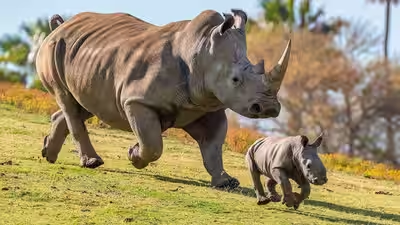
Rescued rhinos defy the odds, give birth after returning to the wild Six rhinos left for dead by poachers in South Africa when they were just young calves have all given birth naturally in the wild, marking a big win for wildlife recovery efforts in KwaZulu-Natal.Poachers killed their mothers around 2017, leaving the young rhinos…

Read More

In 1976, a scientist spent seven years dancing with a lonely whooping crane that refused to mate. The chick that followed helped save one of the world’s rarest birds |

In 1976, ornithologist George Archibald began an unusual daily ritual, dancing beside a whooping crane named Tex in an attempt to save one of the rarest birds on the planet. Tex had been raised in captivity and had imprinted on humans rather than other cranes, meaning she showed no interest in mating with her own…

Read More

Around 1200 BCE, major Mediterranean civilisations began collapsing; scientists have now reconstructed the climate conditions surrounding the crisis

Representative Image (AI-generated) Around 1200 BCE, several of the eastern Mediterranean’s most powerful civilisations, including the Mycenaean kingdoms, the Hittite Empire, Canaanite city-states and parts of New Kingdom Egypt, began experiencing a period of dramatic decline. Historians have long debated whether warfare, invasions, earthquakes, internal unrest or climate change played the biggest role in this…

Read More

‘No other…’: Parents of Indian medical student Vaibhav Duggal who died by suicide seek $30 million from Texas Tech University

Parents of Vaibhav Duggal, the Indian student who committed suicide in Texas, seek $30 million from the university. Vaibhav Duggal, a s 24-year-old medical student of Texas Tech University Health Sciences Center took his life in July 2025 while he was still wearing his doctor’s white coat. A year has passed and the parents now…

Read More

UK’s largest girls’ organisation Girlguiding unveils first uniform redesign since 1990 — focused on ‘self-expression and confidence’ | World News

Girlguiding unveils first uniform redesign since 1990. The UK’s largest youth organisation for girls, Girlguiding, has introduced its first complete uniform redesign in more than three decades, giving members greater flexibility over what they wear while keeping a shared identity across the organisation.The updated range means members only need to wear one top from the…

Read More

Elon Musk says a future on Mars could help humanity survive pandemics, AI and global disasters |

Elon Musk has expanded on his long-standing vision of making humanity a multi-planet species, arguing that a self-sustaining colony on Mars could serve as a crucial safeguard against civilisation-ending catastrophes on Earth. Responding to a debate on X (formerly Twitter), Musk said his views had been misunderstood, emphasising that he has never claimed Mars would…

Read More

Researchers made flying harder for Alaskan seabirds by clipping some wing and tail feathers; only 67% returned the next year, but the survivors were more likely to breed successfully

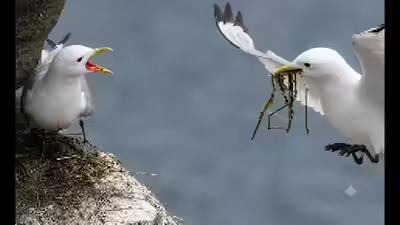
Researchers clipped a few wing and tail feathers of wild Alaskan kittiwakes (AI enhanced image. Credit: Nature Counts) Researchers who clipped a few wing and tail feathers of wild black-legged kittiwakes in Alaska to make flying harder, have found that the effects lasted well beyond a single breeding season. The birds struggled to raise chicks…

Read More

In 1992, Hurricane Andrew may have helped giant Burmese pythons spread across Florida’s Everglades, creating one of America’s worst invasive species crises | World News

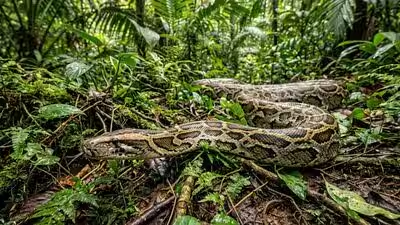
For decades, Florida’s Everglades have faced a silent invasion unfolding beneath the dense vegetation and winding waterways. What began with the arrival of Burmese pythons through the exotic pet trade has become one of the most significant wildlife challenges in the United States. The turning point came around 1992, when Hurricane Andrew damaged facilities in…

Read More