Colombian drug gangs recruiting children through social media to pilot explosive drones: Report

HRW report shows that drug gangs and rebel groups in Colombia are increasingly recruiting children Colombian drug gangs and rebel groups are increasingly recruiting children and training them for dangerous roles, including piloting drones loaded with explosives, Human Rights Watch said in a report published Monday.The rights watchdog said armed groups were using social media…
Read More

In 1959, Vermont bought Snake Mountain land but the seller kept timber rights; 67 years later the state plans to secure 949 acres of those rights and add 256 acres

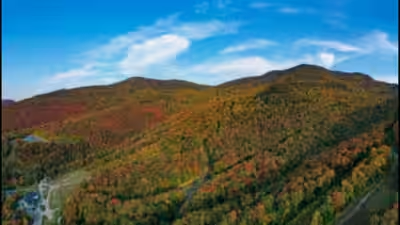
With support from the Trust for Public Land, the Vermont Fish & Wildlife Department plans to secure the timber rights covering 949 acres of the Snake Mountain Wildlife Management Area (WMA). A conservation story that began nearly seven decades ago is entering a new chapter in Vermont. What was once a complicated split between land…

Read More

In 2006, South Dakota began turning a mine that produced 41 million ounces of gold into America’s deepest underground lab; today scientists work 4,850 feet down searching for dark matter and neutrinos

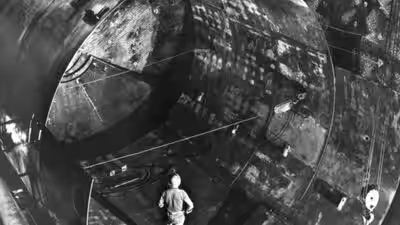
Solar Neutrino Experiment 1 used a tank filled with chlorine-based perchloroethylene to detect neutrinos from the Sun. A gold mine in South Dakota once produced millions of ounces of precious metal. Today, the same site is being used to study some of the biggest mysteries in the universe.The Homestake Gold Mine in Lead, South Dakota,…

Read More

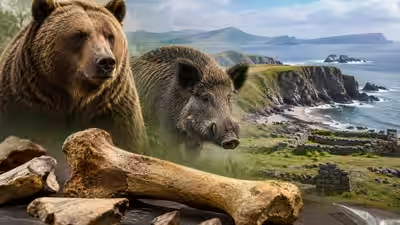
For 30 years, the “Kerry cow” bones were seen as proof of early farming in Ireland; scientists now say they belonged to a bear and wild boar

Representative Image (AI-generated) For more than three decades, a collection of animal bones from Ireland’s Ferriter’s Cove was considered some of the earliest evidence that farming had reached the island. But new research has now overturned that interpretation. According to University College Dublin (UCD), bones once identified as cattle have instead been identified as belonging…

Read More

US removes Syria from terrorism list after 46 years – what it means for the Middle East country

Syrian President Ahmed al-Sharaa said in a video message that Syria is ‘shaking off a dark burden’ (File photo) The United States on Monday removed Syria from its list of state sponsors of terrorism, ending a designation that had been in place since 1979 and imposing significant restrictions on trade, investment and financial transactions with…

Read More

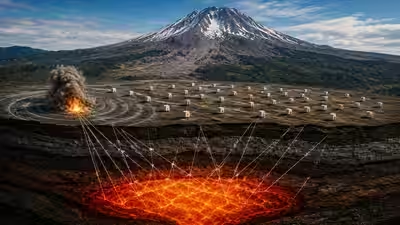
In 2014, scientists set off 23 explosions and deployed 3,500 seismographs around Mount St Helens; the experiment helped image a magma reservoir roughly 4 to 15 km beneath the volcano

Representative Image (AI-generated) Mount St. Helens is one of the most closely studied volcanoes in the United States, but scientists still cannot directly see the complex system of magma and rock hidden beneath it. In 2014, researchers launched an ambitious experiment to change that. According to the Imaging Magma Under St. Helens (iMUSH) project, a…

Read More

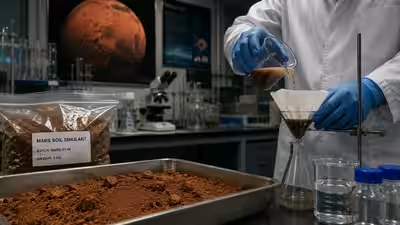
Meet Jeremiah Bents, the Minnesota student who recreated Mars soil in a lab to test whether future astronauts could clean contaminated water |

Mars may be millions of kilometres from Minnesota, but for Cloquet student Jeremiah Bents, one small part of a future Mars mission could be tested much closer to home. Instead of looking at how to reach the Red Planet, Bents turned his attention to what astronauts might do once they get there, particularly when dealing…

Read More

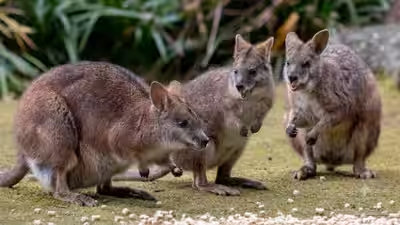
In 1912, New Zealand released wallabies near Rotorua; they now occupy more than 200,000 hectares and, if left unchecked, could spread across a third of the country by 2065, causing $84 million in damage a year

Authorities are asking people to report sightings and signs of the animals. (Photo: WWF Australia) Wallabies introduced to New Zealand more than a century ago have spread across more than 200,000 hectares in the country’s North Island. Authorities are now working to control their population because the animals can damage native forests, compete with farm…

Read More

In 1926, a 10-ft rocket flew 41 ft; 35 years later, NASA honored its creator in space |

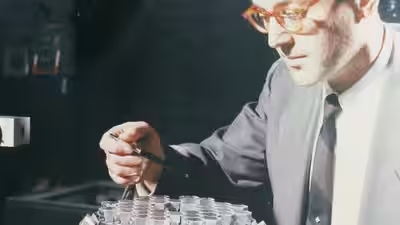
Goddard physicist Henry Plotkin inspects the retroreflector array destined for the 1964 Beacon Explorer A satellite, PC: Henry Plotkin/ Nasa On October 29, 1964, a team at NASA‘s Goddard Space Flight Centre in Greenbelt, Maryland, recorded the first successful laser returns from an artificial satellite. The target was Beacon Explorer B, also known as Explorer…

Read More

Scientists reidentify Ireland’s famous “Kerry Cow” bones as ancient bear and wild boar remains, challenging a long-held theory about how farming reached the island

Representative Image (AI-generated) For more than three decades, a collection of animal bones from Ireland’s Ferriter’s Cove was considered some of the earliest evidence that farming had reached the island. But new research has now overturned that interpretation. According to University College Dublin (UCD), bones once identified as cattle have instead been identified as belonging…

Read More