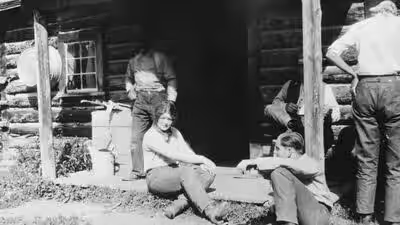
In 1967, Emily Frew Oliver sold her family’s Wyoming dude ranch to Grand Teton National Park but kept a life estate; 39 years later she gave it up, ending her family’s 79-year stewardship of the historic ranch

Emily Frew Oliver and dudes on porch of Main Cabin. (Picture: History Jackson Hole) The 4 Lazy F Ranch sits on the west bank of the Snake River in Wyoming, just north of the Grand Teton National Park headquarters in Moose. Below the Teton Range, the ranch preserves a part of the area’s homestead and…

Read More

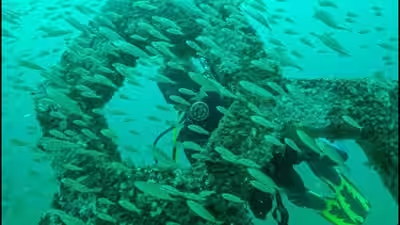
In 2018, Florida opened America’s first permanent underwater sculpture garden 58 feet below the Gulf; it has grown into a living reef where more than 100 species have been documented

According to its official website, the museum was a collaboration between the Cultural Arts Alliance of Walton County and the South Walton Artificial Reef Association in 2018. Imagine you are diving under the Gulf of Mexico and come upon what looks like a museum, only instead of galleries and polished floors, there is an unreal…

Read More

A cooling film developed at the University of Illinois was tested on Houston infrastructure for FIFA; treated metal roofs stayed over 40°F cooler in direct sunlight without using electricity |

In Houston, the heat is part of the setting. During the FIFA Fan Festival, though, some of the infrastructure around the event had a rather different experience of the Texas summer. Roofs treated with a thin cooling film stayed dramatically cooler than nearby untreated metal surfaces, even while sitting beneath direct sunlight.The material was not…

Read More

In the 1970s, Britain imported North American signal crayfish for farms; they escaped, bred in huge numbers and now infest rivers across England, Wales and Scotland, carrying a plague deadly to native crayfish

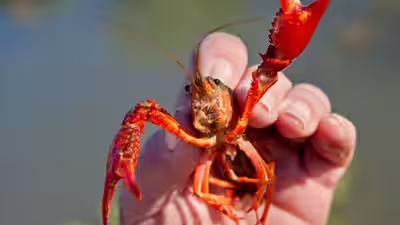
In the 1970s, British aquaculture businesses imported North American signal crayfish to stock farms, hoping to build a profitable new freshwater fishery. But the plan backfired: the hardy invaders escaped into rivers, multiplied rapidly and spread across England, Wales and Scotland. Today they dominate many waterways and carry crayfish plague, a disease that is usually…

Read More

A Rhode Island woman bought her family’s coastal farm in 1908, spent decades painting and birdwatching there, then left the land to become a sanctuary that now protects 300 acres

Cerio began planning a bird sanctuary soon after buying Paradise Farm. (Newport History Society photo) Mabel Norman Cerio spent much of her life between art and nature at Paradise Farm in Middletown, Rhode Island. In 1908, she bought the coastal property from the estate of her brother after the death of her father. Decades later,…

Read More

Indian-origin former Optum director sentenced to 3 years in prison over $950,000 fraud scheme | World News

Karan Gupta former Optum director jailed to 3 years in prison over $950,000 fraud scheme/Image: Getty Images An Indian-origin former director at healthcare company Optum has been sentenced to three years in prison for his role in a scheme that defrauded the company of more than $950,000.Karan Gupta, 48, based in California, was sentenced on…

Read More

Quote of the day by Albert Einstein: “If a cluttered desk is a sign of a cluttered mind, of what, then…” |

Image(s): Left/ Princeton University/Right/Wikipedia While a desk covered in books, papers and unfinished notes may be seen as a sign of an untidy mind, the great scientist Albert Einstein had a different view of this assumption. In particular, he asked, “If a cluttered desk is a sign of a cluttered mind, of what, then, is…

Read More

A Scottish scholar and his American wife bought the remote island of Canna; 43 years later they gifted it, their home and their life’s work preserving Gaelic culture to the National Trust for Scotland

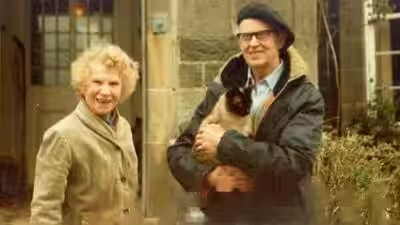
Campbell and Margaret moved to Canna in 1938 after spending three years living on Barra. John Lorne Campbell and Margaret Fay Shaw had already spent years recording Gaelic songs, stories and traditions when they made the remote Isle of Canna their home in 1938. The Scottish folklorists continued that work from the island for more…

Read More

Scientists found traces of two unknown ancient human lineages hiding in modern DNA; one split from our ancestors about 800,000 years ago, another around 1.8 million years ago |

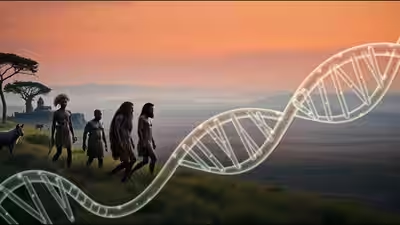
​Representative Image of ancient human evolution showing the genetic connections between humans, Neanderthals, and Denisovans (AI-generated image) Modern humans already carry small amounts of Neanderthal and Denisovan DNA, evidence that our ancestors interbred with other human groups tens of thousands of years ago. Both lineages are known from ancient remains, including fossils from which scientists…

Read More