
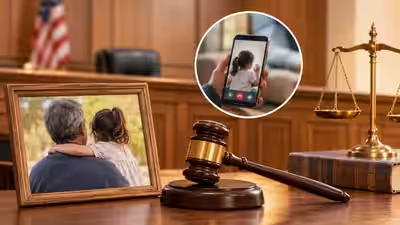
A grandfather who once helped raise his granddaughter for nearly two years found himself seeking court intervention to maintain contact with her after her mother regained custody. Although he requested regular visits, family dinners and weekly video calls, the court initially allowed him only a five-minute telephone conversation with the children once a month. The dispute eventually reached California’s Court of Appeal, where a separate question about legal expenses became the central issue.The ruling in Timothy S v. Sarah H, issued on November 3, 2026, by California’s Court of Appeal, Fourth Appellate District, Division One, is available on Justia under case number D087153. The appeal was brought by the children’s mother, who wanted the grandfather to pay $17,193 in attorney’s fees and legal costs she incurred while opposing his visitation petition. The appellate court upheld the lower court’s refusal to award the money, explaining that the law governing attorney’s fees in parentage proceedings did not apply to a separate petition for grandparent visitation.
Grandfather sought regular visits after helping raise his granddaughter
The dispute involved two children, S.S. and J.S., born in 2018 and 2021 to Sarah H and T.S., the grandfather’s son. The couple were never married. In September 2019, when the older child was approximately 17 months old, authorities removed her from her parents’ custody and placed her with her paternal grandfather, Timothy S, and his wife. Sarah regained custody of the child in August 2021.When the juvenile court later ended its involvement in the children’s cases, it issued final custody and visitation orders. Sarah received sole physical custody of both children, along with shared legal custody with their father. The father was also granted supervised visitation. However, the grandfather wanted to maintain his relationship with the children. In April 2024, he filed a petition under Section 3104 of California’s Family Code, seeking court-ordered visitation.Timothy argued that he had developed an established relationship with the older granddaughter because he had cared for her for almost two years. He also alleged that Sarah had refused to let him visit the children. His petition requested one weekend visit and two dinnertime visits every month, along with weekly video calls. Sarah opposed the request, arguing that her father-in-law did not have a substantial relationship with the children that justified court-ordered visitation.
Court allowed only a five-minute monthly telephone call
While the long-term visitation dispute remained unresolved, the trial court issued an interim order allowing Timothy one telephone call with the children each month. The call was limited to five minutes. The court also scheduled a hearing to consider a longer-term visitation arrangement. Meanwhile, Sarah sought to recover the legal expenses she had incurred while fighting the grandfather’s petition. She requested $17,193 in attorney’s fees and costs.Of that amount, $7,193 represented expenses she had already paid when she submitted the request. She estimated that another $10,000 would be needed for continued preparation and proceedings. The trial court rejected her request, concluding that it did not have statutory authority to award attorney’s fees in a grandparent visitation case. Sarah challenged that decision, arguing that the grandfather’s petition fell under California’s Uniform Parentage Act and that she was therefore entitled to financial assistance under Family Code Section 7605.
Appeals court explains why the fee provision did not apply
The central question before the appellate court was whether Section 7605 could be used to recover legal expenses in a proceeding initiated by a grandparent seeking visitation. The provision allows courts to order one party to pay another party’s attorney’s fees in certain proceedings involving child custody, visitation and parentage under the Uniform Parentage Act.However, the appellate judges explained that Timothy had filed his petition under Section 3104, which specifically addresses grandparents’ rights to seek visitation. That provision belongs to a different part of California’s Family Code and is not included in the Uniform Parentage Act. The court therefore concluded that the grandfather’s petition was not a proceeding under the Act and did not qualify for the fee-shifting provision.Sarah also argued that the visitation dispute should be treated as a proceeding arising from earlier parentage and custody judgments issued during the children’s juvenile dependency cases. The appellate court rejected this argument as well. It explained that juvenile dependency proceedings and Uniform Parentage Act cases serve different legal purposes. Dependency proceedings are initiated to protect children who may be at risk of harm and involve decisions about custody, parental rights and family reunification.Although the juvenile court had made parentage determinations and issued custody and visitation orders, those decisions were made under juvenile law. They did not automatically become judgments under the Uniform Parentage Act simply because the court used certain parentage standards.
Court affirmed denial of the $17,193 request
After examining both arguments, the California Court of Appeal found no legal basis for requiring Timothy to pay Sarah’s attorney’s fees and costs under Section 7605. The judges concluded that the trial court had correctly interpreted the law and had not abused its discretion by rejecting the request.The appellate court therefore affirmed the order denying Sarah’s application for $17,193. It also directed both parties to bear their own costs of the appeal. Importantly, the appeal concerned the mother’s request for legal expenses, not a final determination of the grandfather’s long-term visitation rights. The five-minute monthly telephone call was an interim arrangement while the wider visitation dispute was being addressed.The November 3 ruling thus settled the question of whether the mother could recover her legal expenses under the particular statutory provision, without deciding the merits of the grandfather’s request for regular visits.